20
Piezosurgery // - manual of use and maintenance
21
Piezosurgery // - manual of use and maintenance
06.0 Cleaning and sterilisation
06.1 CLEAN function - Cleaning of the liquid circuit
WARNING: Failure to carry out cleaning of the tubes will lead to crystallisation of salts that can
seriously damage the equipment.
WARNING: The cord cannot be detached from the handpiece.
The device has a CLEAN function (See point 05.3) that can be used to run a cleaning cycle to
clean the hydraulic circuit. This function must be carried out after using the device, before cleaning
and sterilising all the parts (see following points)..
1 Prepare a solution of enzymatic detergent with a pH of 6 to 9, in accordance with the manufac-
turer’s instructions.
2 Disconnect the tube of the peristaltic pump from the ow-control system.
3 Place the tube in a receptacle containing the enzymatic detergent.
4 To activate the CLEAN function, press the power level selection key and hold it down for 5
seconds (Fig. 6 - Ref.D). The following message will appear on the display: “Footswitch to start
or a key to abort”.
5 Fit one of the inserts used during the operation onto the handpiece.
6 Place the handpiece over a bowl to collect the water that pours out of it during the cleaning
cycle.
7 Press the footswitch briey to start the cleaning cycle. As soon as the peristaltic pump starts up
a status bar will appear on the display to indicate progressively the time remaining to comple-
tion of the CLEAN cycle. The cycle lasts for 20 seconds and once it has started it cannot be
stopped.
8 Upon completion of the cleaning cycle, the device exits from the CLEAN function and returns to
whatever function had been set previously.
9 Repeat the operations described above from point 4 onwards to carry out a cleaning cycle for
each of the tubes and for all of the accessories used, i.e.:
- Handpieces;
- Peristaltic pump tubes;
- Fittings.
10 Carry out a CLEAN cycle using distilled water to remove any residual detergent.
11 After completion of the cleaning operations, empty the tubes and dry the accessories and dry
the accessories that have been subjected to the cleaning cycle.
06.2 Cleaning and disinfecting the casing of the device
DANGER: Switch off the device.
Always turn off the device by means of the switch (Fig. 5 - Ref. F) and disconnect it from the power
outlet before carrying out the following cleaning and disinfection activities.
DANGER: The casing of the device is not protected against the penetration of liquids. Do
not spray liquids directly onto the surface of the casing of the device.
DANGER: The device cannot be sterilised.
After each treatment carry out the following operations:
1 Remove the insert from the handpiece.
2 Clean and disinfect the surfaces of the casing, the cords and their connectors using a low-
linting cloth moistened with a mild detergent solution (pH 6 to 9) and/or non-aggressive
disinfectant having a neutral pH (pH 7). Follow the instructions supplied by the manufacturer
of the disinfectant solution carefully. Allow the disinfectant solution to dry in air before using the
device.
NOTE: Water-based disinfectant solutions with a neutral pH are highly recommended. Alcohol-
based disinfectants are not recommended as they could discolour and/or otherwise damage plastic
materials.
06.3 Sterilisation procedure
WARNING: Carry out sterilisation using only a steam autoclave.
Do not use any other type of sterilising procedure (dry heat, radiation, ethylene oxide, gas,
low-temperature plasma, etc.).
DANGER: Infection control - Parts that can be sterilised - Thoroughly remove all
residues before sterilising.
In order to avoid bacterial or viral infections, always clean, disinfect and sterilise the following com-
ponents after each treatment:
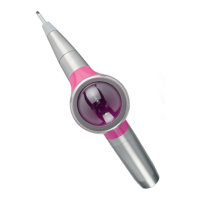
1 Handpiece (Fig. 3 - Ref.E);
2 Inserts (Fig. 3 - Ref.C);
3 Wrench for tightening the inserts (Fig. 3 - Ref.D);
4 Tube for peristaltic pump (Fig. 3 - Ref.I);
5 Fitting between the cord and the tube of the peristaltic pump (Fig. 3 - Ref.F).
These components are made of materials able to withstand a maximum temperature of 135°C for
20 minutes at most.
The steam autoclave sterilising process must be carried out using one of the following two param-
eters:
- Cycle at 121°C for 16 minutes.
- Cycle at 134°C for 4 minutes.
All the stages of sterilisation must be carried out by the operator in accordance with
EN ISO 17665-1:2006, EN ISO 556-1:2001 and ANSI/AAMI ST:46:2002 standards.
NOTE: Do not use hydrogen peroxide for disinfecting. Use only disinfectants with a neutral pH.
Always rinse with sterile water.
06.4 Cleaning and autoclave sterilisation of the handpiece
WARNING: The cord cannot be detached from the handpiece.
WARNING: Disconnect the handpiece from the device only by unplugging the connector.
WARNING: Do not dip the handpiece into disinfectant solutions or liquids of any other
kind since this could damage it.
WARNING: Do not place the handpiece in an ultrasonic tank.
WARNING: Do not sterilise the handpiece with an insert screwed onto it.


 To Next Page