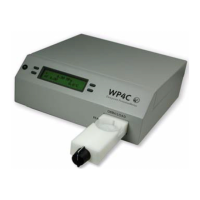
WP4C 2 ABOUT THE WP4C
2.2 WP4C and Water Potential
Water potential is a measurement of the energy status of the water
in a system. It indicates how tightly water is bound, structurally or
chemically, within a substance. Water potential can be computed
from the vapor pressure of air in equilibrium with a sample in a
sealed measurement chamber. For a more detailed description of
water potential, please refer to Chapter 9, titled “Theory: Water
Potential” of this manual.
2.3 How the WP4C works
The WP4C uses the chilled mirror dew point technique to measure
the water potential of a sample. In this type of instrument, the
sample is equilibrated with the headspace of a sealed chamber that
contains a mirror and a means of detecting condensation on the mir-
ror. At equilibrium, the water potential of the air in the chamber is
the same as the water potential of the sample. In the WP4C, the mir-
ror temperature is precisely controlled by a thermoelectric (Peltier)
cooler. A photoelectric cell detects the exact point at which conden-
sation first appears on the mirror. The WP4C directs a beam of light
onto the mirror, which reflects into a photodetector. The photode-
tector senses the change in reflectance when condensation occurs on
the mirror. A thermocouple attached to the mirror then records the
temperature at which condensation occurs. Values begin to be dis-
played indicating that initial measurements are being taken. WP4C
then signals you by flashing a green LED and/or beeping when it
reaches the final values. The instrument will display the final water
potential and temperature of the sample.
In addition to the technique described above, WP4C uses an inter-
nal fan that circulates the air within the sample chamber to reduce
time to equilibrium. Measuring both dew point and sample surface
temperatures are simultaneously measured, this eliminates the need
for complete thermal equilibrium. The WP4C controls the sample
temperature by means of an internal thermo-electrical module that
monitors and stabilizes the sample block temperature according to
how it is set.
5


 To Next Page