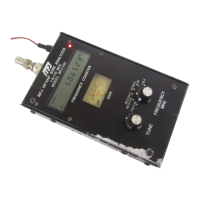
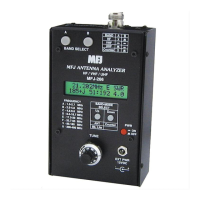
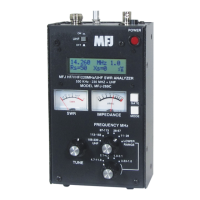
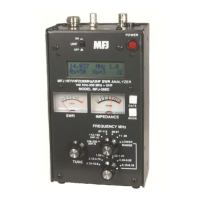
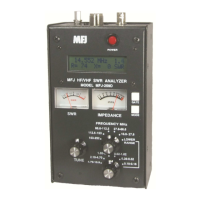
MFJ-259D Instruction Manual HF/VHF SWR Analyzer
10
3.) Adjust the VFO to your frequency of interest. If a range warning comes up, find the closest frequency where no
warning appears. Warnings are C(Z>650), C(X<7), and C(X=0). The C(X=0) warning indicates the capacitor
appears as a near-perfect short.
When measuring a capacitor, it's displayed value in pF will typically change with the test frequency. The change
occurs because stray inductance inside the capacitor and in the wires leading to the calibration plane are in series
with it. The actual value (in pF) for most capacitors does increase with frequency and may reach infinity when the
capacitive element and its stray inductance become series-resonant. This frequency is called the device's Series
Resonant Frequency (where X=0). Bypass capacitors are sometimes intentionally operated at or near this frequency,
but for most applications, the frequencies will be far below it. In addition to the display, the analyzer's Impedance
meter displays the reactance (X in ohms) of the capacitor.
4.5 Inductance
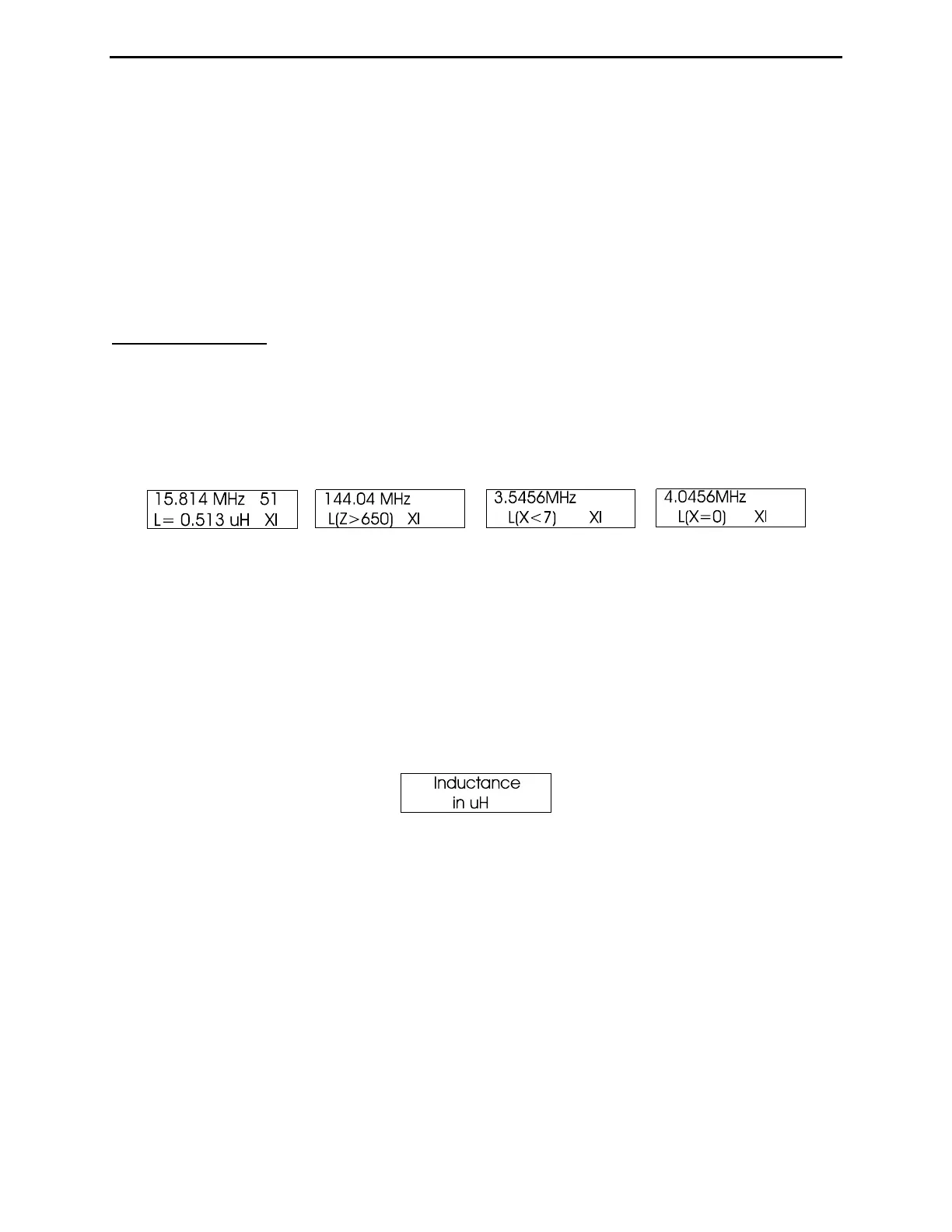
Access the Inductance mode by stepping the Mode switch to the Inductance identification screen. The top line of the
working display shows the VFO Frequency in MHz and the Inductive Reactance (XL) of the DUT at that particular
frequency. The lower line shows the Inductance in uH. Inductance is calculated using the measured Reactance (XL)
and the VFO frequency. The MFJ-259D will become inaccurate when measuring reactance below 7 ohms or above
650 ohms. If component reactance falls into an inaccurate range, L(X<7) L(X=0) or L(Z>650) will be displayed. No
inductance value is displayed if the range is questionable.
Positive Reactance Sign:
The MFJ-259D measures Reactance (X) and mathematically converts it to an Inductance value, but its processor
can't determine if the reactance is inductive or capacitive. You can usually determine the type (or sign) of the
reactance by adjusting the VFO. If tuning up in frequency cause the reactance to decrease, the load is likely
capacitive (-j) at the measurement frequency. If tuning down in frequency causes the reactance to decrease, the load
is likely inductive (+j) at the measurement frequency.
To measure an Inductor:
1.) Turn the analyzer on and step the Mode switch three times to bring up the Inductance identification screen.
2.) Connect the inductor (DUT) across the Antenna connector using the shortest leads possible, or with the lead
length normally used in your working circuit to include stray inductance in the measurement.
3.) Adjust the VFO to your frequency of interest. If an error sign comes up, choose the nearest frequency where no
warning appears. The L(X=0) warning indicates the inductor looks like a near perfect short to the analyzer's
bridge and the frequency is too low (or the inductor too small) to measure. The digital display and the analog
Impedance meter both present the DUT's reactance (X) in ohms.
When measuring an inductor, its displayed value will sometimes change with the test frequency. This happens
because of stray capacitance between coil windings and in the leads going to the Antenna connector. At RF, the
value of an inductor (in uH) may appear substantially different from its "rated" value that was determined at a lower
frequency. With increasing frequency, measured inductance usually increases and, at some high frequency, the coil
may become self-resonant and appear as an open circuit (or a trap) with infinite reactance. At some very low
frequency, it may look like a short.


 To Next Page