MFJ-259D Instruction Manual HF/VHF SWR Analyzer
14
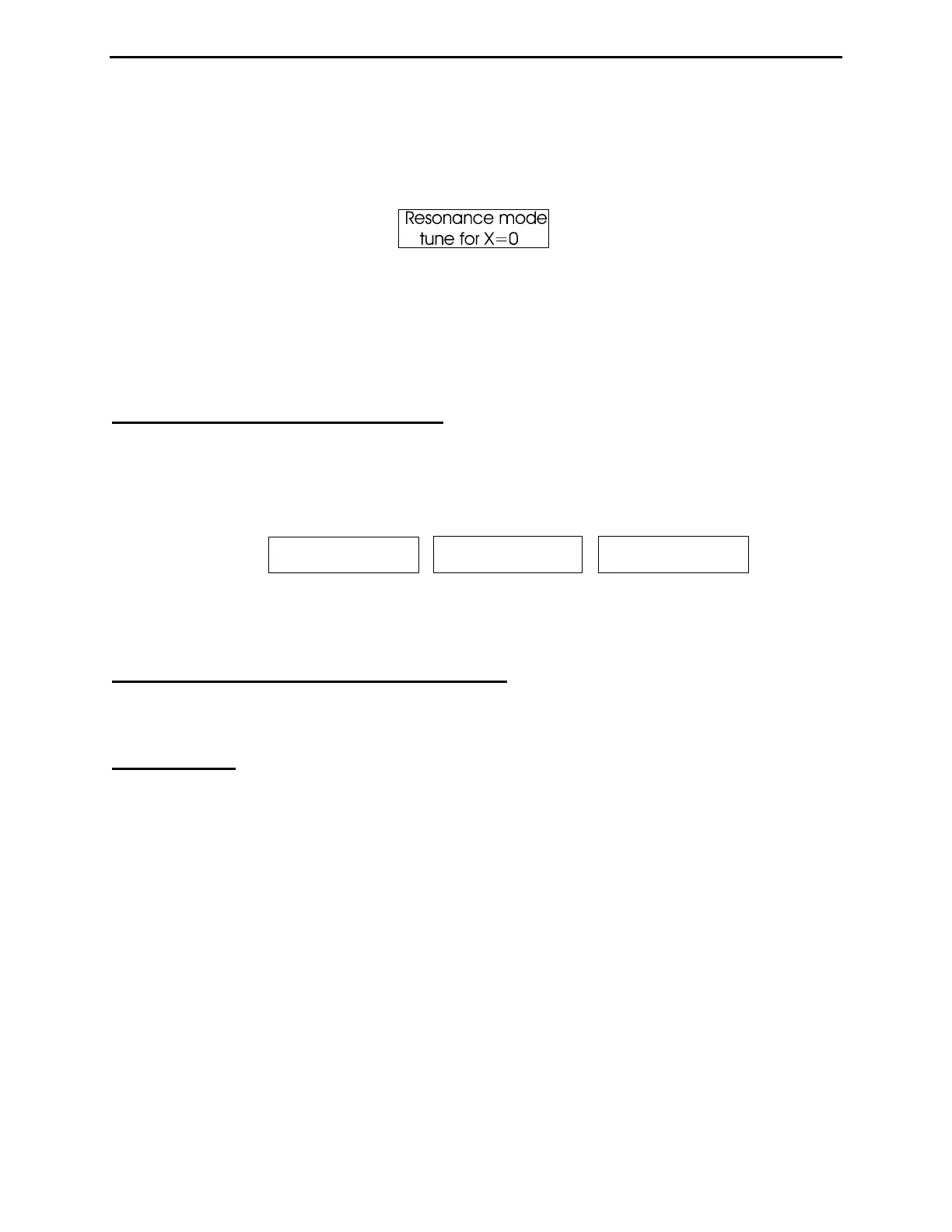
and Reactance (X). Resonance Mode functions exactly the same as in the analyzer's basic SWR mode, except the
analog impedance meter measures Reactance rather than impedance magnitude. This feature allows the operator to
more easily observe frequencies where system reactance crosses zero. When Reactance equals zero (X=0), all
capacitive and inductive components at the load are cancelled out (XL+Xc=0) and the circuit is said to be Resonant.
Accuracy Note:
As previously discussed in Section 4.2, when measured thro feedline, readings indicating zero reactance (or
resonance) may appear at frequencies where the antenna itself isn't actually resonant. Conversely, the antenna may
appear to exhibit some reactance even at its true resonant frequency. To ensure measurement accuracy, the analyzer's
calibration plane should always be located as close to the DUT (or as close to 0-degrees of phase rotation) as
possible.
5.7 Percentage Transmitted Power
From the Advanced screen, toggle the Mode button four times to open Percentage of Transmitted Power. This
parameter is yet another way of representing the basic SWR measurement (see chart at 5.1). Mathematically, it is an
inverse presentation of the Percentage of Reflected Power scale. If your load measures 3.1:1 SWR, the Percentage of
Reflected Power in the system will be 26%. By subtracting 26% from 100%, the Percentage of Transmitted Power is
74% (see examples below).
1.8963 MHz 3.1
Power = 74 % SWR
50.097 MHz 1.3
Power =98% S
WR
29.538 MHz >25
Power< 15% SWR
Note that the Percentage of Transmitted Power may be open to misinterpretation because the power ultimately
absorbed into the load may be significantly different than the raw Percentage of Transmitted Power parameter might
suggest.
6.0 ADJUSTING SIMPLE ANTENNAS
Most antennas are tuned for operating frequency by varying the element length -- and most homemade verticals and
dipoles are very simple to adjust.
6.1 Dipoles
Because the dipole is a balanced antenna, it's always a good idea (and good engineering practice) to install a balun at
the feed point. A balun could be as simple as several turns of coax wrapped several inches in diameter or it could be
a complicated affair with many windings on a ferromagnetic core. A 1:1 Guanella "current" balun wound on a toroid
core made from material with the appropriate permeability is usually the most effective choice.
The height of a dipole above ground, as well as any surrounding objects, will influence the feed point impedance and
SWR. Typical residential heights usually result in minimum SWR readings below 1.5:1 when using 50-ohm coaxial
cable. In general, the only adjustment available for tuning a simple wire dipole is its length. If too long, it resonates
too low in the band. If too short, it resonates high. You may be able to improve the match (SWR) by raising or
lowering the element in relationship to ground. However, doing so may impact other parameters such as the best
take-off angle for distant or local contacts (TOA).
Anytime the antenna impedance and feedline impedance do not precisely match each other (as is usually the case),
the feedline will act like a transformer and modify the Impedance of the load placed at the opposite end. However, if
you use good-quality 50-ohm cable, the SWR should remain constant except for a small reduction caused by resistive
loss as the line is made longer. If changing the coax length by a relatively small amount changes SWR at your test
frequency, the feedline either has common-mode current flowing on the outer surface of the shield that is detuning
the antenna, or the feedline itself is not really 50-ohm cable. Common-mode current caused by conduction typically
occurs when no balun has been installed at the feed point to choke it off. Common-mode induction currents may also


 To Next Page