122
8575
8575
N/B Maintenance
N/B Maintenance
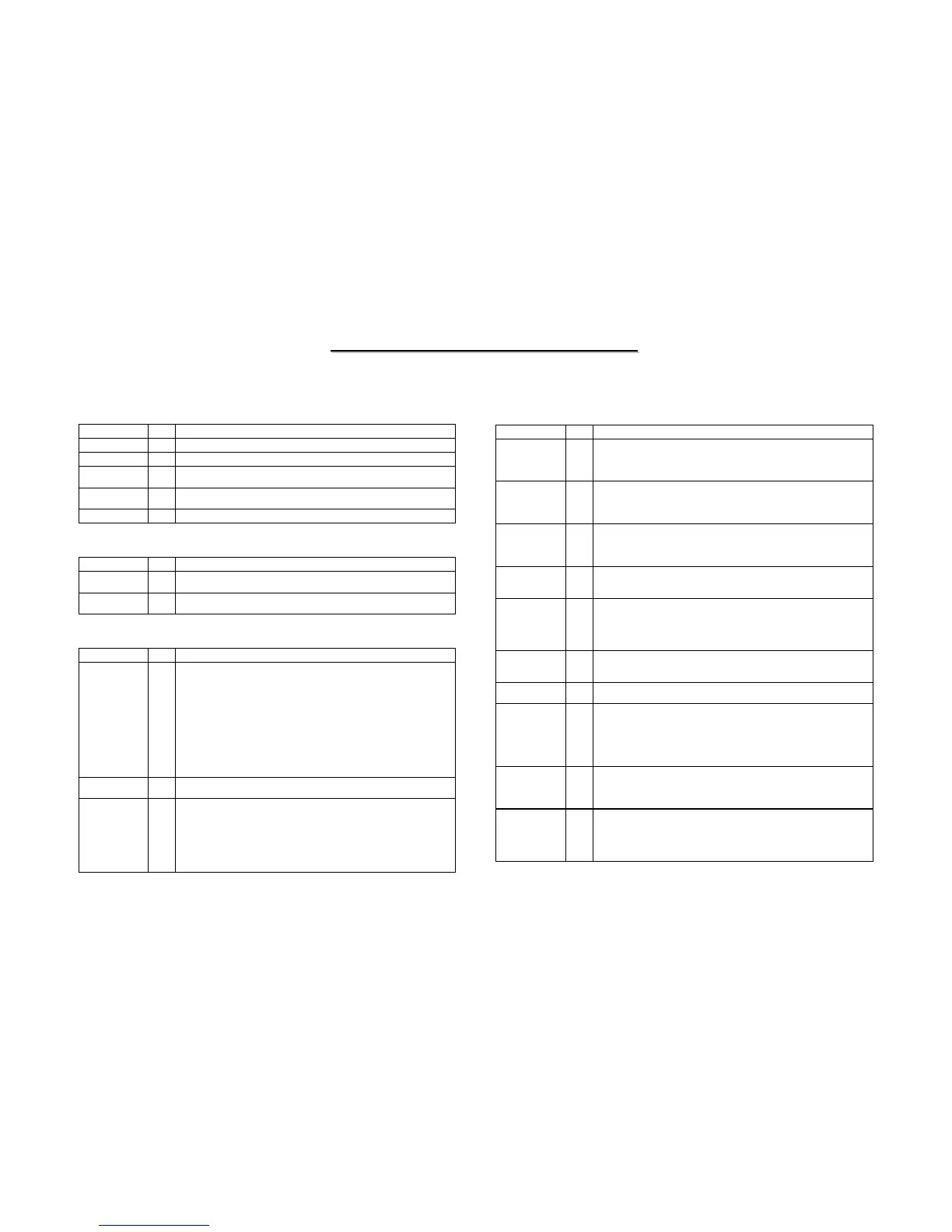
5.5 PCI1410GGU PCMCIA Controller
Power Supply
Name I/O Description
GND
Device ground terminals
VCC
Power supply terminal for core logic (3.3V)
VCCCB
Clamp voltage for PC Card interface. Matches card signaling environment,
5 V or 3.3 V.
VCCI
Clamp voltage for interrupt subsystem interface and miscellaneous I/O, 5 V
or 3.3 V
VCCP
Clamp voltage for PCI signaling, 5 V or 3.3 V
PC Card Power Switch
Name I/O Description
VCCD0
VCCD1
O Logic controls to the TPS2211 PC Card power interface switch to control
AVCC.
VPPD0
VPPD1
O Logic controls to the TPS2211 PC Card power interface switch to control
AVPP.
PCI System
Name I/O Description
GRST#
I Global reset. When the global reset is asserted, the GRST# signal causes the
PCI1410 to place all output buffers in a high-impedance state and reset all
internal registers. When GRST# is asserted, the device is completely in its
default state. For systems that require wake-up from D3, GRST# will
normally be asserted only during initial boot. PRST# should be used
following initial boot so that PME context is retained when transitioning
from D3 to D0. For systems that do not require wake-up from D3, GRST#
should be tied to PRST#.
When the SUSPEND# mode is enabled, the device is protected from the
GRST#, and the internal registers are preserved. All outputs are placed in a
high-impedance state, but the contents of the registers are preserved.
PCLK
I PCI bus clock. PCLK provides timing for all transactions on the PCI bus.
All PCI signals are sampled at the rising edge of PCLK.
PRST#
I PCI reset. When the PCI bus reset is asserted, PRST# causes the PCI1410 to
place all output buffers in a high-impedance state and reset internal
registers. When PRST# is asserted, the device is completely nonfunctional.
After PRST is deasserted, the PCI1410 is in a default state.
When the SUSPEND# mode is enabled, the device is protected from the
PRST#, and the internal registers are preserved. All outputs are placed in a
high-impedance state, but the contents of the registers are preserved.
PCI Interface Control
Name I/O Description
DEVSEL#
I/O PCI device select. The PCI1410 asserts DEVSEL# to claim a PCI cycle as
the target device. As a PCI initiator on the bus, the PCI1410 monitors
DEVSEL# until a target responds. If no target responds before timeout
occurs, then the PCI1410 terminates the cycle with an initiator abort.
FRAME#
I/O PCI cycle frame. FRAME# is driven by the initiator of a bus cycle.
FRAME# is asserted to indicate that a bus transaction is beginning, and data
transfers continue while this signal is asserted. When FRAME# is
deasserted, the PCI bus transaction is in the final data phase.
GNT#
I PCI bus grant. GNT# is driven by the PCI bus arbiter to grant the PCI1410
access to the PCI bus after the current data transaction has completed.
GNT# may or may not follow a PCI bus request, depending on the PCI bus
parking algorithm.
IDSEL
I Initialization device select. IDSEL selects the PCI1410 during configuration
space accesses. IDSEL can be connected to one of the upper 24 PCI address
lines on the PCI bus.
IRDY#
I/O PCI initiator ready. IRDY# indicates the PCI bus initiator’s ability to
complete the current data phase of the transaction. A data phase is
completed on a rising edge of PCLK where both IRDY# and TRDY# are
asserted. Until IRDY# and TRDY# are both sampled asserted, wait states
are inserted.
PERR#
I/O PCI parity error indicator. PERR# is driven by a PCI device to indicate that
calculated parity does not match PAR when PERR# is enabled through bit 6
of the command register.
REQ#
O PCI bus request. REQ# is asserted by the PCI1410 to request access to the
PCI bus as an initiator.
SERR#
O PCI system error. SERR# is an output that is pulsed from the PCI1410 when
enabled through bit 8 of the command register indicating a system error has
occurred. The PCI1410 need not be the target of the PCI cycle to assert this
signal. When SERR# is enabled in the command register,
this signal also pulses, indicating that an address parity error has occurred
on a CardBus interface.
STOP#
I/O PCI cycle stop signal. STOP# is driven by a PCI target to request the
initiator to stop the current PCI bus transaction. STOP# is used for target
disconnects and is commonly asserted by target devices that do not support
burst data transfers.
TRDY#
I/O PCI target ready. TRDY# indicates the primary bus target’s ability to
complete the current data phase of the transaction. A data phase is
completed on a rising edge of PCLK when both IRDY# and TRDY# are
asserted. Until both IRDY# and TRDY# are asserted, wait states are
inserted.



 To Next Page