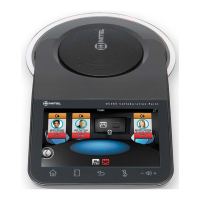
UC360 New Features and Enhancements
This section of the document briefly describes the new features and enhancements available
on the Mitel
®
UC360 Collaboration Point with Release 2.1 software.
UC360 Release 2.1
• Sound — can enable audible clicks for all selections and keyboard input.
See “Sound” on page 51.
• Apps Settings — enables or disables any of the apps that are currently implemented on
the UC360. New apps include
- MiCollab Conference
- Cisco™ WebEx® Meetings
- Remote VNC Pro
See “Apps Settings” on page 16 for more information.
• New SIP Settings
- Security - ability to install trusted root certificates (see “Security” on page 15)
- Transport - support TLS transport (see “Transport” on page 13)
• VNC Settings — allows the UC360 to connect to and control non-MS Windows computers
as RDP (Remote Desktop Protocol) does for MS Windows computers. Apple Mac
computers which come with a VNC (Virtual Network Connection) server already installed
and Linux/Unix computers can use the RemoteVNC application on the UC360. This app is
turned off by default.
See “VNC Settings” on page 29 for more information.
• Extension microphones — enables the settings for an Extension Microphone (Revolabs
only) if installed. See “Extension Microphone Settings” on page 31 for more information.
• UC360 Web Server — enables a Remote Diagnostic Web Application that allows you to
access debug and diagnostics through a web service on the UC360. From the Remote
Diagnostic Web page, the Administrator can download a configuration XML file.
See “Web Server Settings” on page 48 and “UC360 Web Server” on page 87 for more
information.
• Mass deployment — The Mass Deployment feature allows an administrator configure
multiple units all at once without manually changing the settings for each unit. The UC360
settings can be exported to a configuration XML file. This file can be edited. That file can
then be imported manually through "Backup Import/Export" via the HTTP server. The HTTP
server can be manually configured or automatically populated via DHCP.
See “MASS DEPLOYMENT” on page 97.


 To Next Page