36
Visit our website at http://modeltech.globalhobby.com or for Customer Service at http://globalservices.globalhobby.com
❑ After you have the receiver installed, drill a 5/64" diameter
hole in the fuselage for the antenna to exit. Unwrap the
receiver antenna and feed it out through the hole.
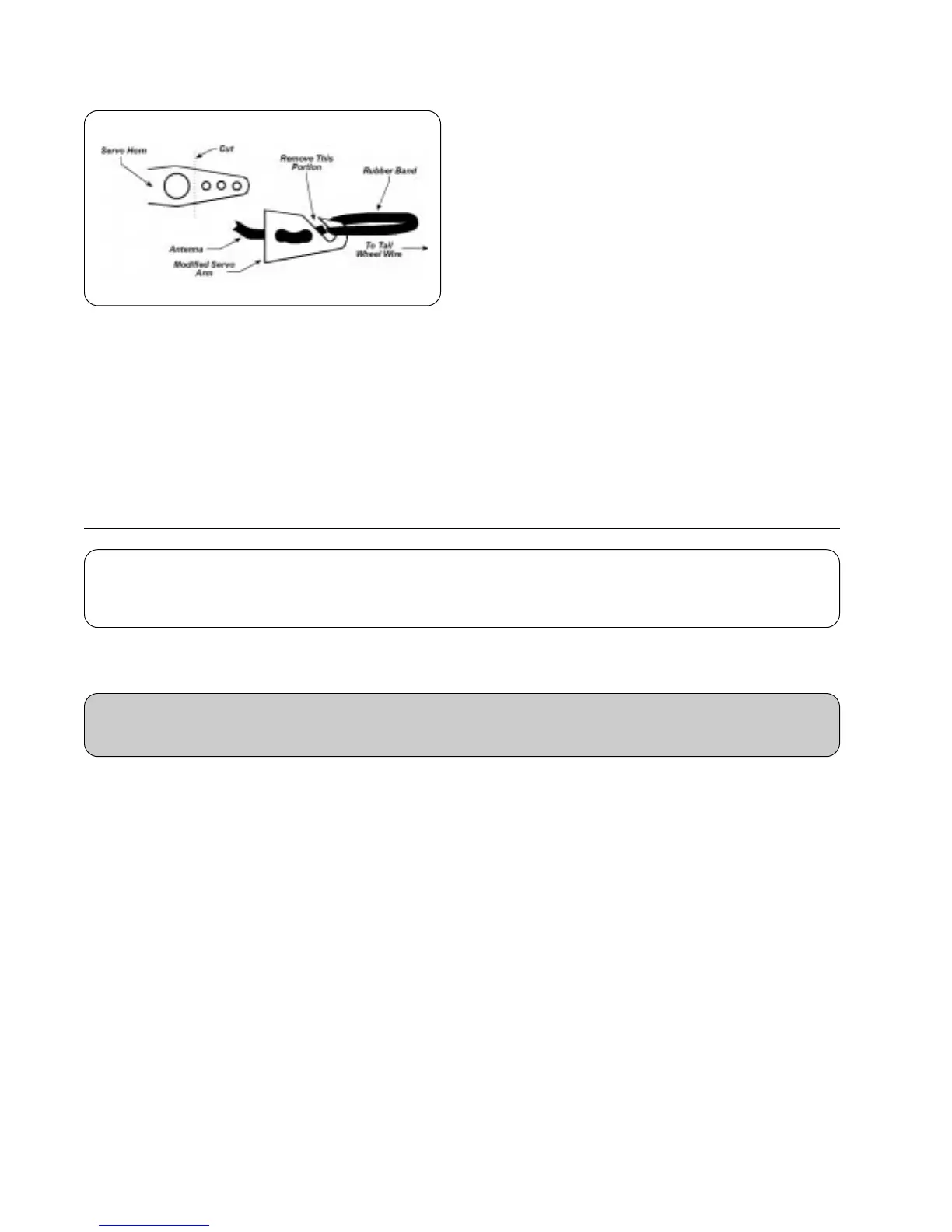
❑ Using a modeling knife, carefully make an antenna mount
out of an extra servo horn. Remove one of the arms and cut
it into the shape shown.
❑ Use the modified servo arm and a rubber band to secure
the end of the antenna to the tail wheel wire.
❑ Mount the switch into the precut hole in the side of the fuselage and connect the battery lead to the switch, and the
switch and servo leads to the receiver.
❑ # 2 Phillips Head Screwdriver
❑ Ruler
SECTION 21: BALANCING THE DRAGON LADY 60 ARF
YOU'LL NEED THE FOLLOWING TOOLS AND SUPPLIES:
❑ Masking Tape
IMPORTANT It is critical that your airplane be balanced correctly. Improper balance will cause your airplane to lose
control and crash!
Center of Gravity Location:
3-3/8" to 4-1/8" back from the leading edge of the wing, at the fuselage sides.
WARNING This is the recommended C.G. range. For test-flying we suggest you start with the C.G. in the middle of
the range, then move it farther back as you become familiar with the flying characteristics of the airplane. It is not
recommended that the C.G. be located any farther back than 4-1/8".
☞
Always balance the airplane with the fuel tank empty.
❑ Install the wing onto the fuselage. Apply two short pieces of masking tape onto the top of the wing, 3-3/4" back from
the leading edge, at the fuselage sides.
❑ Turn the airplane upside down and place your fingers on the masking tape, and carefully lift the airplane. If the nose
of the airplane falls, the airplane is nose heavy. To correct this, move the battery pack and/or receiver back far enough to
bring the airplane into balance. If the tail of the airplane falls, the airplane is tail heavy. To correct this, move the battery
pack and/or receiver far enough forward to bring the airplane into balance. When balanced correctly, the airplane should
sit level or slightly nose down when you lift it up with your fingers at the C.G. location.
☞
Once you have flown and become familiar with the flight characteristics of the airplane, the C.G. can be moved fore or
aft within the C.G. range to change the flight performance. Moving the C.G. back will cause the airplane to be more
responsive, but less stable. Moving the C.G. forward will cause the airplane to be more stable, but less responsive.
Do not fly the airplane beyond the recommended balance range or an uncontrollable crash could result!
Step 3: Applying the Decals
❑ Cut out and apply the decals using the box cover photos as your guide. If any air bubbles form under the decals you
can "prick" the bubbles with a straight pin to release the air.


 To Next Page