11
- Trees
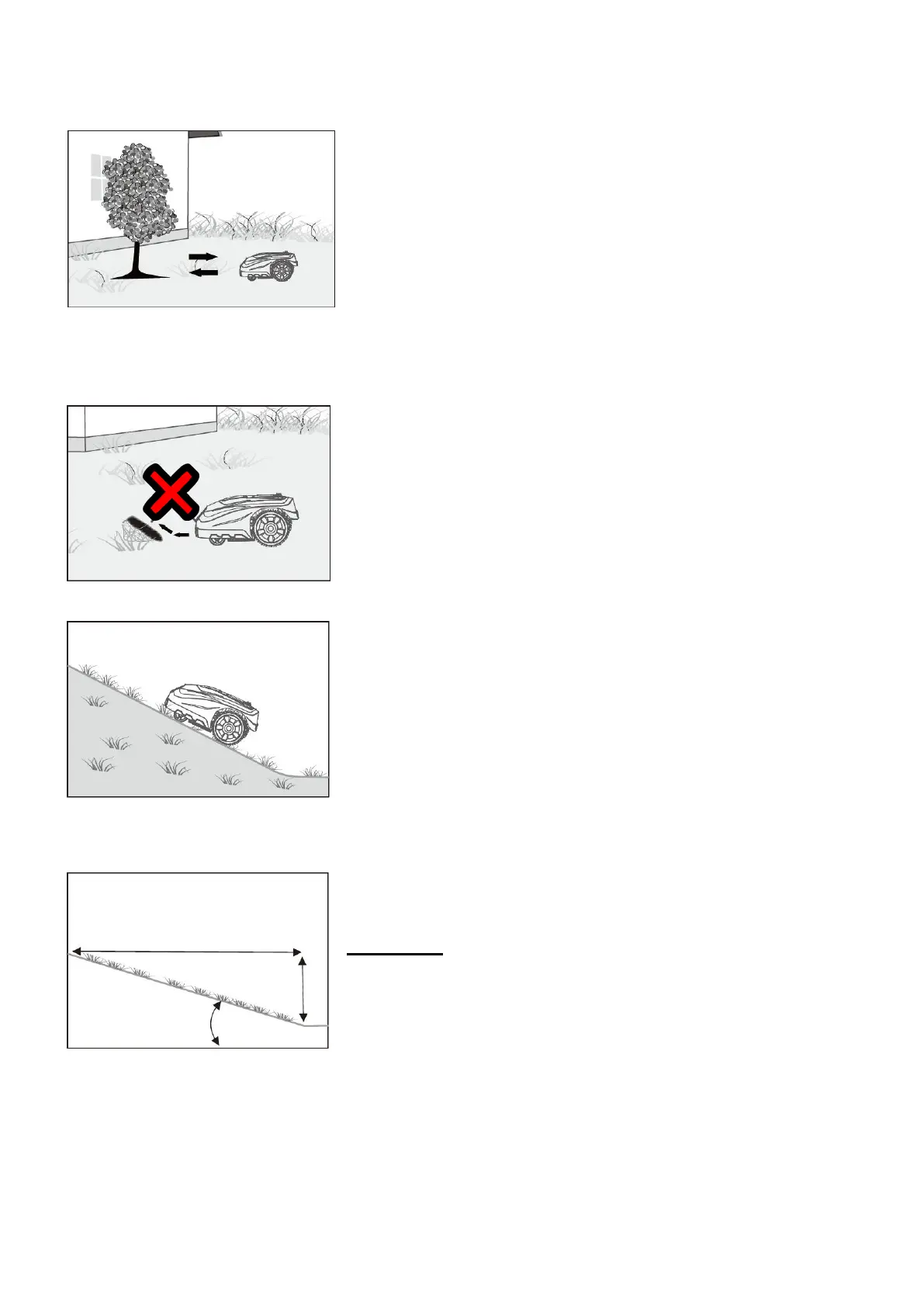
The Robotic Mower treats trees as common obstacles, but if some roots of the tree are exposed in your garden
and lower than 100 mm, this area should be protected in order to prevent the tree root, cutting blades or rear
wheels profile damage. (Fig.8)
Fig.8
- Stones, gravel or rocks
If there are rocks, gravel or stones situated within the cutting area, this is also an obstacle and needs to be
protected as the Robotic Mower could ride upwards on it or become stuck. Do not allow the Robotic Mower to
operate on graveled areas. (Fig.9)
Fig.9
- Slopes
Fig.10
The Robotic Mower is able to climb slopes up to 35%
(20
o
),
but avoid areas steeper than this. (Fig.10)
How to calculate the slope of your lawn. (Fig.11)
Slope level in this example:
35 cm (elevation)
= 35% (slope)
100cm (length)
Fig.11
Placement of boundary wire on slopes
The upper boundary wire should not be placed on slopes steeper than 35% (20 degrees). The upper boundary wire
should have a distance of at least 30cm between any obstacles. The lower boundary wire should not be placed on
slopes steeper than 17% (10 degrees). The lower boundary wire should have a distance of at least 40cm between
any obstacles when it is positioned on a slope that is 17%. (Fig.12)
Note: the lower boundary wire cannot be laid across a slope steeper than 17%, or the Robotic Mower will
slip and cross outside the wire, especially when the grass is wet.


 To Next Page