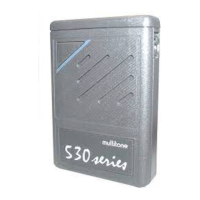
The Multitone RPR 950 Series Radio Receiver is a sophisticated paging device designed for optimal performance within a transmission system's coverage area. It supports various call types, including tone, alphanumeric, and voice messages, and offers a range of customizable alert and display options to suit user needs and system requirements.
Function Description:
The RPR 950 Series pager serves as a communication receiver, alerting users to incoming calls through visual, audible, and tactile (vibration) signals. It can store messages for later retrieval and offers features like voice message recording and playback. The device is designed for ease of use with a simple two-button interface for navigation and control.
Important Technical Specifications:
- Message Capacity: Up to 5 free message formats of 120 characters each, and up to 4 pre-programmed messages of 14 characters each. New messages overwrite the oldest when memory is full.
- Voice Message Storage: Up to 120 seconds of speech, divided into 5 segments of 24 seconds each. Messages exceeding 24 seconds are truncated.
- Battery Type: Compatible with 1.5 Volt nominal AA (LR6) primary cells, or NiCD (if permitted) or NiMH secondary cells for rechargeable use.
- Battery Life Retention: Recorded messages are retained for approximately 12 hours after battery removal or device shutdown.
- Display: Alphanumeric Liquid Crystal Display (LCD) with backlight for message viewing.
- Alert Types: Tone, alphanumeric, voice, with options for audible (normal, rising, extended), silent (LED flash, vibration), and vibrate-only alerts.
- Call Comparator: Programmable to ignore repeated calls within 30, 120, or 300 seconds of the original call.
Usage Features:
- Turning On/Off: Pressing the Power/Cancel/Redial (OCR) button once turns the pager on, initiating a self-test sequence. To turn off, press and hold the MUTE button, then press and hold the OCR button for approximately 2 seconds. For pagers with the "permanent ON" option, removing the battery is the only way to turn it off.
- Display Options: The LCD shows priority status information. The "Invert Display" option allows users to flip the text orientation by pressing the OCR button (to display status) and then the MUTE button. This setting is retained even after power cycling.
- Receiving Calls: Upon receiving a call, the red "alert" LED flashes, followed by a "call tone" and optional vibration. The alert sequence can be interrupted by pressing the CANCEL button. Messages ending with "**" indicate the call type.
- Tone-only Calls: Displays a dial tone number for the duration of the alert. Canceling the alert shows call data for an additional 2.5 seconds.
- Alphanumeric Messages: Displays messages up to 120 characters. Messages longer than 14 characters scroll in segments (1.25 seconds per segment, 2.5 seconds for the final screen). The MUTE button can be used to pause/resume scrolling or speed up/slow down viewing.
- Voice Calls: Activates an alert sequence (flashing LED, alert tone) for 4 seconds, then opens the voice channel to play the message. Voice messages are automatically stored for later retrieval. Pressing the OCR button during the alert ends the call; pressing it again ends the voice message. Pressing OCR during the voice message timeout reopens the channel.
- Retrieving Messages from Memory: Double-press the OCR button from standby. The pager displays the timestamp or message number (header) of the most recent message. Subsequent presses of the OCR button scroll through stored message headers. Releasing the OCR button displays the full message.
- Retrieving Voice Messages: Voice messages are replayed automatically when their associated alphanumeric message is retrieved from memory. Pressing the OCR button ends playback and retrieves the next message. Pressing and releasing the MUTE button restarts the current message.
- Voice Volume Adjustment: From standby, press MUTE then OCR. The display shows the current volume. Press OCR to increase, MUTE to decrease. Release both buttons when the desired level is reached.
- Alert Options:
- Rising Alert: Volume gradually increases. Starts with LED flash, then audible alert, ending with maximum volume and LED lighting for the selected duration (8, 16, 32 seconds, or constant).
- Extended Alert: A reminder if the original alert is not canceled. Starts with one LED flash every 2 seconds, then two beeps every 120 seconds, until canceled by OCR.
- Mute Mode: Silences all audio alerts and voice calls. Notifies with flashing LED and vibration (if selected). Messages are displayed and saved normally.
- Vibrate Option: Provides a discreet alert, usable with or without sound alerts. Can be toggled on/off by pressing and holding the MUTE button from sleep mode to cycle through options (On, On+vibrate, Mute+vibrate).
- Pager Status: Pressing the OCR button once from sleep mode displays status messages like "new post," "out of reach," "battery low," "hour," "mute," "vibrator," and "walk" (no other message to display).
- Time Display: Can be programmed to show time in sleep mode, sourced from an internal clock or system signal. The internal clock can be set by pressing OCR during power-up.
- Other Options:
- Group Alert: Activates an audible alert for group calls even if the pager is muted.
- Out of Range: Alerts the user if no valid radio signal is received for a predetermined time (e.g., 3 minutes 30 seconds). Can be visual, audible, or both, with optional vibration.
- Low Battery Warning: (Not recommended for rechargeable cells). Monitors battery voltage, and if low, the pager continues to operate but the battery should be replaced within 24 hours. Warnings include a buzzing sound during ignition and alerts, and a "low battery" message in status query mode.
- Absence and Loading (Holster Use): When placed in its holster, the pager enters "away mode." An already on pager resets, and an off pager turns on and enters away mode. No calls are accepted, and no recorded messages are erased in this mode. The display shows a programmable message (defaulting to the RIC number). The display orientation corrects for holster viewing, and the "alert" light turns on half bright during charging. Removing the pager from the holster reverts it to power-up sequence mode. In a single-unit charger, radio sensitivity may be reduced, and vibration may not work.
Maintenance Features:
- General Care: Protect the pager from liquids, extreme temperatures, and strong magnetic fields. Avoid direct sunlight exposure.
- Repair: Do not attempt to open or repair the pager. Return it to a designated repair agent or Multitone Electronics for service by qualified personnel in authorized workshops.
- Battery Replacement:
- Ensure the pager is off.
- Hold the pager front-side down. Slide the clasp in the direction of the arrow.
- Insert the valve removal tool (or a thin blade) into the opening on the side of the valve and gently lift it out of its notch.
- Gently lift and pull the battery door out, being careful not to damage the rubber seal.
- Remove the old battery by lifting its positive end while pushing down on the negative contact spring.
- Insert the new battery, observing polarity, by placing it against the negative contact and gently pressing it into the compartment, snapping the positive end into place.
- Replace the battery door by ensuring the tab at the bottom is correctly positioned, then gently lower the door, being careful not to damage the rubber seal.
- Once closed, press the flap on the upper end and slide the clasp into place.
- Clip Removal and Replacement:
- Hold the pager in one hand and open the clip to expose the metal bracket.
- Insert a clip blade tool or similar device under the edge of the media (as indicated by the arrow) and lift it from the pager body.
- Slide the clip down the pager until it releases.
- Before replacing, ensure the grip adjustment slider is securely attached to the top of the clip and the metal bracket is straightened.
- Reinsert the metal bracket into the guides at the back, sliding the clip assembly into place, ensuring the retaining tab is fully seated in the notch of the back bracket.
- User Serviceable Parts: Specific part numbers are provided for replacement components such as the battery door assembly, battery valve and clip tool, belt clip assembly, lanyard, and various label colors.

 Need help?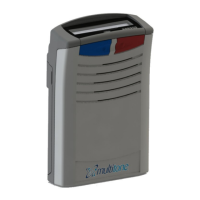

 To Next Page
 General