5.1.
Dynamo
5.1.1.
Checking the Armature for Accidental Eerth
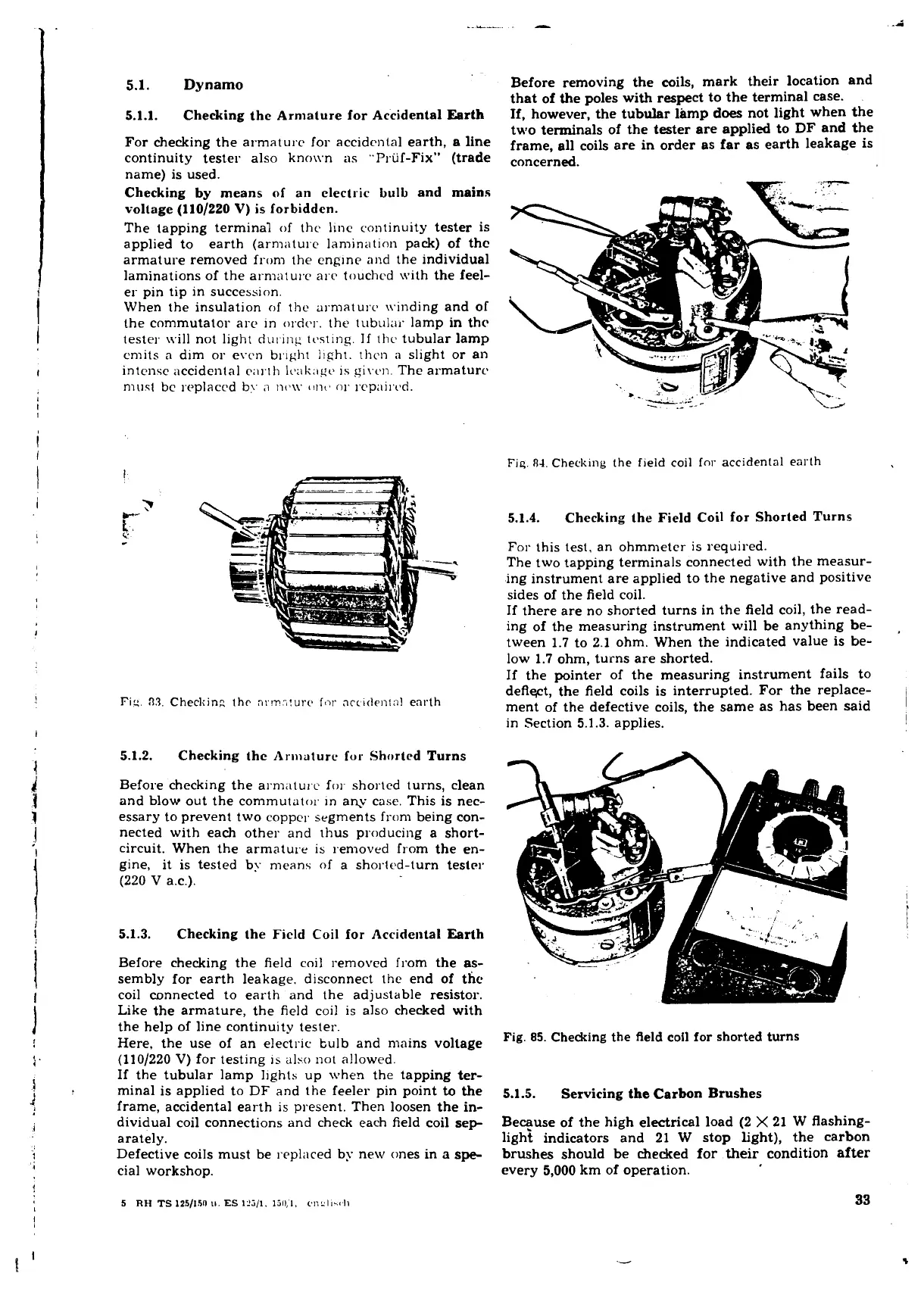
For checking the armaturc for accidcnlal earth, a line
continuity tester also kno\vn
as
"Priif-Fix" (trade
name) is used.
Checking
by
means of an electric bulb and mains
voltage
(110/220
V)
is forbidden.
The tapping terminal of thc Ilne continuity tester is
applied to
earth (arnx1tu1.c lamination pack) of thc
armature removed from the englne and the individual
laminations of the arn1ntul.r arc touched with the feel-
er pin tip in succession.
When the insulation of
the al.matuw \vinding and of
the commutator arc in o~.d(~. the t~rb~rlau lamp in thr
tester
\vill not light du~.ing tosting.
If
thc tubular lamp
cnlits a dim or e\.rn br~glit 11ght. thcn
ii
slight or an
intcmsc accidental c;rr~h l~~ak:~gc~ 1s
gi\.cm.
The armaturr
ninst bc ~vplacrd b).
;I
ncw
on,,
01. IT~;I~IX~.
Fir,
33.
Checkin:. thr
nrm:!ur'c
ftnr'
acc~tlenl;ll
earth
5.1.2.
Checking the Armaturc for Shorted Turns
Before checking the almature for shorted turns, clean
and blow out the commutator In any case. This is nec-
essary to prevent two coppcl segments from being con-
nected with each other and
~hus producing a short-
circuit. When the armature is removed from the en-
gine, it is tested by means of a shortcd-turn tester
(220 V a.c.).
5.1.3.
Checking the Ficld Coil for Accidental Earth
Before checking the field coil removed from the as-
sembly for earth leakage. disconnect the end of thc
coil connected to earth and the adjustable resistor.
Like the armature, the field coil is also checked with
the help of line continuity tester.
Here, the use of an electric bulb and mains voltage
(110/220 V) for testing 1s also not allowed.
If the tubular lamp llghts up when the tapping ter-
minal is applied to DF and the feeler pin point
to
the
frame, accidental earth
is
present. Then loosen the in-
dividual coil connections and check each field coil sep
arately.
Defective coils must be replaced by new ones in
a
spe-
cial workshop.
Before removing the coils, mark their location and
that of the poles with respect to the terminal case.
If, however, the tubular lamp does not light when the
two terminals of the tester are applied to DF and the
frame, all coils are in order as far as earth leakage is
concerned.
Fig.
84.
Checking the field coil
for
accidental earth
5.1.4.
Checking the Field Coil for Shorted Turns
For this test, an ohmmeter is required.
The two tapping terminals connected with the measur-
ing instrument are applied to the negative and positive
sides of the field coil.
If there are no shorted turns in the field coil, the read-
ing of the measuring instrument will be anything be-
tween 1.7 to 2.1 ohm. When the indicated value is be-
low 1.7 ohm, turns are shorted.
If the pointer of the measuring instrument fails to
deflqct, the field coils is interrupted. For the replace-
ment of the defective coils, the same as has been said
in Section 5.1.3. applies.
Fig.
85.
Checking the fleld coil for shorted turns
5.1.5.
Servicing the Carbon Brushes
Be~use of the high electrical load (2
X
21 W flashing-
light indicators and 21 W stop light), the carbon
brushes should be checked for their condition after
every
5,000
km of operation.



 To Next Page