sulator. In any case, pay particular attention to the
appearance of the plug. After a longer period of oper-
ation of the plug, the appearance is indicative of the
action of the engine, the formation of fuel-air mixture,
of the petrol used, of the carburetter tuning and
suit-
ability of the plug for the engine.
5.4.4.
Plug Cable Connector
The function of the plug cable connector is to estab-
lish a connection between sparking-plug and ignition
cable and to screen the electric field of the sparking-
plug from the environment.
To ensure a proper radio-shielding of the sparking-
plug, take care that the sheet-metal shell fastened to
the plug cable connector is properly fitted on the hex-
agon of the plug.
In the case of ignition failures and difficulties in start-
ing. especially in wet weather, thoroughly clean the
plug cable connector with clean petrol and dry it.
If
this
does not improve the conditions, replace the connector
by a new one.
On no account should the sheet-metal shell be removed
because this will lead to interferences with VHF and
television reception.
The plug cable connector, must be handled as gently
as the sparking-plug. Hair cracks in the insulating
body which lead to the formation of leakage paths
render it useless.
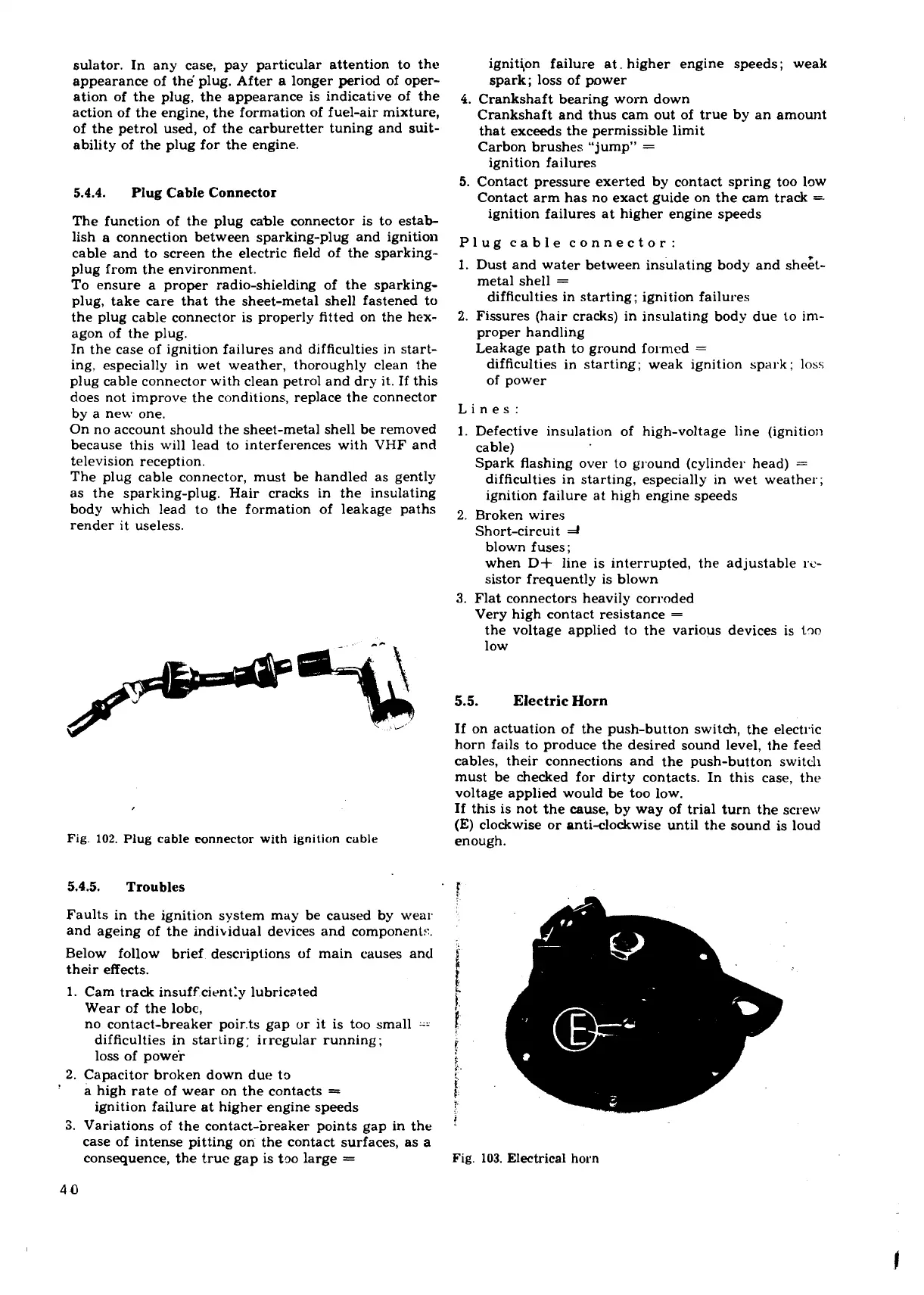
Fig.
102.
Plug
cable connector
with
ignition cable
5.4.5.
Troubles
Faults in the ignition system may be caused by wear
and ageing of the indikidual devices and components.
Below follow brief descriptions of main causes and
their effects.
1.
Cam track insuff cirntly lubricated
Wear of the lobe,
no contact-breaker
poir.ts gap or it is too small
difficulties in starting: irregular running;
loss of
powei
2.
Capacitor broken down due t:,
!
a high rate of wear on the contacts
=
ignition failure at higher engine speeds
3.
Variations of the contact-breaker points gap in the
case of intense pitting on the contact surfaces, as
a
consequence, the true gap is t~o large
=
ignition failure at. higher engine speeds; weak
spark; loss of power
Crankshaft bearing worn down
Crankshaft and thus cam out of true by an amount
that exceeds the permissible limit
Carbon brushes "jump"
=
ignition failures
Contact pressure exerted by contact spring too low
Contact arm has no exact guide on the cam track
=
ignition failures at higher engine speeds
Plug cable connector:
1.
Dust and water between insulating body and she&-
metal shell
=
difficulties in starting; ignition failures
2.
Fissures (hair cracks) in insulating body due to im-
proper handling
Leakage path to ground forn~ed
=
difficulties in starting; weak ignition spark; loss
of power
Lines:
Defective insulation of high-voltage line (ignition
cable)
Spark flashing over to ground (cylinder head)
=
difficulties in starting, especially in wet weather;
ignition failure at high engine speeds
Broken wires
Short-circuit
4
blown fuses;
when D+ line is interrupted, the adjustable
re-
sistor frequently is blown
Flat connectors heavily corroded
Very high contact resistance
=
the voltage applied to the various devices is
tm
low
5.5.
Eiectric Horn
If on actuation of the push-button switch, the electric
horn fails to produce the desired sound level, the feed
cables, their connections and the push-button switch
must be checked for dirty contacts. In this case, the
voltage applied would be too low.
If this is not the cause, by way of trial turn the screw
(E)
clockwise or anti-clockwise until the sound is loud
enough.
Fig.
103.
Electrical
horn



 To Next Page