1.4. Environment used in switch configuration examples
• switch address set to dynamic 192.168.239 only if no gateway device was connected
• switch gateway address before does not effect outcome gateway address
When the Reset button was applied:
• always leaves port behaviour configuration unchanged
1.4 Environment used in switch configuration examples
Two networks were used; a hardwired network and a wireless network. The network address of the
hardwired network was 192.168.14.0 and 192.168.8.0 for the wireless network.
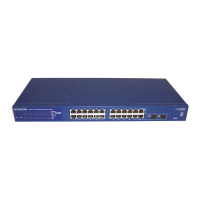
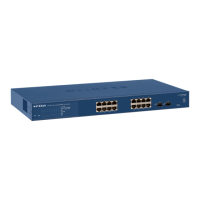
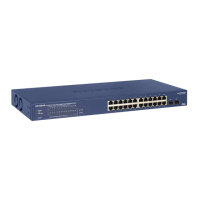
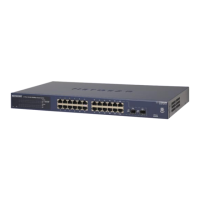
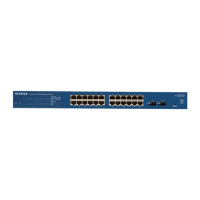
Table 1.2: Summary of devices connected to switch of the examples
Port Description of device IP address assigned MAC address
g1 HP Color Laserjet Pro M252dw printer 192.168.14.31 d0:bf:9c:bd:4b:4d
g2 Netgear ReadyNAS 316 192.168.14.107 28:c6:8e:d5:ed:08
g7 Mac Pro server Linux 192.168.14.9 00:3e:e1:c1:74:b3
g19 Mac mini server Linux 192.168.8.7 c8:2a:14:56:3c:a2
g23 D-Link DAP-1650 wireless extender 192.168.8.240 c0:a0:bb:f7:44:c0
Table 1.2 shows the details of the devices used in the examples. The switch was set with address 192.
168.14.155, placing it on the hardwired ethernet. The netmask for each device was set to 255.255.
0.0. That mask enabled devices on both networks to communicate. This enabled that Mac mini with
address 192.168.8.7 to act as controller for the switch.
Figure 1.1: Model of the network visualizations used here
Figure 1.1 shows the style of diagram used to depict the network of each example. In Figure 1.1 the
switch is configured to have two networks with one device connected to the switch and the configured
network. An internet gateway on a separated wireless network is also shown.
A D-Link ASL-2900AL Viper wireless router with IP address on the wireless network of 192.168.
8.244 with corresponding MAC address e8:cc:18:f1:79:6f provided a link between the wireless
network and the Internet. The D-Link DAP-1680 wireless extender provided the link between the hard-
wired and wireless networks.
4



 To Next Page
 Loading...