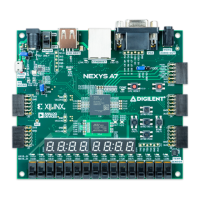
https://reference.digilentinc.com/reference/programmable-logic/nexys-a7/reference-manual 24/30
The Nexys A7 includes an Analog Device ADT7420 temperature sensor. The sensor provides up to 16-bit resolution with a typical accuracy
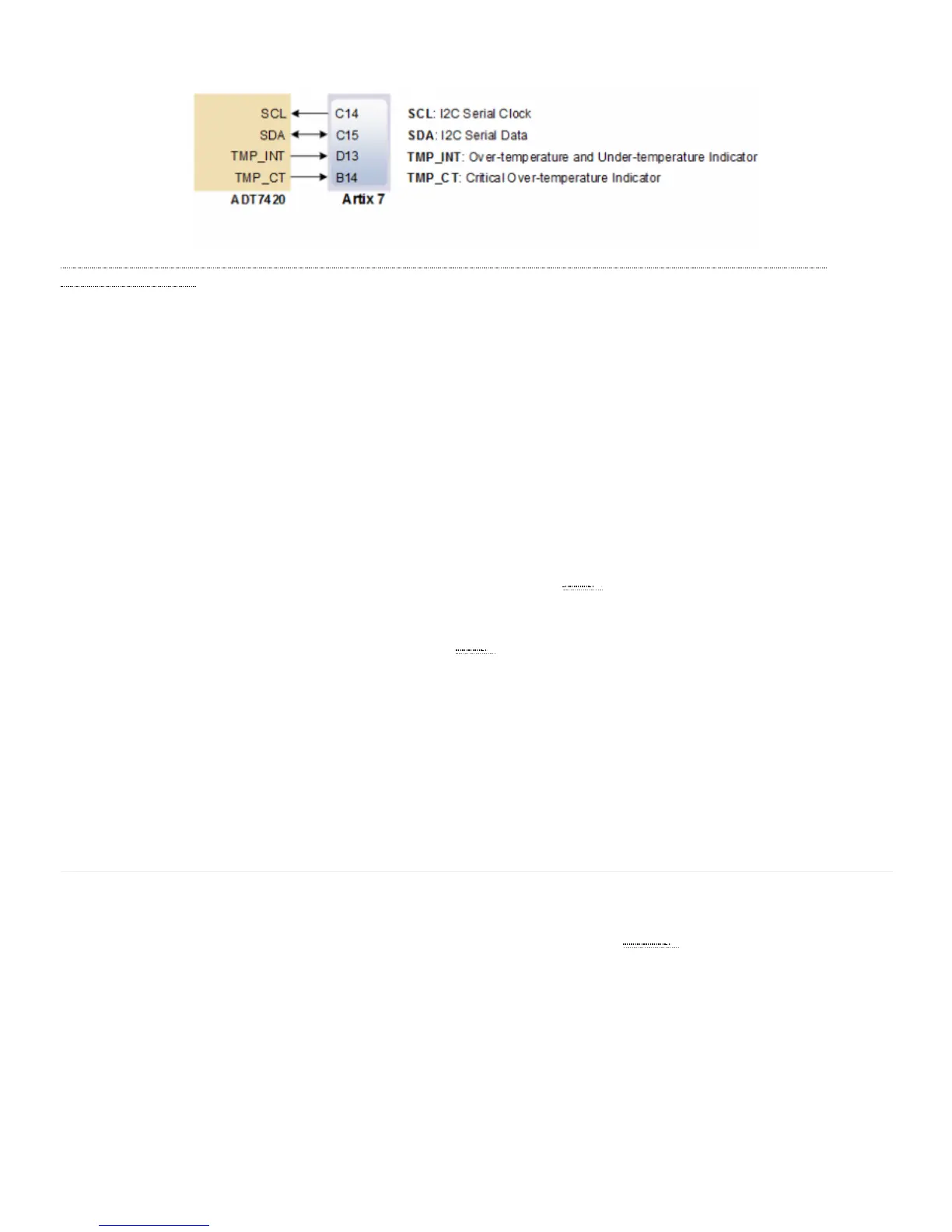
better than 0.25 degrees Celsius. The interface between the temperature sensor and FPGA is shown in Figure 12.1.
(https://reference.digilentinc.com/_detail/reference/programmable-logic/nexys-a7/n4x.png?id=reference%3Aprogrammable-logic%3Anexys-
a7%3Areference-manual) Figure 12.1 Temperature Sensor Interface
The ADT7420 chip acts as a slave device using the industry standard I²C communication scheme. To communicate with ADT7420 chip, the
I²C master must specify a slave address (0x4B) and a flag indicating whether the communication is a read (1) or a write (0). Once
specifications are made for communication, a data transfer takes place. For ADT7420, the data transfer should consist of the address of the
desired device register followed by the data to be written to the specified register. To read from a register, the master must write the desired
register address to the ADT7420, then send an I²C restart condition, and send a new read request to the ADT7420. If the master does not
generate a restart condition prior to attempting the read, the value written to the address register will be reset to 0x00. As some registers
store 16-bit values as 8-bit register pairs, the ADT7420 will automatically increment the address register of the device when accessing certain
registers, such as the temperature registers and the threshold registers. This allows for the master to use a single read or write request to
access both the low and high bytes of these registers. A complete listing of registers and their behavior can be found in the ADT7420
datasheet available on the Analog Devices website.
The ADT7420 provides two open drain output signals to indicate when pre-set temperature thresholds are reached. If the temperature
leaves a range defined by registers TLOW (0x06:0x07) and THIGH (0x04:0x05), the INT () pin can be driven low or high based upon the
configuration of the device. Similarly, the CT pin can be driven low or high if the temperature exceeds a critical threshold defined in TCRIT
(0x08:0x09). Both of these pins need internal FPGA pull-ups when used.
For details on the electrical specifications and configuration of the INT () and CT pins, refer to the ADT7420 datasheet
When the ADT7420 is powered up, it is in a mode that can be used as a simple temperature sensor without any initial configuration. By
default, the device address register points to the temperature MSB register, so a two byte read without specifying a register will read the
value of the temperature register from the device. The first byte read back will be the most significant byte (MSB) of the temperature data,
and the second will be the least significant byte (LSB) of the data. These two bytes form a two’s complement 16-bit integer. If the result is
shifted to the right three bits and multiplied by 0.0625, the resulting signed floating point value will be a temperature reading in degrees
Celsius.
For information on reading and writing to the other registers of the device, as well as notes on the accuracy of the temperature
measurements, refer to the ADT7420 datasheet.
The Nexys A7 includes an Analog Device ADXL362 accelerometer. The ADXL362 is a 3-axis MEMS () accelerometer that consumes less
than 2μA at a 100Hz output data rate and 270nA when in motion triggered wake-up mode. Unlike accelerometers that use power duty
cycling to achieve low power consumption, the ADXL362 does not alias input signals by under-sampling; it samples the full bandwidth of
the sensor at all data rates. The ADXL362 always provides 12-bit output resolution; 8-bit formatted data is also provided for more efficient
single-byte transfers when a lower resolution is sufficient. Measurement ranges of ±2 g, ±4 g, and ±8 g are available with a resolution of 1
mg/LSB on the ±2 g range. The FPGA can talk with the ADXL362 via SPI interface. While the ADXL362 is in Measurement Mode, it
continuously measures and stores acceleration data in the X-data, Y-data, and Z-data registers. The interface between the FPGA and
accelerometer can be seen in Figure 13.1.
12.1 I²C Interface
12.2 Open Drain Outputs
12.3 Quick Start Operation
13 Accelerometer


 To Next Page
 Loading...