
 To Next Page
R
Richard FrankSep 15, 2025
Why can't exposure compensation be used on my Nikon Digital Camera?
- RRachel JacksonSep 16, 2025
Exposure compensation cannot be used if you do not choose exposure mode P, S, or A.

Why can't exposure compensation be used on my Nikon Digital Camera?
Exposure compensation cannot be used if you do not choose exposure mode P, S, or A.
Why is the view finder out of focus on my Nikon D70 Digital Camera?
To correct a viewfinder that is out of focus, adjust the viewfinder focus or use an optional diopter adjustment lens.
What to do if the Nikon D70 displays turn off without warning?
To prevent the displays from turning off unexpectedly, choose longer monitor off or meter off delays.
How to fix the Nikon D70 Digital Camera taking time to turn on?
To speed up the camera's start time, delete files or folders.
Why are some photos not displayed during playback on my Nikon Digital Camera?
Some photos may not be displayed during playback if you do not select All for Playback Folder. Note that Current will automatically be selected when the next photo is taken.
Why are the displays in control panel or viewfinder slow and dim on my Nikon D70 Digital Camera?
The displays are affected by high or low temperatures.
Why is the image size can not be changed on my Nikon D70?
The image size cannot be changed if NEF (RAW) is selected for image quality.
Why does the focus not lock when the shutter-release button is pressed halfway on my Nikon D70?
If the focus does not lock when the shutter-release button is pressed halfway, it may be because the camera is in focus mode C. Use the AE-L/AF-L button to lock focus.
Why is the menu item unavailable on my Nikon D70?
A menu item might be unavailable because a memory card is not inserted. Also, the Battery Info option is only available when using EN-EL3e batteries.
Why are the colors unnatural in photos taken with my Nikon D70?
If the colors in your photos appear unnatural, you can adjust the white balance to match the light source or adjust the Optimize Image settings.
Overview of camera body components, controls, and displays.
Essential initial procedures for using the camera, like attaching accessories and setup.
Step-by-step guide to taking photos using default camera settings.
How to view and delete photographs on the camera monitor.
How to navigate and use the camera's menu system.
Explanation of different shooting modes and their functions.
Details on setting image quality and resolution for photos.
Guide to adjusting camera sensitivity to light conditions.
How to set white balance for accurate color reproduction under various lighting.
Explanation of focus modes, area selection, and AF-assist features.
Understanding metering, exposure modes, compensation, and bracketing.
Guide to using the built-in flash and sync modes.
How to view, manage, and display photos on the camera.
Options for initial camera setup, including format and language.
Customization of shooting parameters like image quality and focus.
Settings for managing and displaying photos after shooting.
Fine-tuning camera operations and personalizing settings.
Overview of compatible accessories for the camera.
Guidelines for storing, cleaning, and maintaining the camera.
Solutions for common camera problems and error messages.
Supplementary information, charts, and data for camera operation.
Technical details and features of the camera.
 General
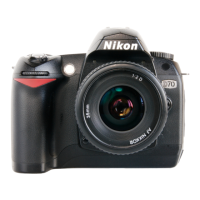
| Model | Nikon D70 |
|---|---|
| Sensor Type | CCD |
| Sensor Size | 23.7 x 15.6 mm |
| ISO Sensitivity | 200 - 1600 |
| Shutter Speed | 30 - 1/8000 sec |
| Continuous Shooting | 3 fps |
| Storage Media | CompactFlash (Type I or II) |
| Battery | Nikon EN-EL3 |
| Weight | 595 g (1.31 lb) |
| Dimensions | 140 x 111 x 78 mm (5.5 x 4.4 x 3.1 in) |
| Type | DSLR |
| Release Date | 2004 |
| Sensor Resolution | 6.1 megapixels |
| Image Sensor Size | APS-C |
| Resolution | 3008 x 2000 |
| Lens Mount | Nikon F-mount |
| ISO Range | 200 - 1600 ISO |
| LCD Screen Size | 1.8 in |
| LCD Size | 1.8 inches |
| Viewfinder | Optical |
| Storage | CompactFlash |