Recommended separation distances between portable and mobile
RF communications equipment and the EQUIPMENT or SYSTEM –
for EQUIPMENT or SYSTEM that are LIFE-SUPPORTING
Recommended separation distances between
portable and mobile RF communications equipment and the YP-970 Infant Incubator
The YP-970 Infant Incubator is intended for use in an electromagnetic environment in which radiated RF
disturbances are controlled. The customer or the user of the YP-970 Infant Incubator can help prevent
electromagnetic interference by maintaining a minimum distance between portable and mobile RF communications
equipment (transmitters) and the YP-970 Infant Incubator as recommended below, according to the maximum output
power of the communications equipment.
Separation distance according to frequency of transmitter
(m)
Rated
maximum
output power
of transmitter
(W)
150 kHz to 80 MHz
outside ISM bands
P
V
d
⎥
⎦
⎤
⎢
⎣
⎡
=
1
5.3
150 kHz to 80 MHz
in ISM bands
80 MHz to 800
MHz
800 MHz to 2.5 GHz
0.01
0.1167 0.12 0.12 0.23
0.1
0.3689 0.3795 0.3795 0.7273
1
1.1667 1.2 1.2 2.3
10
3.6893 3.7947 3.7947 7.2732
100
11.6667 12 12 23
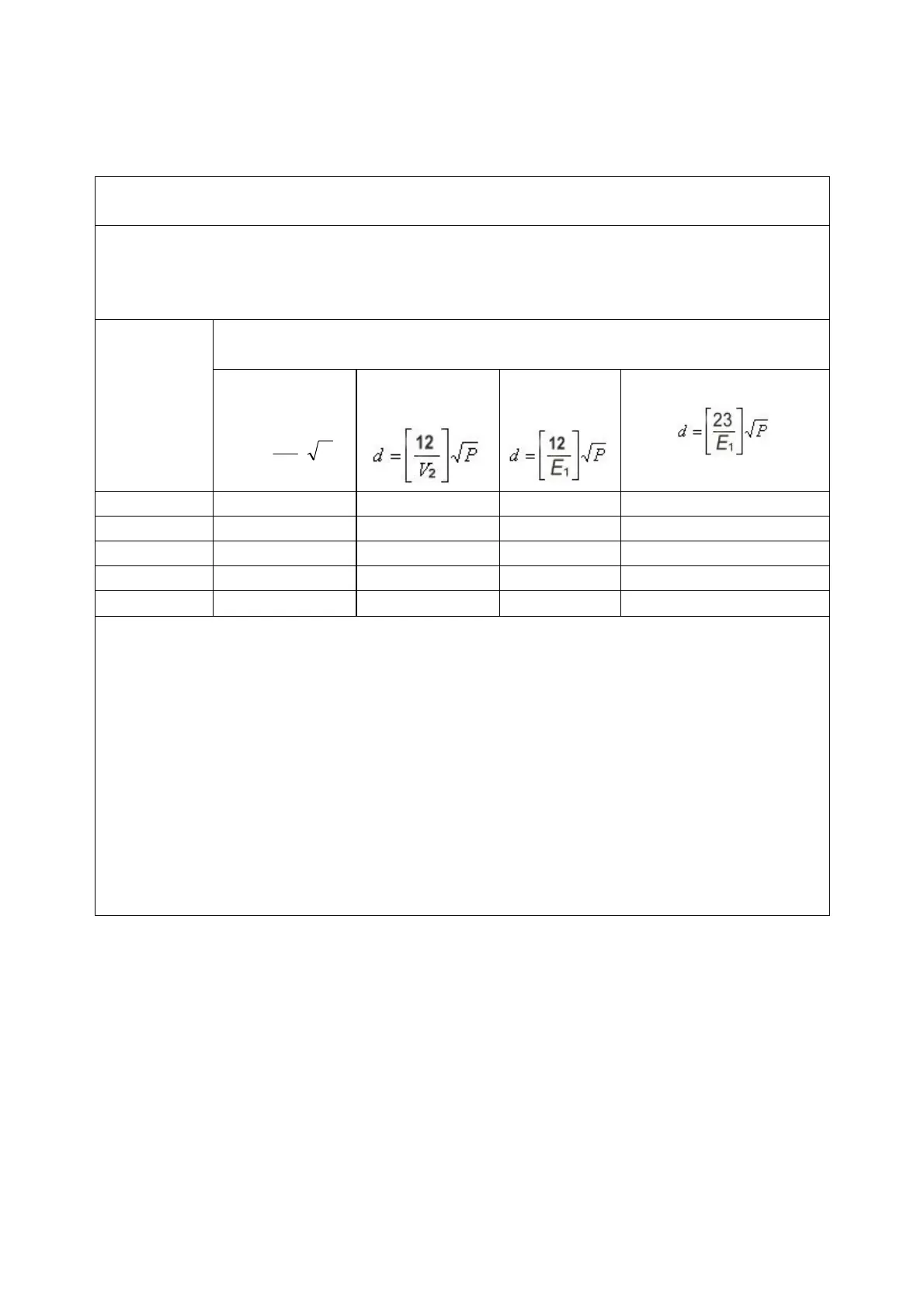
For transmitters rated at a maximum output power not listed above, the recommended separation distance d in
metres (m) can be estimated using the equation applicable to the frequency of the transmitter, where P is the
maximum output power rating of the transmitter in watts (W) according to the transmitter manufacturer.
NOTE 1 At 80 MHz and 800 MHz, the separation distance for the higher frequency range applies.
NOTE 2 The ISM(industrial, scientific and medical) bands between 150kHz and 80MHz are 6.765MHz to
6.795MHz; 13.553 MHz to 14.567 MHz; 26.957 MHz to 27.283 MHz; and 40.66 MHz to 40.70 MHz.
NoTE 3 An additional factor of 10/3 is used in calculating the recommended separation distance for transmitters in
the ISM frequency bands between 150kHz and 80 MHz and in the frequency range 80 MHz to 2.5 GHz to decrease
the likelihood that mobile/portable communications equipment could couse interference if it is inadvertently brought
into patient areas.
NOTE 4 These guidelines may not apply in all situations. Electromagnetic propagation is affected by absorption
and reflection from structures, objects and people.
Page 4 of 4


 To Next Page