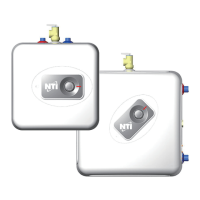
When installing the valve, follow these guidelines:
●
Ensure that the discharge capacity of the pressure
relief valve is equal to or greater than the
maximum pressure rating of the appliance.
●
Ensure that the maximum BTU/H rating on the
pressure relief valve is equal to or greater than the
maximum input BTU/H rating of the appliance's
water heater.
●
Direct the discharge piping of the pressure relief
valve so that hot water will not splash on anyone
or any nearby equipment.
●
Attach the discharge line to the pressure relief
valve and run the end of the line to within 6-12 in
(150-300 mm) of the oor.
●
Ensure that the discharge line will allow free and
complete drainage without restriction. Do not
install a reducing coupling or other restriction on
the discharge line.
●
If the relief valve discharges periodically, this may
be due to thermal expansion in a closed water
supply system. Contact the water supplier or
local plumbing inspector on how to correct this
situation. Do not plug the relief valve.
3.5 Connecting the Condensate Drain
This appliance creates condensation when it
operates. This condensate has an acidic pH of
3-5. Follow all local codes and regulations when
disposing of condensate from the appliance. We
recommend draining the condensate into a laundry
tub, as the alkali in laundry detergent will neutralize
the acid in the condensate. However, other suitable
waste drain locations may be used according to
local codes.
CAUTION
●
Do not cap or plug the integrated condensate
line. If prevented from draining, condensate
can damage the appliance.
●
The condensate line must have a negative
slope to drain properly.
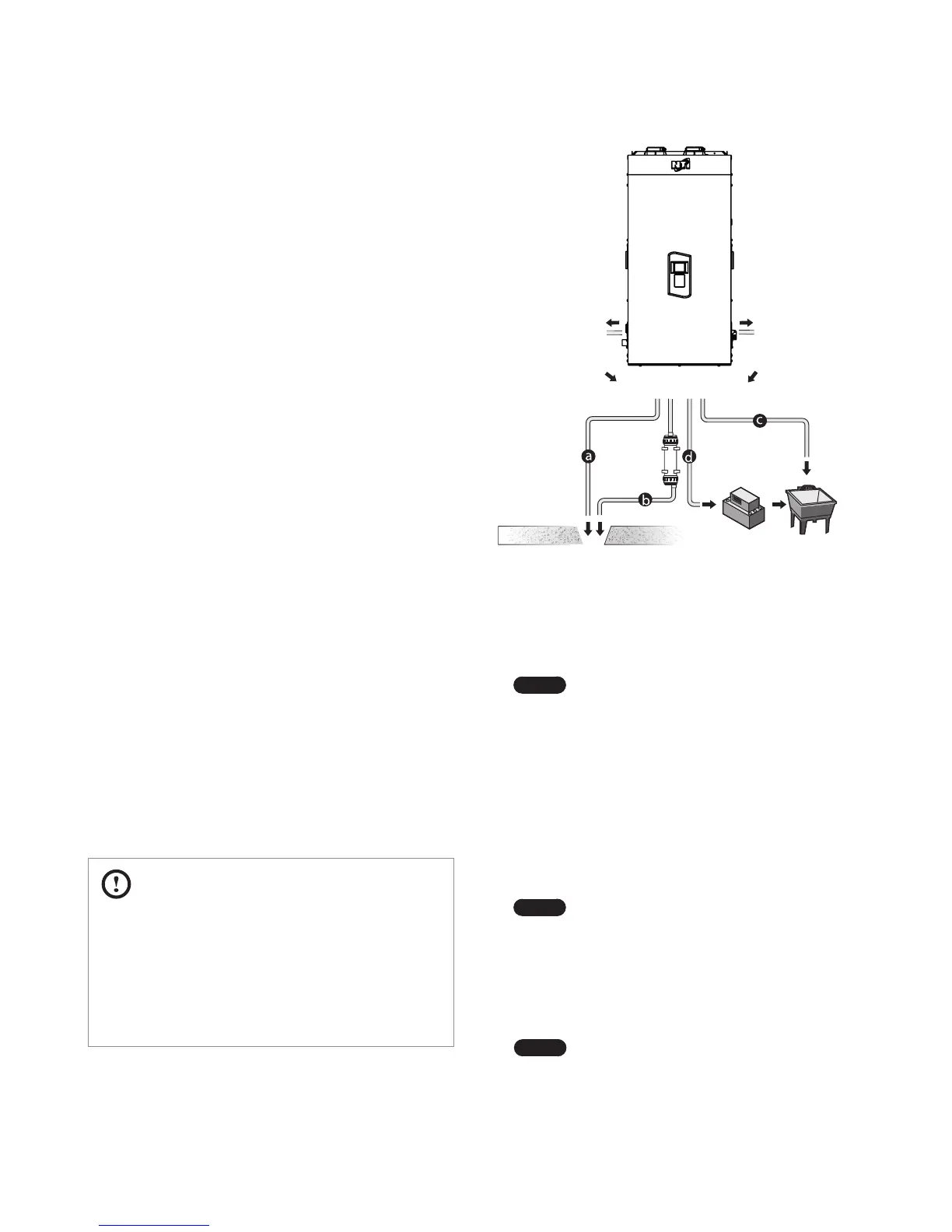
Before connecting the condensate drain, choose
one of the following disposal options:
a. From the appliance directly into an external
drain.
b. From the appliance, through a neutralizing
agent, and then into an external drain.
Note
If you choose this option, the
neutralizing agent must be replaced
periodically. Depletion of the
neutralizing agent will vary, based
on the usage rate of the appliance.
During the rst year of operation, the
neutralizer should be checked every
few months for depletion and replaced
as needed.
c. From the appliance into a laundry tub.
Note
The condensate outlet must be higher
than the top of the laundry tub to use
this option. The condensate line must
have a negative slope to drain properly.
d. From the appliance into a condensate pump, and
then into a laundry tub.
Note
A pump can be used when there is a
long distance between the appliance
and the laundry tub or when the
condensate outlet is lower than the top
of the laundry tub.
Direct to
drain
Drain via
Neutralizer
Laundry tub via
condensate pump
Direct to
laundry tub
Choose
Connection Side
19


 To Next Page