DHW Piping (Combi) │ Tx I&O Manual
11.0 DOMESTIC HOT WATER (DHW) PIPING – Tx151C & Tx200C (COMBI)
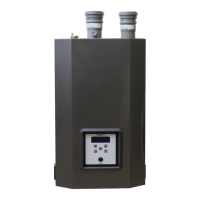
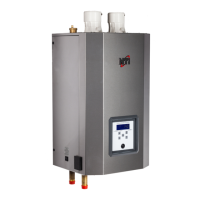
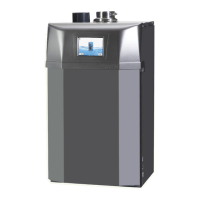
The Trinity Tx boiler comes in two versions; non-Combi (Tx51-200) and Combi (Tx151C & Tx200C). Both
versions are designed to provide Central Heating and Domestic Hot Water (DHW) heating. To provide DHW
heating, the non-Combi version must be installed in combination with an Indirect Fired Hot Water Heater, as in
Figures 10-4 and 10-5. The Combi version incorporates a DHW heat exchanger (Brazed Plate) and the controls
necessary to heat DHW without requiring the addition of an Indirect Fired Hot Water Heater.
The Tx-Combi is designed for installations where there is a limited DHW demand, such as smaller apartments
and condos. In applications where there is a greater DHW demand NTI recommends the Tx51-200 (non-Combi)
installed with an Indirect Fired Hot Water Heater (Figures 10-4 & 10-5), or a Tx151C or Tx200C (Combi)
installed with a DHW storage tank (Figure 11-2).
Hard Water – To prevent the formation of scale on the inside of the brazed plate heat exchanger and other
components in the domestic hot water system, water with hardness higher than 50 ppm Calcium Carbonate must
be treated with a “Water Softener” prior to entering the appliance. Plugging of the domestic system by scaling or
accumulation of dirt is not the responsibility of NY Thermal Inc., and suitable steps shall be taken to avoid it.
Cleaning – Brazed plate heat exchangers operate with high turbulence flow, even at low flow rates. This high
turbulence keeps small particles in suspension minimizing fouling and scaling. However, in some applications
the fouling tendency can be very high, e.g. when using extremely hard water at high temperatures. In such cases
it is always possible to clean the exchanger by circulating a cleaning liquid. Use a tank with weak acid, 5%
phosphoric acid or, if the exchanger is frequently cleaned, 5% oxalic acid. Pump the cleaning liquid through the
exchanger. For optimum cleaning, the cleaning solution flow rate should be a minimum of 1.5 times the normal
flow rate, preferably in a back-flush mode. After use, do not forget to rinse the heat exchanger carefully with
clean water. A solution of 1-2% sodium hydroxide (NaOH) or sodium bicarbonate (NaHCO3) before the last
rinse ensures that all acid is neutralized. Clean at regular intervals.
DHW Description of Operation
The Tx-Combi heats domestic hot water on demand, indirectly, using an internal brazed plate heat exchanger. An
internal flow sensor detects potable water flow; when in excess of 0.3gpm the controller operates in DHW mode,
whereby the potable water is heated to the “DHW Setpoint” (Installer Menu setting 2-07). Set “DHW Setpoint”
to the desired hot water temperature; to avoid the risk of scalding a Thermostatic Mixing Valve must be installed,
see Figure 11-1.
Code requirements may require the maximum setting of the Thermostatic Mixing Valve to
be fixed at 120°F or lower, see “Thermostatic Mixing Valve” below and the instructions
included with the valve.
Scald Hazard - Hotter water increases the risk of scald injury. There is a hot water scald
potential if a thermostatic mixing valve is not used or is set too high. Be sure to follow
the adjustment instructions provided with the thermostatic mixing valve. Failure to follow these instructions may
result in serious injury or death.



 To Next Page