6: Technical Specifications
225-00000-000-11-201604 53
CCD Well Depth
We strive for a large signal-to-noise (S:N) in optical measurements so that small signal
variations can be observed and a large dynamic range is available. The S:N in photon noise-
limited systems is defined and measured as the square root of the number of photons it takes
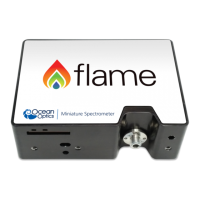
to fill a well to saturation. In the Flame, the well depth of the CCD pixels is about 160,000
photons, providing a S:N of 400:1 (S:N can also be measured as the saturation voltage divided
by near-saturation RMS noise). There is also a fixed readout noise component to all samples.
The result is a system with a S:N of ~275:1.
There are two ways to achieve a large S:N (e.g., 6000:1) in CCD detectors where photon noise
is predominant.
1. Use a large-well device that integrates to saturation over a long period of time until the
photon noise is averaged out by the root of
n
multiples of a defined short t.
2. Use a small-well device that integrates to saturation at one short t and then signal
average mathematically
n
times.
Theoretically, both approaches achieve the same results, though there are large differences in
actual operation. Traditional spectroscopic instruments use large-well devices and 16-bit ADCs
to achieve the defined S:N. The Flame uses a small-well device and utilizes signal averaging to
achieve the same S:N. A brief comparison of large and small-well devices is shown in the table
below.
Well Depth Comparison
Medium photon noise that can be averaged out
Moderate operating speeds (~2 MHz)
Signal Averaging
Signal averaging is an important tool in the measurement of spectral structures. It increases the
S:N and the amplitude resolution of a set of samples. The types of signal averaging available in
our software are time-based and spatial-based.
When using the time-base type of signal averaging, the S:N increases by the square root of the
number of samples. Signal averaging by summing is used when spectra are fairly stable over
the sample period. Thus, a S:N of 2500:1 is readily achieved by averaging 100 spectra.


 To Next Page