4: Sample Experiments
Reflection Experiments
Reflection is the return of radiation by a surface, without a change in wavelength and can be:
• Specular, in which the angle of incidence is equal to the angle of reflection.
• Diffuse, in which the angle of incidence is not equal to the angle of reflection.
Every surface returns both specular and diffuse reflections. Some surfaces may return mostly specular
reflection, others more diffuse reflection. Specular reflection increases proportionately with the glossiness
of a surface.
Reflection is expressed as a percentage (%R
λ
) relative to the reflection from a standard reference
substance:
S
λ
- D
λ
%R
λ
=
R
λ
- D
λ
x 100%
Where:
S
λ
= the sample intensity at wavelength λ
D
λ
= the dark intensity at wavelength λ
R
λ
= the reference intensity at wavelength λ
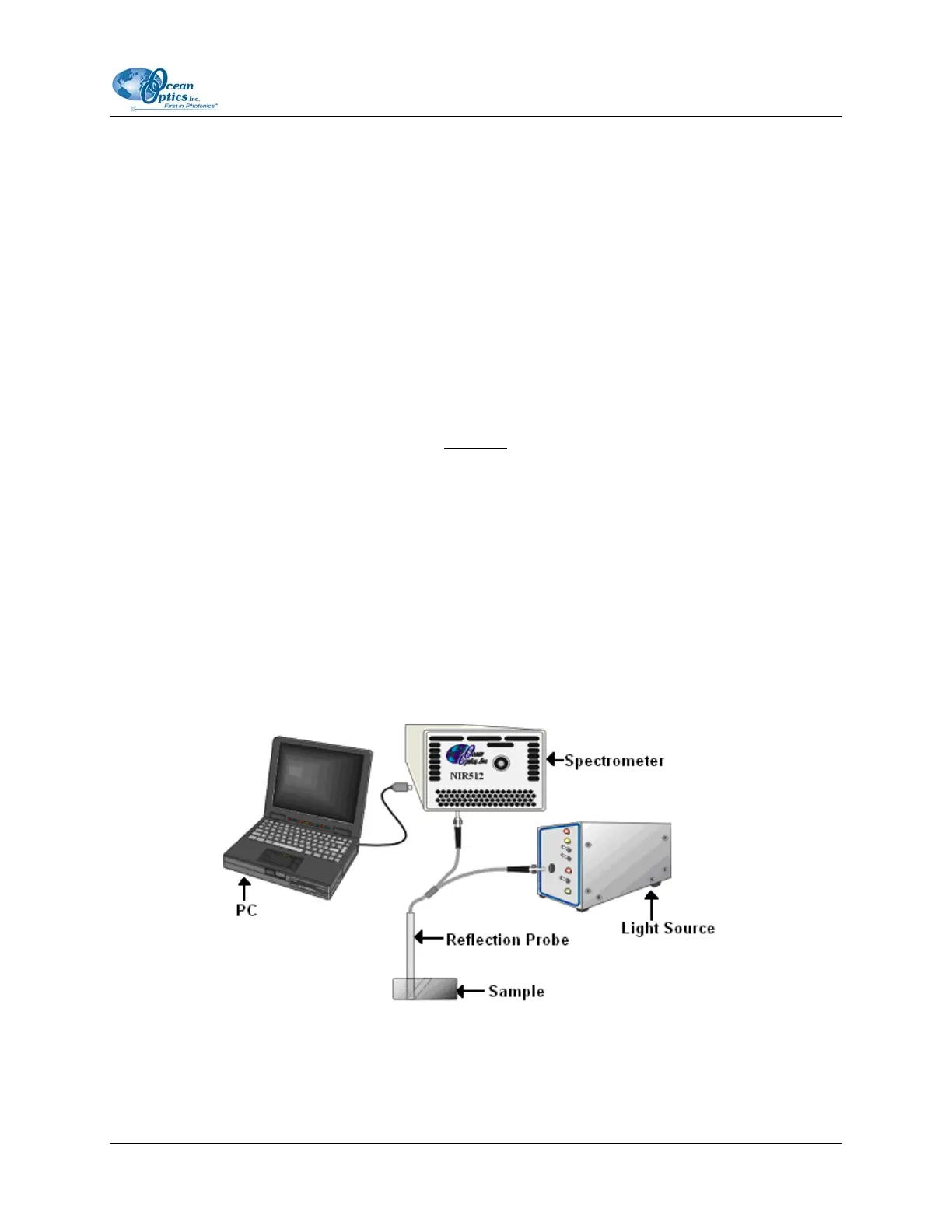
The following figure shows a typical reflection setup. A light source sends light via the input leg of a
reflection probe onto a sample. A reflection probe holder holds the probe in either a 90 or 45-degree angle
from the surface. The output leg of the reflection probe carries light from the sample to the spectrometer,
which is connected to the PC.
Common applications include measuring the reflection properties of mirrors and coatings, and measuring
the visual properties of the color in paints, plastics, and food products.
197-00000-512-02-0305 23



 To Next Page