EasyManua.ls Logo

Omnicomm Optim 3.0 - User Manual

Omnicomm Optim 3.0
44 pages
Go to English
Print Icon
To Next Page IconTo Next Page
Loading...
Optim
ООО «Омникомм Технологии»
Россия, 127055 г. Москва,
ул. Бутырский вал, 68/70, стр.1
8 800 100-24-42,
+7 495 989-62-20
info@omnicomm.ru
www.omnicomm.ru
Паспорт
Passport
Made in Russia
Omnicomm
68/70 Building 1. Butyrski Val str.
127055. Moscow, Russia
+7 495 108-04-23
support@omnicomm-world.com
www.omnicomm-world.com
Терминал
Сделано в России
Terminal
3.0
Question and Answer IconNeed help?

Do you have a question about the Omnicomm Optim 3.0 and is the answer not in the manual?

Overview

The Omnicomm Optim 3.0 is an onboard equipment designed for comprehensive vehicle monitoring and data transmission. It collects information on a vehicle's status and transfers this data to the Omnicomm Online cloud service or other third-party software.

Function Description:

The primary functions of the Omnicomm Optim 3.0 include:

  • Location Tracking: Determining the vehicle's location, speed, and travel direction using GPS/GLONASS.
  • Jamming Detection: Actively detecting both GPS/GLONASS and GSM signal jamming attempts.
  • Data Acquisition: Reading and filtering measurements from fuel level sensors and a wide range of other connected equipment.
  • Remote Control: Providing remote control capabilities for connected auxiliary equipment.
  • Data Storage: Storing collected data in non-volatile memory to prevent loss.
  • Data Transmission: Transferring data to the Omnicomm Online platform or other compatible software.

Important Technical Specifications:

  • Dimensions: The device measures 101.0 x 91.0 x 31.3 mm.
  • SIM Card Support: It supports two SIM cards and has an optional SIM-chip support.
  • Ingress Protection: Rated at IP52, according to NEMA IEC 60529, indicating protection against dust and dripping water.
  • Supported Protocols: Compatible with Omnicomm and EGTS protocols.
  • Weight: Weighs 0.15 kg.
  • Average Lifetime: Designed for an average lifetime of 8 years.
  • Supply Voltage: Operates on a supply voltage range of +8 to +65 VDC, with protection against reverse voltage.
  • Inbuilt Backup Battery: Features a 1400 mA/h Li-pol backup battery. This battery requires replacement at least once every 3 years, and its warranty term is 1 year.
  • Power Consumption: Average power consumption is 2.0 W, with a maximum of 6.0 W (during inbuilt backup battery "cold" start).
  • Data Collection Period: Data collection intervals can be set from 1 to 240 seconds.
  • Archive Volume: Capable of storing up to 150,000 records.
  • Real-time Clock: Includes an available real-time clock.
  • Accelerometer: Equipped with a three-axis accelerometer, with a measurement limit of ±8 g.
  • Temperature Sensor: An available temperature sensor provides measurement accuracy of ±1 °C.
  • Jamming Detection: Features GPS/GLONASS and GSM jamming detection.
  • GSM/GPRS: Operates on frequency ranges of 850/900/1800/1900 MHz.
  • Interfaces:
    • RS-485 (№1 and №2): Two independent RS-485 interfaces with transmission rates from 2400 to 115200 bit/sec, capable of working with different protocols.
    • RS-232: One RS-232 interface.
    • USB: USB 2.0.
    • CAN: Supports J1939 and FMS protocols.
    • Line Output: Mini Jack Ø2.5 mm.
    • 1-Wire: Available.
  • Inputs:
    • Ignition Key: Potential voltage triggering from 8 V, connected from the ignition key.
    • Panic Button: Becomes activated if grounded to VH, with a pull-up resistor.
    • GSM Call Button: Becomes activated if grounded to VH, with a pull-up resistor.
    • Engine Speed (RPM): Input frequency from 10 Hz to 1 kHz, signal amplitude at least 5 V, providing a frequency-modulated signal.
    • Universal Inputs (4): These inputs do not have a particular designation. They can connect analogue, pulse, frequency, and potential signals. The signal type is selected in the software.
      • Analogue Signal: Input voltage range from 0 to 30 V, measurement resolution of 12 bit, basic percentage error limits of ±1%, and measurement rates of 1 sec.
      • Pulse and Frequency Signals: Pulse frequency from 10 Hz to 1 kHz, pulse duration at least 1 msec, signal amplitude at least 5 V.
      • Potential Signal: Voltage threshold to recognize activation from 1 to 30 V, time when the voltage is over the threshold is 100 msec. The status is transmitted during data collection.
  • Discrete Outputs (2): Switching current maximum 300 mA, "Open collector" type.
  • Global Positioning System: Utilizes GLONASS and GPS jointly, with 32 channels.
  • Maximum Instrumental Error in Measurements:
    • Coordinates in the plan: 3 m
    • Altitude: 5 m
    • Speed: 0.05 m/sec
  • Start-up Time:
    • "Cold" start: 35 sec max (with 130 dBm signal level).
    • "Hot" start: 4 sec max (with 130 dBm signal level).
  • Antenna Type: External, SMA connector.
  • Precious and Non-ferrous Metals: Contains gold (less than 0.0001 g), copper (less than 30 g), nickel (less than 0.001 g), and brass (less than 30 g).

Usage Features:

  • Operating Conditions: The terminal is designed for operation in enclosed, explosion-safe premises free from aggressive vapors and gases. It can withstand ambient temperatures from -40 to +85 °C, relative humidity no higher than 80% at 35 °C (without moisture condensation at lower temperatures), and atmospheric pressure from 84 to 106.7 kPa.
  • Installation:
    • The Omnicomm Optim terminal should be installed inside the vehicle's cab or in specially fitted electrical equipment boxes, protected from atmospheric precipitation.
    • It must be installed on an even surface.
    • The GLONASS/GPS antenna is recommended for installation on the vehicle's roof, preferably on a metal surface. It can also be attached to a non-metal surface using glue. If installed inside the vehicle, it must be on a horizontal surface with adequate satellite signal coverage, and signal reception quality should be verified.
    • The GSM antenna is best installed on the vehicle's windshield or the internal side of the plastic front panel.
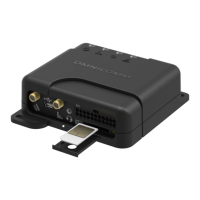
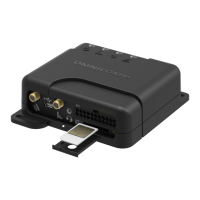
  • SIM Card Insertion: Before inserting SIM cards, disable the PIN-code request. For SIM card No. 1, press the button on the side of the connectors to eject the SIM card tray, place the SIM card with contacts facing up, and reinsert the tray. For SIM card No. 2 and micro SD card, open the terminal's case, insert the cards into the appropriate slots, and then close the case.
  • Wiring: Detailed wiring diagrams are provided for connecting to the supply circuit, ignition key, tachometer, panic button, GSM call button, voice communication equipment (requiring TRS 2.5 mm connector unsoldering), RS-232, RS-485, universal inputs (for analogue, current, and contact sensors), and LLS fuel level sensors.
  • Configuration: The terminal is configured using the Omnicomm Configurator Software (latest version).
  • Sealing: Sealing procedures should be performed according to the user manual.

Maintenance Features:

  • Warranty: OMNICOMM provides a limited warranty of 36 months from the date of original purchase, covering defects in materials and workmanship under normal use. The warranty is valid for the original purchaser from OMNICOMM or its authorized distributors.
    • Warranty services are obtained through the OMNICOMM office or authorized distributors. If the original distributor is unavailable, contact OMNICOMM Global Support Center.
    • To request warranty service, the product, proof of purchase, serial number, and a warranty reclamation report must be provided. OMNICOMM reserves the right to deny free warranty services if documents are not presented, incomplete, or illegible.
    • Warranty service may involve repair or exchange of the defective product.
    • OMNICOMM covers one-way freight for warranty replacements; shipping of non-warranty sensors back to the client is at the customer's expense.
    • Warranty services will be added to the warranty term for the time spent on reclamation.
    • The warranty does not cover components requiring periodic replacement (batteries, cables), or issues arising from improper installation, usage, maintenance, fires, accidents, liquids, chemicals, floods, excessive heat, electrical overloads, incorrect voltage, radiation, electrostatic discharges, lightning, or other external forces.
    • OMNICOMM does not warrant peripheral devices not confirmed by OMNICOMM.
    • OMNICOMM's liability is limited to the purchase price paid for the product.
  • Transportation and Storage:
    • The device should be transported in its original packaging at temperatures from -25 to +70 °C and relative humidity not exceeding 50% (at 35 °C).
    • All types of enclosed transport are permitted. For air transport, the device must be kept in a heated and sealed compartment.
    • The device's shelf life is 5 years from the date of manufacture.
    • Storage conditions for the terminal in transport packaging at the consumer's warehouse must comply with GOST 15150 conditions 1. Storage under GOST 15150 conditions 2 is allowed for no more than 6 months. The storage area must be free of aggressive vapors and gases.
  • Declaration of Conformity: The Omnicomm Optim Terminal complies with EN301 489-1 V1.9.2(2011-09) and EN301 489-7 V1.3.1(2005-11). The declaration can be consulted on the Omnicomm website.

Omnicomm Optim 3.0 Specifications

General IconGeneral
BrandOmnicomm
ModelOptim 3.0
CategoryTouch terminals
LanguageEnglish

Related product manuals