OPTIMUM
MASCHINEN - GERMANY
Version 1.0.1 dated 2018-01-31Page 44 Translation of the original instructions
TM4010 | TM4010DGB
TM4010_TM4010D_GB_4.fm
4.13.7 Mounting workpiece holder
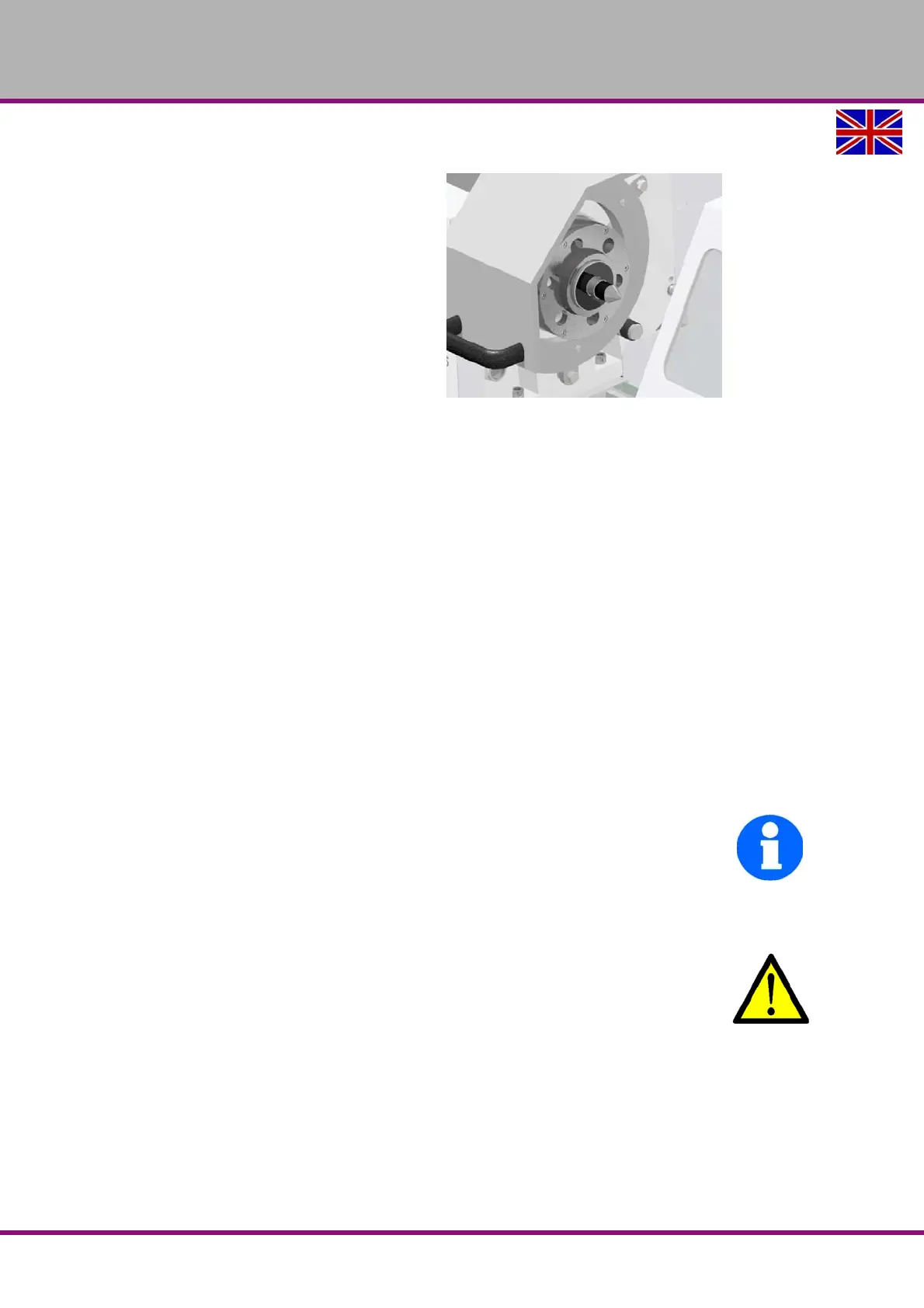
Centering point
Clean the taper bore of the lathe spindle holding
fixture.
Clean the reducing bush and the taper of the cen-
tring point.
Press the centring point with the reducing bush
into the taper bore of the lathe spindle holding fix-
ture.
Img.4-8: Centring point with reducing bush
4.14 Tailstock
The tailstock quill is used to hold the tools (bits, centres, etc.)
Clamp the required tool into the quill of the tailstock.
Use the scale on the sleeve to re-adjust and / or adjust the tool.
Clamp the quill with the clamping lever.
Use the hand wheel to move the sleeve back and forth.
The quill of the tailstock is useable with a drill chuck with countersinking tools.
4.14.1 Cross-adjustment of the tailstock
The cross-adjustment of the tailstock is used for turning long, thin bodies.
Loosen the adjusting screws in the front and in the rear of the tailstock.
By alternately loosening and tightening the two (front and rear) adjusting screws, the tail-
stock is moved out of the central position. The desired cross-adjustment can be read off the
scale.
Re-tighten both adjusting screws of the tailstock.
INFORMATION
The tailstock may be cross-adjusted to each direction by approximately + - 10 mm.
Example:
A 300 mm long shaft is to be taper-turned between the centres with an angle of 1°.
Cross-adjustment of the tailstock = 300 mm x Tan 1°. The tailstock must be cross-adjusted by
approximately 5.236 mm.
CAUTION!
Check clamping of the tailstock and the sleeve, respectively for the turning jobs between
the centres! Tighten the securing screw at the end of the lathe bed in order to prevent
the tailstock from unintentional drawing-out of the lathe bed.



 To Next Page