29
OrionWelders.com
ch.4
temperature (especially at the interface between the two pieces) can become hot enough to melt
the metal in a spot. e terms resistance welder and spot welder are descriptive of this process.
If you limit the amount of energy and electrical current going into the weld you can create a
temporary or weak weld called a “tack” weld. It provides the ability to temporarily position a part
before permanent welding. is ability opens a multitude of creative possibilities. It also helps
eliminate the need for complicated binding or clamping of parts before permanent welding or
soldering.
Because the heart of the Orion is an industrial capacitive resistance welder, everything from one
time custom pieces to production welding is possible.
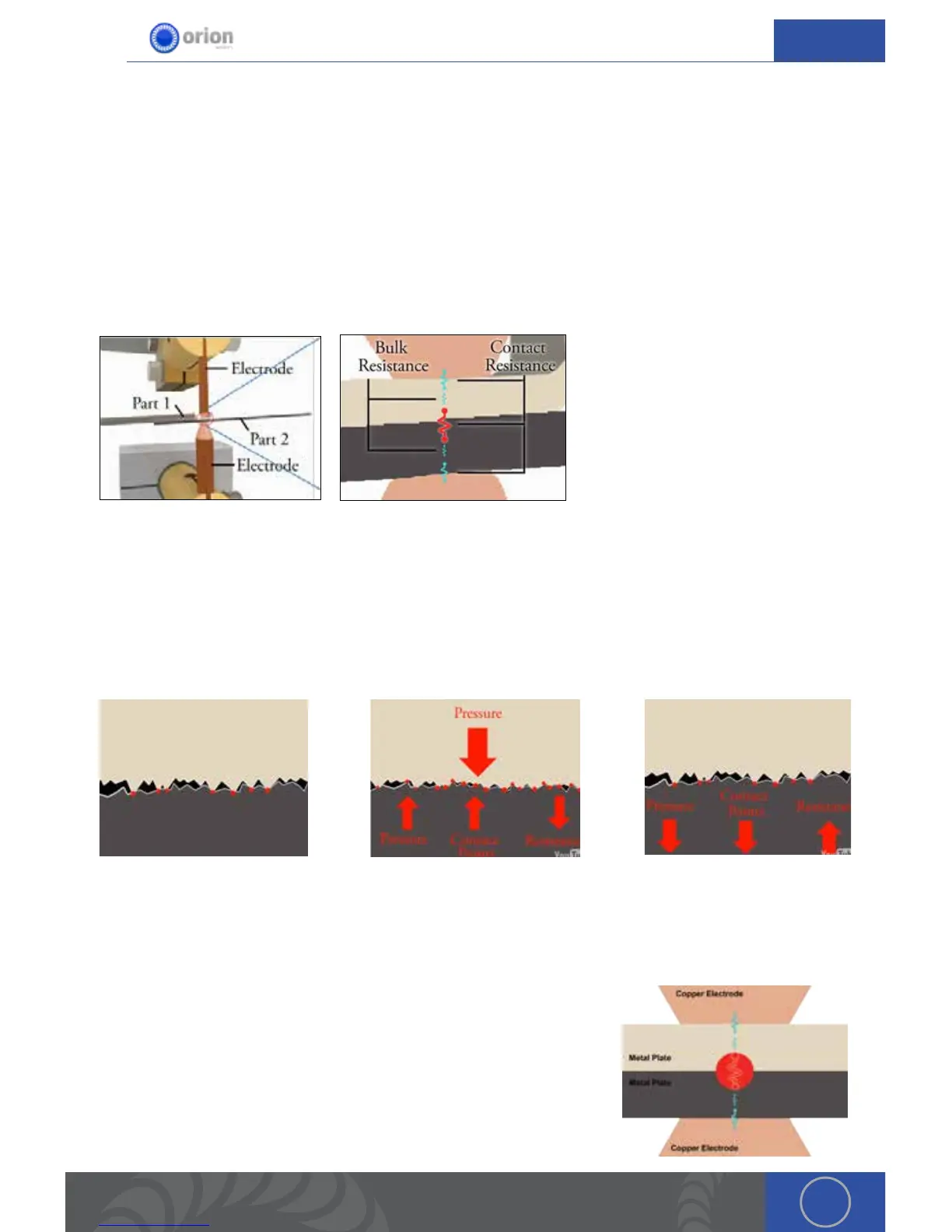
Left: A typical (industrial) welding
configuration. Right: A close-up
zoom of the weld showing the
electrical resistances that are
used to create the weld spot.
As shown in the figure above, a typical weld configuration requires a positive and negative
electrode with pressure applied to the work piece parts. As we zoom in on a cross sectional
view of the work piece parts, we can identify the electrical resistance locations where heat is
generated. For fine spot, or small scale resistance welding, most of the heat is generated at the
contact point between the two work pieces. is has been identified on the figure as the largest
resistance point. During the weld a large pulse of electrical current is dumped quickly through the
work piece causing rapid heating and melting at the electrode location.
Left: On the micro scale all surfaces have a degree of surface roughness. is roughness causes
the work pieces to only contact in a limited number of locations. Middle: Applying more pressure
will cause more surface contact, less resistance and less resistive heating. Right: Applying less
pressure will cause less surface contact, more resistance for better resistive heating.
A resistance welder uses the resistance to the flow of electricity
to heat and melt the part via a large electrical current. is contact
point is where the highest heat is generated. Light pressure
between the parts means less contact between the two surfaces,
more resistance, and hence more heating and melting. Heavy
pressure between the parts translates to more contact between
the two surfaces, less resistance, and less heating.



 To Next Page