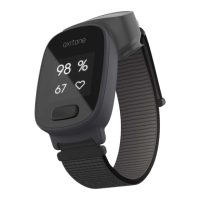
Oxitone 1000M
User Manual Rev. 1.
Page 33 of 39
2
Oxitone 1000M has been validated to pulse rate accuracy for the range of 30-250 bpm in bench top
testing against a Fluke ProSim 8 simulator. This variation equals plus or minus one standard
deviation which encompasses 68% of the population.
11.1.1 MANUFACTURER'S DECLARATION (EMC)
Caution: The Oxitone 1000M has been tested and found to comply with the limits per IEC
60601-1-2:2014 Standard and 93/42/EEC directive. These limits are designed to provide
practical protection against harmful interference in a medical device installation.
Refer to the following tables (table 1 2 3 and 4 below) for specific information regarding this
device compliance.
Federal Communication Commission (FCC) Notice (USA)
Warning: Changes or modifications to the device not expressly approved by Murata Electronics N.A.
could void the user's authority to operate the equipment.
This device complies with Part 15 of the FCC rules. Operation is subject to the following two
conditions: (1) this device may not cause harmful interference, and (2) this device must accept any
interference received, including interference that may cause undesired operation.
The FCC requires the OEM to be notified that any changes or modifications not expressly approved
by Murata may void the user's authority to operate the equipment. While an applicator of the
MBN52832 module in a product is not required to obtain a new FCC authorization for the module,
this does not preclude the possibility that some other form of authorization or testing may be
required for that end product.
The device using the integrated antenna has been tested to comply with FCC CFR Part 15. The device
meets the requirements for modular transmitter approval as detailed in the FCC public notice
DA00.1407.
This requirement has been tested and found to comply with the limits for a Class B digital device,
pursuant to Part 15 of the FCC Rules. These limits are designed to provide reasonable protection
against harmful interference in a residential installation. This equipment generates uses and can
radiate radio frequency energy and, if not installed and used in accordance with the instructions, may
cause harmful interference to radio communications. However, there is no guarantee that
interference will not occur in a particular installation. If this equipment does not cause harmful
interference to radio or television reception, which can be determined by turning the equipment off
and on, the user is encouraged to try to correct the interference by one or more of the following
measures:
• Reorient or relocate the receiving antenna.
• Increase the separation between the equipment and receiver.
• Connect the equipment into an outlet on a circuit different from that to which the receiver
Is connected.
• Consult the dealer or an experienced radio/TV technician for help.


 To Next Page