3.
THEORY OF OPERATION
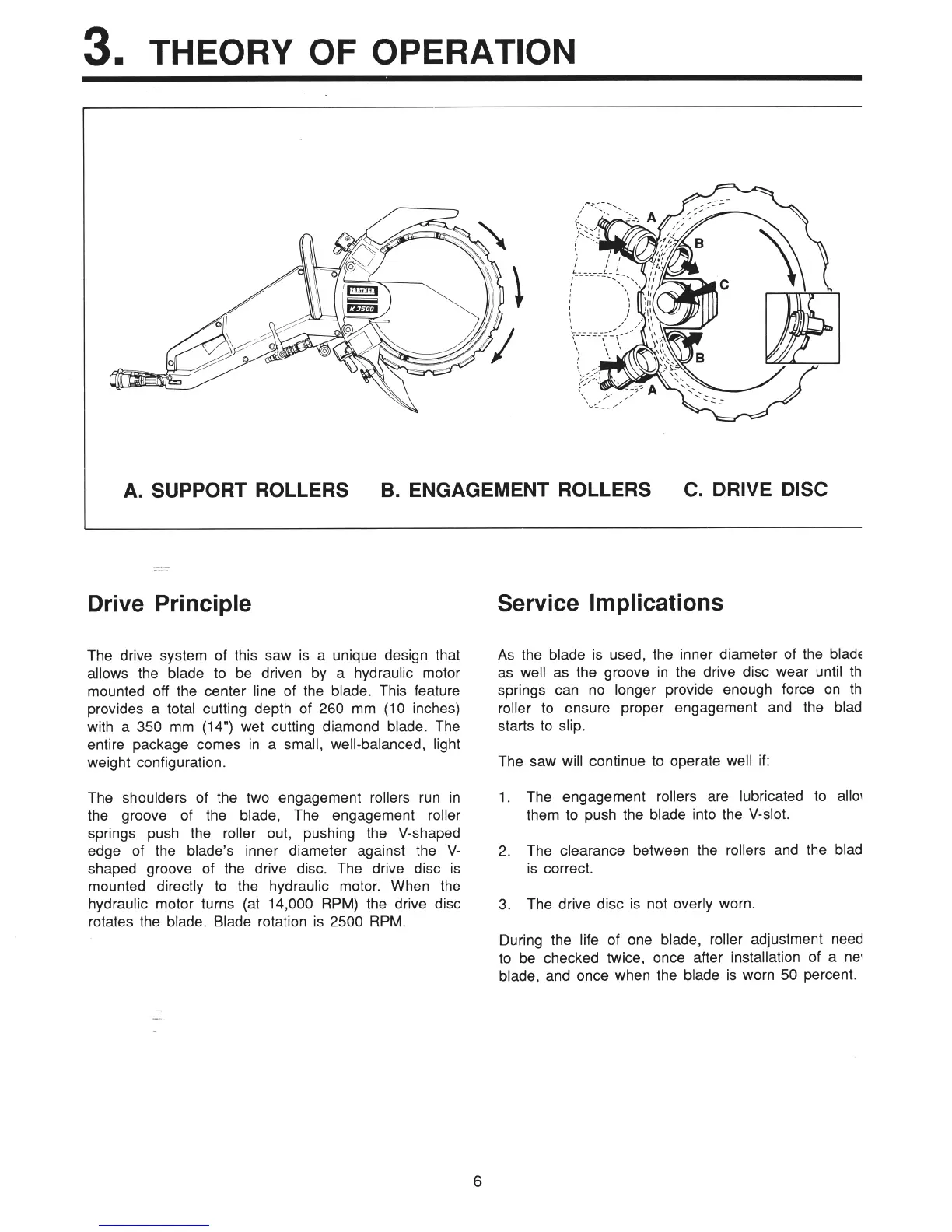
A. SUPPORT ROLLERS
B. ENGAGEMENT ROLLERS
C. DRIVE DISC
Drive Principle
Service Implications
The drive system of this saw is a unique design that
allows the blade to be driven by a hydraulic motor
mounted off the center line of the blade. This feature
provides a total cutting depth of 260 mm (10 inches)
with a 350 mm (14”) wet cutting diamond blade. The
entire package comes in a small, well-balanced, light
weight configuration.
The shoulders of the two engagement rollers run in
the groove of the blade, The engagement roller
springs push the roller out, pushing the V-shaped
edge of the blade’s inner diameter against the V-
shaped groove of the drive disc. The drive disc is
mounted directly to the hydraulic motor. When the
hydraulic motor turns (at 14,000 RPM) the drive disc
rotates the blade. Blade rotation is 2500 RPM.
As the blade is used, the inner diameter of the blade,
as well as the groove in the drive disc wear until the
springs can no longer provide enough force on the
roller to ensure proper engagement and the blade
starts to slip.
The saw will continue to operate well if:
1. The engagement rollers are lubricated to allow
them to push the blade into the V-slot.
2. The clearance between the rollers and the blade
is correct.
3. The drive disc is not overly worn.
During the life of one blade, roller adjustment needs
to be checked twice, once after installation of a new
blade, and once when the blade is worn 50 percent.
-.
6



 To Next Page