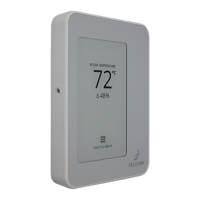
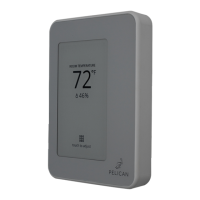
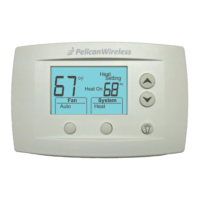
To increase energy efficiency in relation to ventilation
needs based on actual occupancy, Pelican zone
thermostats with in-room CO2 sensors can be use for
demand ventilation sequences.
The following conditions must be true for a demand
ventilation cycle to start:
◦ Reliable Communication: The thermostat must
be able to communicate with the zone
coordinator.
◦ Available Cycle: The zone coordinator must have
control over the outside damper on the HVAC
equipment (refer to the zone coordinator
installation manual for details).
◦ Ventilation Allowance: Demand ventilation must
be enabled in the thermostat’s configurations,
and the thermostat should not be sending a "do
not ventilate" message. This feature is generally
applied during unoccupied hours or emergency
situations (e.g., Shelter-in-Place) when ventilation
is not required.
◦ CO2 Reading: The zone thermostat must have a
CO2 sensor with a reading above the configured
CO2 threshold for ventilation.
When these preconditions are met, the zone thermostat
sends a Demand Ventilation request to the zone
coordinator, including the current CO2 level in the zone.
The zone coordinator then initiates its Demand
Ventilation sequence to determine how much additional
outside air needs to be mixed into the supply air stream
(refer to the zone coordinator installation manual for
specific calculations and configurations).
If the CO2 levels fall below the configured threshold and
all other ventilation preconditions are still met, the zone
coordinator will adjust ventilation to maintain the
Minimum Damper Position setting.
The pre-occupancy ventilation cycle enables zone
thermostats to request outside air to purge indoor
contaminants before the building becomes occupied.
This cycle follows the same sequence as the standard
Ventilation/Fan Only cycles detailed in previous zone
damper sequences.
To ensure effective pre-occupancy ventilation, zone
thermostats should be scheduled to initiate a
Ventilation/Fan Only cycle at least 1–2 hours before the
regular occupancy period begins.
Pre-Occupancy Ventilation
The Fan Purge Cycle keeps zone thermostat dampers
open after a heating or cooling cycle to release any
residual energy from the air handler or reheat system
into the room. This process enhances the overall energy
efficiency of the mechanical system.
Fan Purge Cycle
Zone thermostats equipped with in-room Relative
Humidity (RH) sensors can be configured to request
dehumidification cycles from their zone coordinator.
When a humidity sensor is used to control
dehumidification, each thermostat has a humidity set
point. If the thermostat detects that the room humidity
exceeds this set point, it sends a Dehumidification
Request to the zone coordinator.
In response, the zone coordinator enters
dehumidification mode, which may involve:
◦ Activating compressors to lower the humidity in
the supply air.
◦ Modulating a reheat source to temper the supply
air as it returns to the zones.
◦ Enabling a hot gas bypass or other
dehumidification methods.
The dehumidification cycle continues until all
thermostats' RH readings fall to or below their set
points, there is no longer an active demand for
dehumidification, or a different cycle that overrides
dehumidification begins.
Refer to the zone coordinator installation manual for
specific calculations and configurations.
Dehumidification
"Waiting" is a normal status for a Pelican zone
thermostat. Thermostats enter the Waiting status when
a cycle they do not currently need is active. or Capacity
Management is in affect. The Waiting status can
indicate:
◦ The zone has demand for a different cycle and is
waiting for the zone coordinator to switch to that
cycle.
◦ The zone has demand and is awaiting
confirmation from the zone coordinator that its
requested cycle can begin.
◦ In rare cases, a zone may remain in Waiting due
to communication issues, such as being unable to
send or receive messages with the zone
coordinator.
Waiting...
Demand Ventilation
Sequence of Operations
45



 To Next Page
 Loading...