SEBU8337 51
Maintenance Section
Refill Capacities
Three new engin
e tests were developed for the API
CH-4 oil. The firsttestspecifically evaluates deposits
on pistons for engines with the two-piece steel piston.
This test (pis
ton deposit) also measures the control
of oil consumption. A second test is conducted
with moderate oil soot. The second test measures
the followin
g criteria: wear of piston rings, wear of
cylinder liners, and resistance to corrosion. A third
new test measures the following characteristics with
high levels
of soot in the oil: wear of the valve train,
resistance of the oil in plugging the oil filter, and
control of sludge.
In addition to the new tests, API CH-4 oils have
tougher limits for viscosity control in applications that
generate hi
gh soot. The oils also have improved
oxidation resistance. API CH-4 oils must pass an
additional test (piston deposit) for engines that use
aluminum p
istons (single piece). Oil performance is
also established for engines that operate in areas
with high sulfur diesel fuel.
All of these improvements allow the API CH-4
oil to achieve optimum oil change intervals. API
CH-4 oils
are recommended for use in extended oil
change intervals. API CH-4 oils are recommended
for conditions that demand a premium oil. Your
Perkins d
ealer or your Perkins distributor has specific
guidelines for optimizing oil change intervals.
Some comm
ercial oils that meet the API
classifications may require reduced oil change
intervals. To determine the oil change interval, closely
monitor
the condition of the oil and perform a wear
metal analysis.
NOTICE
Failure
to follow these oil recommendations can cause
shortened engine service life due to deposits and/or
excessive wear.
Total Ba
se Number (TBN) and Fuel S ulfur
Levels for Direct Injection (DI) Diesel
Engines
The Total Base Number (TBN) for an oil depends on
the fuel sulfur level. For direct injection engines that
use dis
tillate fuel, the minimum TBN of the new oil
must be 10 times the fuel sulfur level. The TBN is
defined by “ASTM D2896”. The minimum TBN of the
oil is
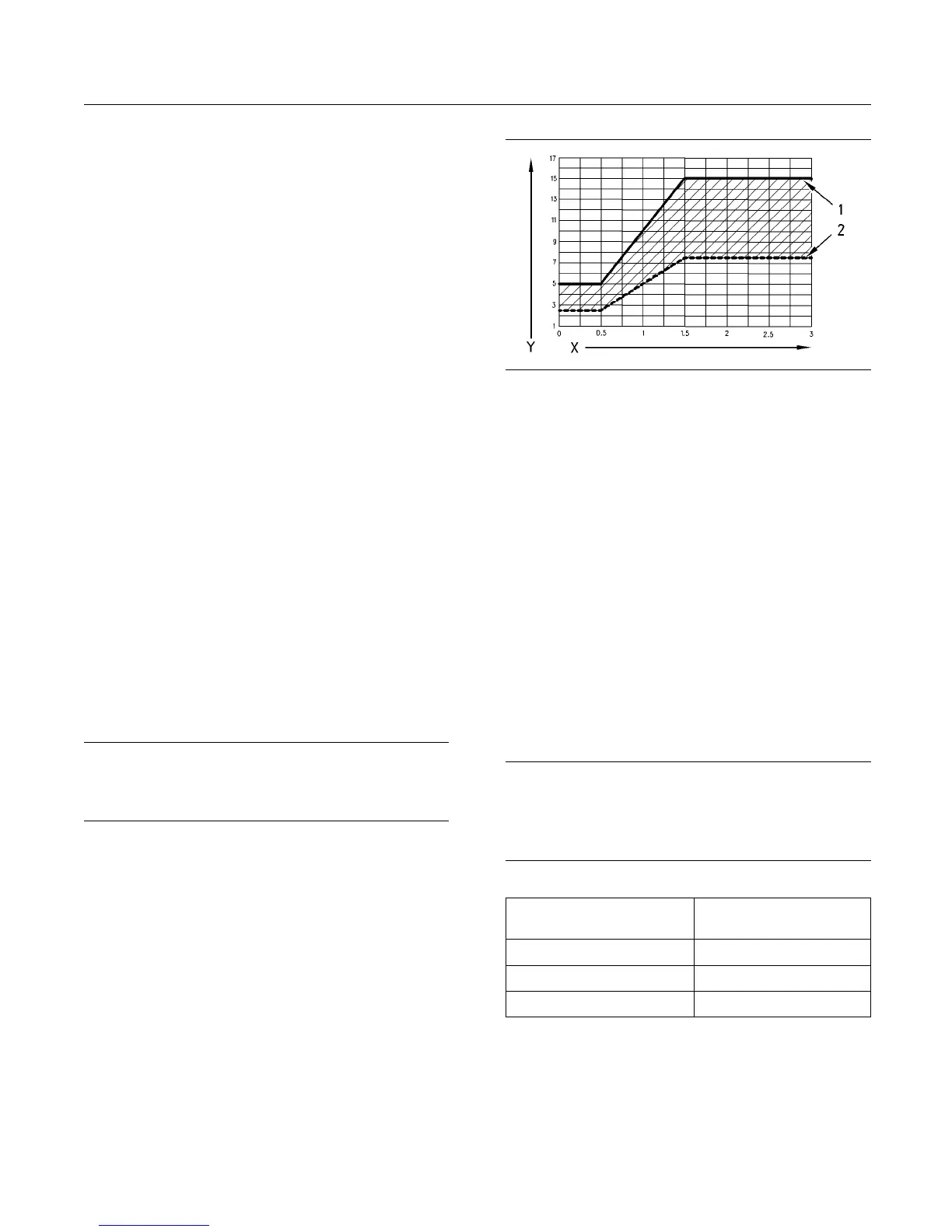
5 regardless of fuel sulfur level. Illustration 19
demonstrates the TBN.
g00799818
Illustration 19
(Y) TBN by “ASTM D289 6”
(X) P ercentage of fuel sulfur by weight
(1) TBN of new oil
(2) Change the oil when the TBN deteriorates to 50 percent of
the original TBN.
Use the following guidelines for fuel sulfur levels that
exceed 1.5 percent:
•
Choose an oil with the highest TBN that meets one
of these classifications: EMA DHD-1 and API CH-4.
•
Reduce the oil change interval. Base the oil
change interval on the oil analysis. Ensure that the
oil analysis includes the condition of the oil and a
wear metal analysis.
Excessive piston deposits can be produced by an oil
withahighTBN.Thesedepositscanleadtoaloss
of control of the oil consumption and to the polishing
of the cylinder bore.
NOTICE
Operating Direct Injection (DI) diesel engines with fuel
sulphur levels over 0.5 percent will require shortened
oil change intervals in order to help maintain adequate
wear protection.
Table 18
Percentage of Sulfur in
the fuel
Oil change interval
Lower than 0.5 Normal
0.5 to 1.0 0.75 of normal
Greater than 1.0 0.50 of normal
Lubricant Viscosity Recommendations
for Direct Injection (DI) Diesel Engines
The correct SAE viscosity grade of oil is determined
by the minimum ambient temperature during
cold engine start-up, and the maximum ambient
temperature during engine operation.



 To Next Page