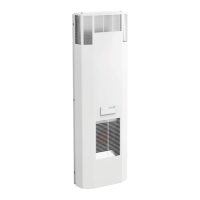
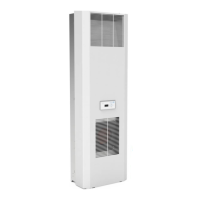
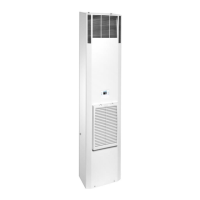
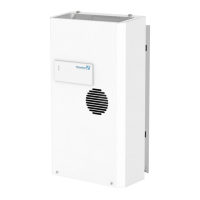
085 408 164 9
3 Scope of delivery and options
3.1 Scope of delivery
The Scope of delivery includes:
• coolingunit(withconnectionfordoorcontactswitch)
• Enclosedpackage(amongotherthingssealingprole,faste-
ningmaterial,electricalplug-typeconnectors)
• specialaccessories,ifapplicable.
3.2 Options
The following parts may be ordered separately:
– Coverwithfront-endlter;
– further options on request or in accordance with the catalogue.
4 General Information
• OlddevicescanbeproperlydisposedofbyPfannenberg.They
must be sent to one of our works shipment/postage paid.
• AllcoolingunitsproducedbyPfannenberg are free from
– siliconecompounds,
– PCB,
– PCT,
– asbestos,
– formaldehyde,
– cadmium,
– substances impairing wetting.
• Everycoolingunitis checked to ensure that it is tight accor-
ding totheprovisionsofUVV-BGV
D4(Germanregulationscovering accidentprevention).
• Priortodeliverytheelectricalsafetyofeverycoolingunitis
factory tested. This means that,
inaccordancewithUVV-BGVA2,§5(4),theoperatingcompanyis
released from the obligation to arrange for a test of the electrical
part of the cooling unit before initial start of operation.
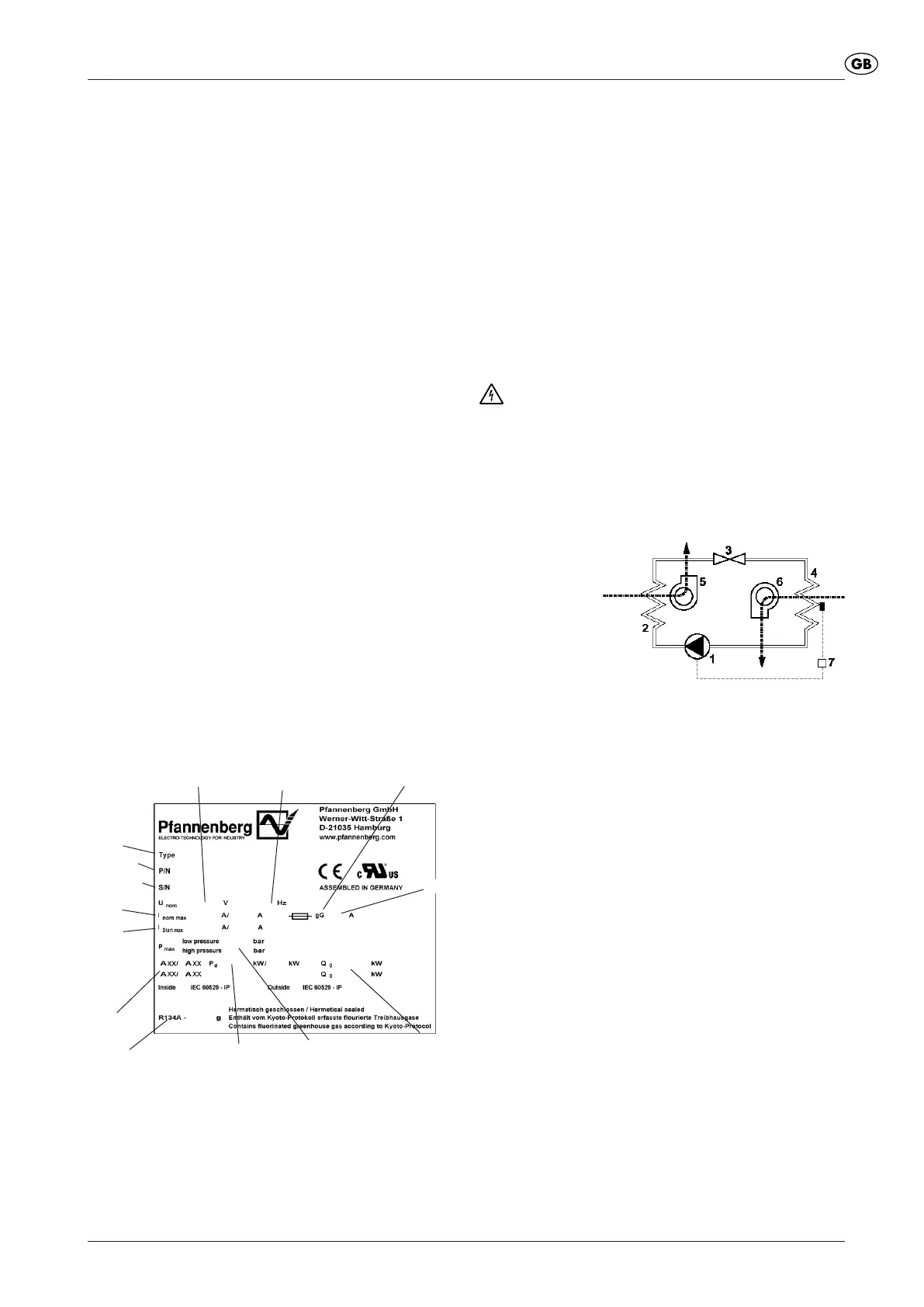
5 ID Plate and Technical Data
For installation and maintenance, note the data on the ID plate; it is
to be found on the back of the cooling unit casing
The technical details applicable to the cooling unit are in the sup-
plement.
6 Safety
Cooling units produced by Pfannenberg are designed for dissipa-
tingheatfromswitchcabinets(IP54).Duringeachcoolingprocess
condensate can be produced. The cooling unit is only suitable for
stationary operation.
The cooling unit may only be used under the ambient conditions
speciedontheenclosedsheet.
Thecoolingunitistoalargemeasuremaintenance-free(seeSec-
tion11).
Every other use is considered as non-authorized use making any
warranty null and void.
The electrical equipment must be regularly checked. Any faults
such as loose connections or scorched cables must be removed
immediately.
Work on the cooling system and on electrical components may only
be carried out by authorized specialist personnel.
Compliance with applicable safety and environmental regulations
is mandatory.
Hazard!
Isolate the cooling unit from the mains before carrying out
any cleaning or maintenance operations.
Only original spare parts may be used.
7 Function
7.1 Principles of function
1 Compressor
2 Heat exchanger
(condenser)
3 Expansion valve
4 Heat exchanger
(evaporator)
5 fan, exterior circulation
6 fan, inner circulation
7 Electronic control system with temperature sensor
Thecompressor(1)compressestherefrigerantuntilhighpressure
is achieved. During this process temperature increases. In the con-
denser(2)heatisdissipatedtoambientair,thecoolantbecoming
liquid.Thecondenserfan(5)ofthecondensatortakesambientair
in through the condenser, then it releases the air.
Intheexpansionvalve(3)thepressureofthecoolantdrops.Inthe
evaporator(4)thecoolantabsorbsheatfromtheairintheswitch
cabinet and evaporates. Thus, the air in the switch cabinet cools
down. At the same time the air inside the switch cabinet is being
dehumidied.Theevaporatorfan(6)suckstheairoutoftheswitch
cabinetviatheevaporator,thecooledairowsbacktotheswitch
cabinet.
The cooling unit is electronically controlled. For that purpose a
temperature sensor records the temperature of the air inside the
switchcabinet(7).
The refrigerant is not detrimental to the ozonosphere; it is hardly
combustible.
7.2 Condensate
During cooling on the evaporator the moisture removed from the air is
collected as condensate. In order to avoid any damage to the switch
cabinet and the cooling unit, the condensate must be discharged.
The condensate is discharged in the following way:
• Incaseofnormalcondensatedrainageareservoircollectsthe
condensate which is then drained by means of a hose.
Always ensure that the condensate is drained properly (safety-
drainage).
Excessive condensation can occur if, for example, the switch cabinet
is not sealed or if the internal temperature of the switch cabinet is
frequently below the dew point.
unit type
refrigerant
nominal voltage
pressure of
refrigerant
frequency
serial number
type of fuse
electrical
energy
exterior/interior
conditions
cooling
capacity
starting
current
nominal current
part number
fuse


 To Next Page
 Loading...