EasyManua.ls Logo

Pioneer SA-708 - Power Amplifier Circuit; Indicator & Protection Circuits

Pioneer SA-708
21 pages
Print Icon
To Next Page IconTo Next Page
To Previous Page IconTo Previous Page
Loading...
4.3
POWER
AMPLIFIER
The
first
stage
is
a
differential
amplifier
formed
by
twin
transistor,
while
the
load
circuit
forms
a
current
mirror
circuit.
The
current
mirror
serves
to
make
this
stage
operate
in
push-pull
mode,
thereby
eliminating
the
even
numbered
harmonics,
and
doubling
the
gain.
The
pre-driver
stage
is
a
Darlington
connection,
while
the
load
circuit
forms
a
constant-current
source,
thereby
obtaining
a
high
voltage
gain.
The
power
stage
is
a
Darlington
connection
pure-complementary
SEPP
circuit,
employing
an
high
speed
transistor.
The
high
speed
transistor
is
a
kind
of
IC
consisting
of
a
number
of
small
transistor
being
connected
in
parallel
via
an
emitter
resistor.
This
provides
excellent
high
frequency
characteristics
comparable
to
those
of
a
small-signal
transistor.
Furthermore,
because
there
is
no
time
constant
in
the
NFB
circuit
in
the
low-frequency
region,
amplification
is
possible
down
to
DC
(DC
inputs
will
be
cut
off,
however,
by
the
input
coupling
capacitor
of
the
power
amplifier.).
The
circuit
features
described
above
provide
an
extremely
wide
power
frequency
range
(65W
+
65W,
20Hz
to
20kHz,
THD
0.02%,
82).
4.4
INDICATOR
CIRCUIT
The
SA-708
output
power
and
function
indi-
cators
feature
fluorescent
indicator
tube
(FL
tube).
In
this
tube,
thermionic
emissions
from
the
cath-
ode
are
accelerated
into
the
fluorescent
substance
of
the
segmental
anodes,
resulting
in
the
emission
of
light.
This
tube
is
used
to
indicate
numerals,
letters,
and
other
symbols.
IC
(TA7T3IBP)
172
COMPRESSOR
HOLD
&
H
DETECTOR
SIGNAL
INO
(6)
(40
dB)
DC
AMP
SA-708
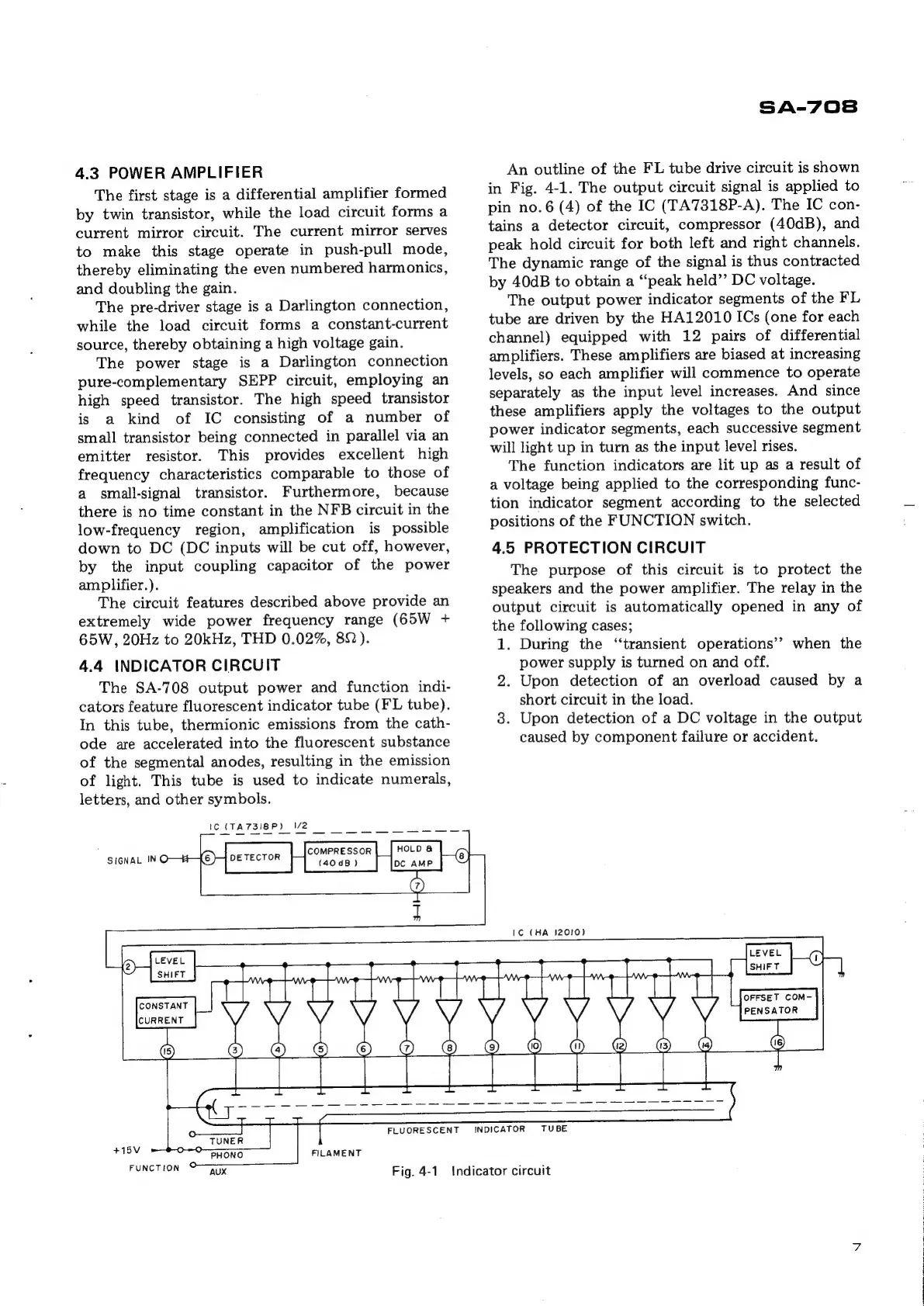
An
outline
of
the
FL
tube
drive
circuit
is
shown
in
Fig.
4-1.
The
output
circuit
signal
is
applied
to
pin
no.
6
(4)
of
the
IC
(TA7318P-A).
The
IC
con-
tains
a
detector
circuit,
compressor
(40dB),
and
peak
hold
circuit
for
both
left
and
right
channels.
The
dynamic
range
of
the
signal
is
thus
contracted
by
40dB
to
obtain
a
“‘peak
held’’
DC
voltage.
The
output
power
indicator
segments
of
the
FL
tube
are
driven
by
the
HA12010
ICs
(one
for
each
channel)
equipped
with
12
pairs
of
differential
amplifiers.
These
amplifiers
are
biased
at
increasing
levels,
so
each
amplifier
will
commence
to
operate
separately
as
the
input
level
increases.
And
since
these
amplifiers
apply
the
voltages
to
the
output
power
indicator
segments,
each
successive
segment
will
light
up
in
turn
as
the
input
level
rises.
The
function
indicators
are
lit
up
as
a
result
of
a
voltage
being
applied
to
the
corresponding
func-
tion
indicator
segment
according
to
the
selected
positions
of
the
FUNCTION
switch.
4.5
PROTECTION
CIRCUIT
The
purpose
of
this
circuit
is
to
protect
the
speakers
and
the
power
amplifier.
The
relay
in
the
output
circuit
is
automatically
opened
in
any
of
the
following
cases;
1.
During
the
“transient
operations’?
when
the
power
supply
is
turned
on
and
off.
2.
Upon
detection
of
an
overload
caused
by
a
short
circuit
in
the
load.
8.
Upon
detection
of
a
DC
voltage
in
the
output
caused
by
component
failure
or
accident.
(HA
12010)
SHIFT
oe
Pe
eee
ee
SHIFT
CONSTANT
|
|
z
ie
aa
||
[|
a
OFFSET
COM~
CURRENT
ey
v
¥
ey
\/
\/
\/
PENSATOR
@)
(4)
ica
i
(9)
(0)
(i!)
(2)
(3)
(4)
eae
FLUORESCENT
INDICATOR
TUBE
A
TDN
OO
BHONO
FILAMENT
°
FUNCTION
AUX
Fig.
4-1
Indicator
circuit

Other manuals for Pioneer SA-708

Related product manuals