EasyManua.ls Logo

Piper SENECA III - Page 110

Piper SENECA III
408 pages
Print Icon
To Next Page IconTo Next Page
To Previous Page IconTo Previous Page
Loading...
SECTION
4
PIPER AIRCRAFT
CORPORATION
NORMAL
PROCEDURES
PA-34-220T, SENECA
IH
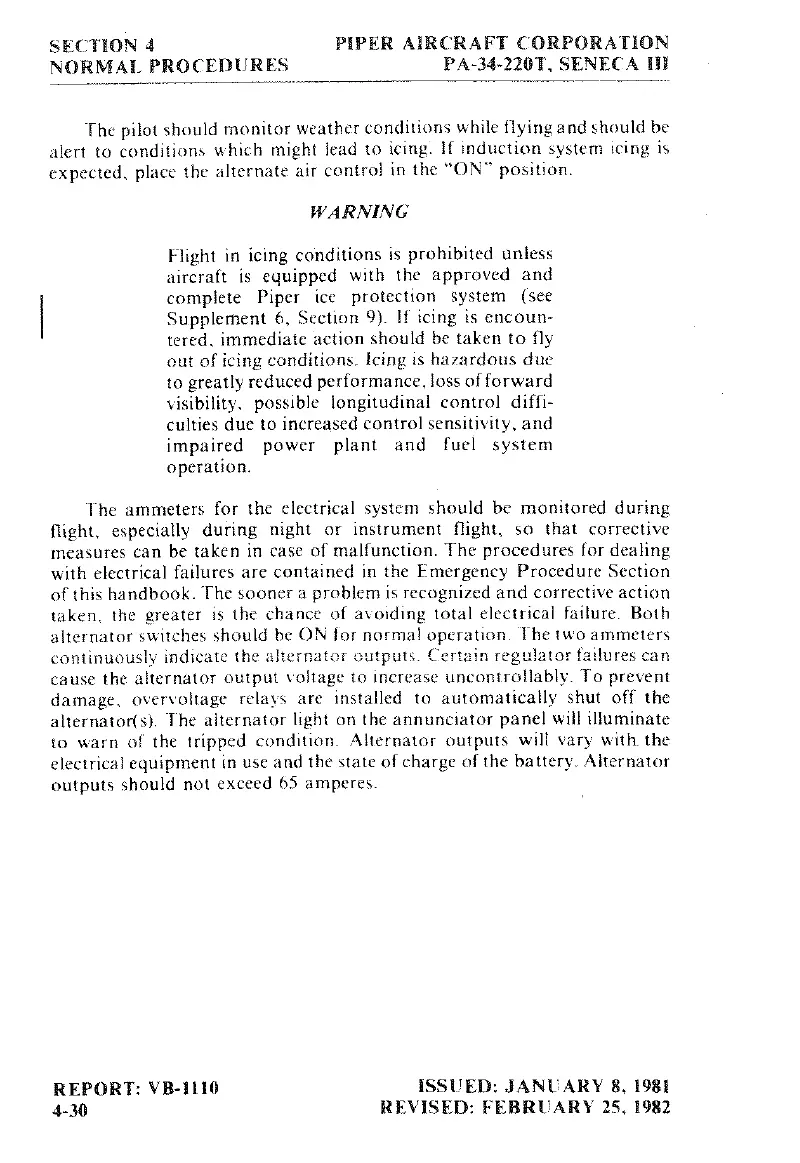
The
pilot
should
monitor weather
conditions while
flying
and
should
be
alert
to
conditions
which might
lead
to
icing. If induction
system
icing
is
expected, place
the
alternate
air
control
in
the
"ON" position.
WARNLNG
Flight
in
icing
conditions
is
prohibited
unless
aircraft
is
equipped
with the
approved and
complete
Piper ice
protection
system
(see
Supplement
6,
Section
9). If
icing is
encoun-
tered,
immediate
action
should
be taken
to
fly
out
of
icing
conditions,
icing
is hazardous due
to
greatly
reduced
performance, loss
of
forward
visibility,
possible
longitudinal
control
diffi-
culties
due
to
increased control
sensitivity,
and
impaired
power
plant and fuel
system
operation.
The
ammeters
for
the
electrical
system
should
be
monitored
during
flight,
especially
during
night
or
instrument
flight,
so
that
corrective
measures
can
be
taken
in
case
of malfunction.
The
procedures
for
dealing
with
electrical
failures
are
contained
in
the
Emergency
Procedure
Section
of
this
handbook.
The
sooner a
problem
is
recognized
and
corrective action
taken. the
greater
is
the chance
of
avoiding
total electrical
failure.
Both
alternator
switches
should
be
ON
for
normal
operation.
The
two ammeters
continuously
indicate
the alternator
outputs.
Certain
regulator
failures
can
cause
the
alternator
output
voltage
to
increase
uncontrollably.
To
prevent
damage.
overvoltage
relays
are
installed
to
automatically
shut
off
the
alternator(s).
The alternator
light
on
the annunciator
panel
will
illuminate
to
warn
of the
tripped
condition.
Alternator
outputs
will
vary
with
the
electrical
equipment
in
use
and
the
state
of
charge
of the
battery. Alternator
outputs
should
not
exceed
65
amperes.
REPORT:
VB-Ill0
ISSUED:
JANUARY
8,
1981
4-30
REVISED:
FEBRUARY
25, 1982

Table of Contents

Related product manuals