EasyManua.ls Logo

Piper SENECA III - Emergency Locator Transmitter; Piper External Power

Piper SENECA III
408 pages
Print Icon
To Next Page IconTo Next Page
To Previous Page IconTo Previous Page
Loading...
PIPER
AIRCRAFT
CORPORATION
SECTION 7
PA-34-220T,
SENECA
III
DESCRIPTION
&
OPERATION
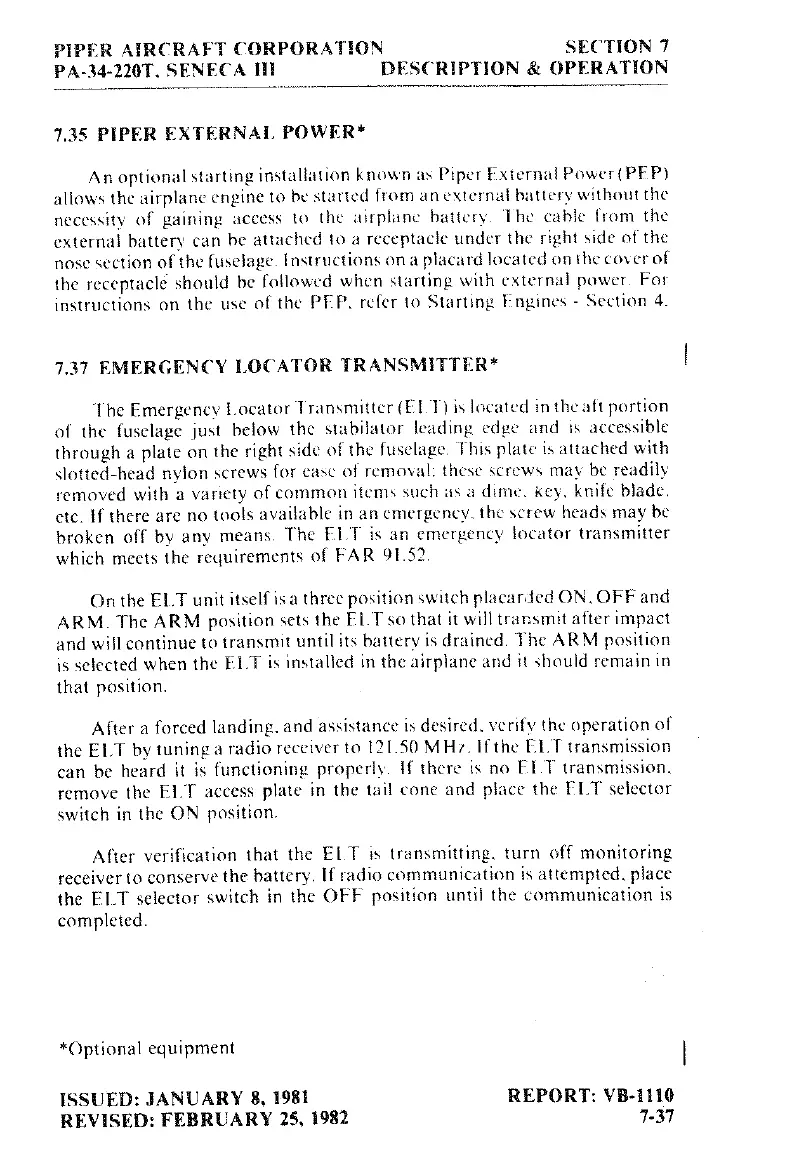
7.35
PIPER
EXTERNAf
POWER*
An
optional
starting
installinion
known
as
Piper
External
Power(PEP)
allows
the
airplane
engine
to
be
started
from
an
external
battery
without the
necessity
of
gaining
access
to
the
;úrphine
battery The
cable
from
the
external
battery
can
be
attached
to
a
receptacle
under
the
right side of the
nose
section
of the
fuselage.
Instructions
on a
placard
located
on
the
cover
of
the
receptaclé
should be
followed
when
starting with
external
power.
For
instructions
on
the
use
of
the
PEP.
refer
to
Starting
Engines
-
Section
4.
7.37
EMERGENOV
LOCATOR
TRANSMITTER*
The Emergency
Locator
Transmitter
(El
T)
is located
in
theaft
portion
of the
fuselage
just
below
the
stabilator
leading
edge
and
is
accessible
through
a
plate
on
the
right
side of the
fuselage.
This
plate
is
attached
with
slotted-head
nylon
screws
for
case
of
removal:
these
screws
may
be
readily
removed
with
a
variety
of
common
items
such
as
a
dime.
Key,
knife blade,
etc.
If
there
are
no
tools
available
in
an
emergency,
the
screw
heads
may
be
broken
off
by
any
means.
The ELT
is
an
emergency
locator
transmitter
which
meets
the
requirements
of
FAR
91.52.
On
the ELT
unit
itself is
a
three
position
switch
placarded
ON.OFF and
ARM. The
ARM
position
sets
the
ELT
so
that
it
will
transmit
after
impact
and
will
continue
to
transmit
until
its
battery
is
drained. The
ARM
position
is
selected when the
El.T
is
installed
in
the
airplane
and
it
should remain
in
that
position.
After
a
forced
landing. and
assistance is
desired,
verify
the
operation
of
the
ELT by
tuninga
radio
receiver
to
121.50
MHr.
If the
ELT
transmission
can
be
heard
it is
functioning
properly.
If
there
is
no
F I T
transmission.
remove
the
ELT
access
plate
in
the
tail
cone
and
place the
ELT selector
switch
in
the
ON
position.
After
verification that
the El T
is
transmitting,
turn
off
monitoring
receiver
to conserve
the
battery
If
radio
communication
is
attempted,
place
the
ELT
selector
switch
in
the
OFF
position
until
the
communication
is
completed.
*Optional
equipment
ISSUED:
JANUARY 8,
1981
REPORT:
VB-1110
REVISED:
FEBRUARY
25,
1982
7-37

Table of Contents

Related product manuals