EasyManua.ls Logo

Piper SENECA III - Pitot Static System

Piper SENECA III
408 pages
Print Icon
To Next Page IconTo Next Page
To Previous Page IconTo Previous Page
Loading...
SECTION 7
PIPER
AIRCRAFT
CORPORATION
DESCRIPTION &
OPERATION
PA-34-220T,
SENECA III
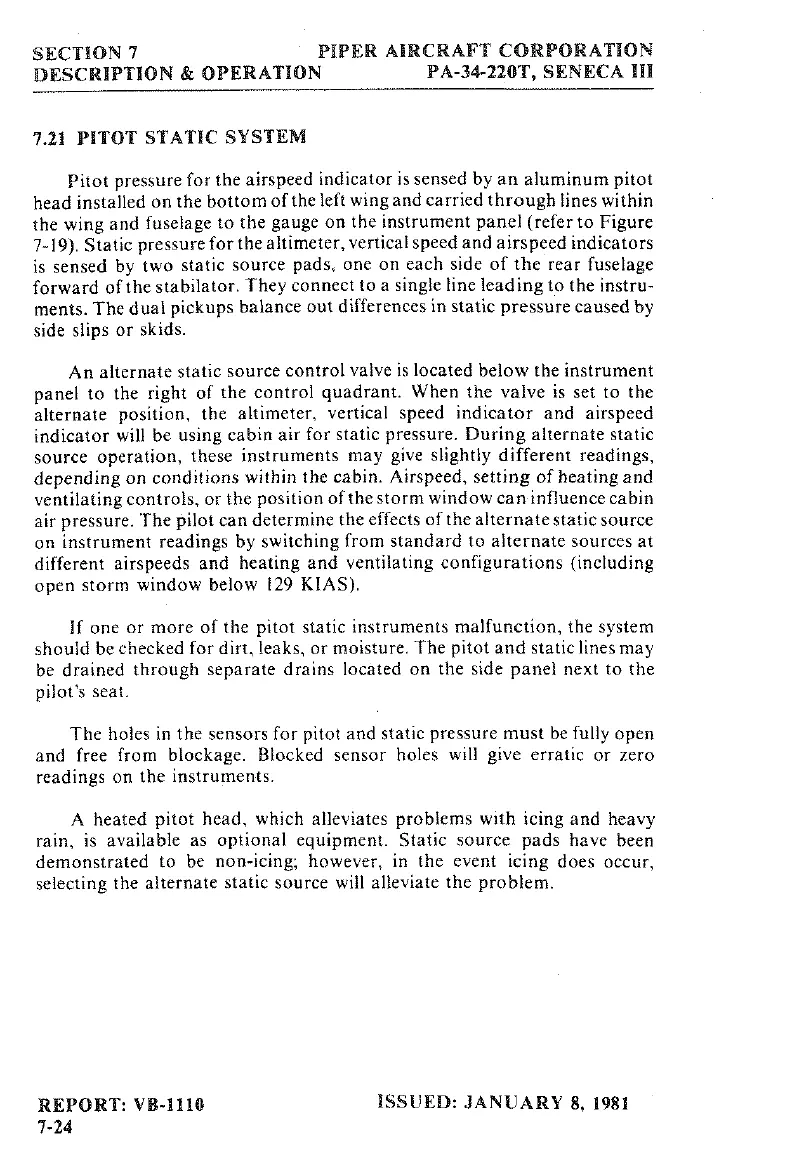
7.21
PITOT
STATIC
SYSTEM
Pitot
pressure
for
the
airspeed
indicator
is
sensed
by
an
aluminum pitot
head
installed
on
the
bottom
of
the
left
wing and
carried
through lines
within
the
wing
and
fuselage
to
the
gauge
on
the instrument panel
(refer
to
Figure
7-19).
Static
pressure
for the
altimeter,
vertical
speed
and
airspeed
indicators
is sensed by
two
static
source
pads,
one
on
each
side
of the
rear
fuselage
forward
of
the
stabilator.
They
connect to
a
single
line leading
to
the
instru-
ments.
The
dual
pickups
balance
out
differences in
static
pressure
caused
by
side
slips
or
skids.
An
alternate
static
source
control valve
is
located below
the
instrument
panel
to
the
right
of
the
control
quadrant. When
the valve
is
set
to
the
alternate
position,
the
altimeter,
vertical speed
indicator
and
airspeed
indicator
will
be
using
cabin
air for
static
pressure.
During
alternate static
source
operation, these
instruments
may
give
slightly different
readings,
depending
on
conditions
within
the
cabin.
Airspeed,
setting
of
heating
and
ventilating controls,
or
the
position
of
the
storm
window
can
influence
cabin
air
pressure.
The
pilot
can
determine the
effects of the alternate
static
source
on
instrument
readings
by
switching
from
standard
to
alternate
sources
at
different
airspeeds and
heating
and
ventilating configurations
(including
open
storm
window
below 129 KIAS).
If
one or more
of
the
pitot static
instruments
malfunction,
the
system
should
be
checked
for
dirt,
leaks,
or
moisture.
The pitot
and
static lines
may
be
drained
through
separate
drains
located
on
the side
panel
next
to
the
pilot's
seat.
The
holes
in
the
sensors
for
pitot
and
static
pressure
must
be fully
open
and
free
from blockage. Blocked
sensor
holes
will
give
erratic
or zero
readings
on
the
instruments.
A
heated
pitot
head,
which
alleviates
problems
with
icing
and
heavy
rain,
is
available
as
optional
equipment.
Static
source
pads
have
been
demonstrated
to
be
non-icing;
however, in
the
event
icing
does
occur,
selecting
the alternate
static
source
will
alleviate the
problem.
REPORT: VB-1110
ISSUED:
JANUARY
8,
1981
7-24

Table of Contents

Related product manuals