EasyManua.ls Logo

Piper SENECA III - Vsse - Intentional One Engine Inoperative Speed; Vmca Minimum Signle-Engine Control Speed

Piper SENECA III
408 pages
Print Icon
To Next Page IconTo Next Page
To Previous Page IconTo Previous Page
Loading...
SECTION
4
PIPER
AIRCRAFT
CORPORATION
NORMAL
PROCEDURES
PA-34-220T,
SENECA IH
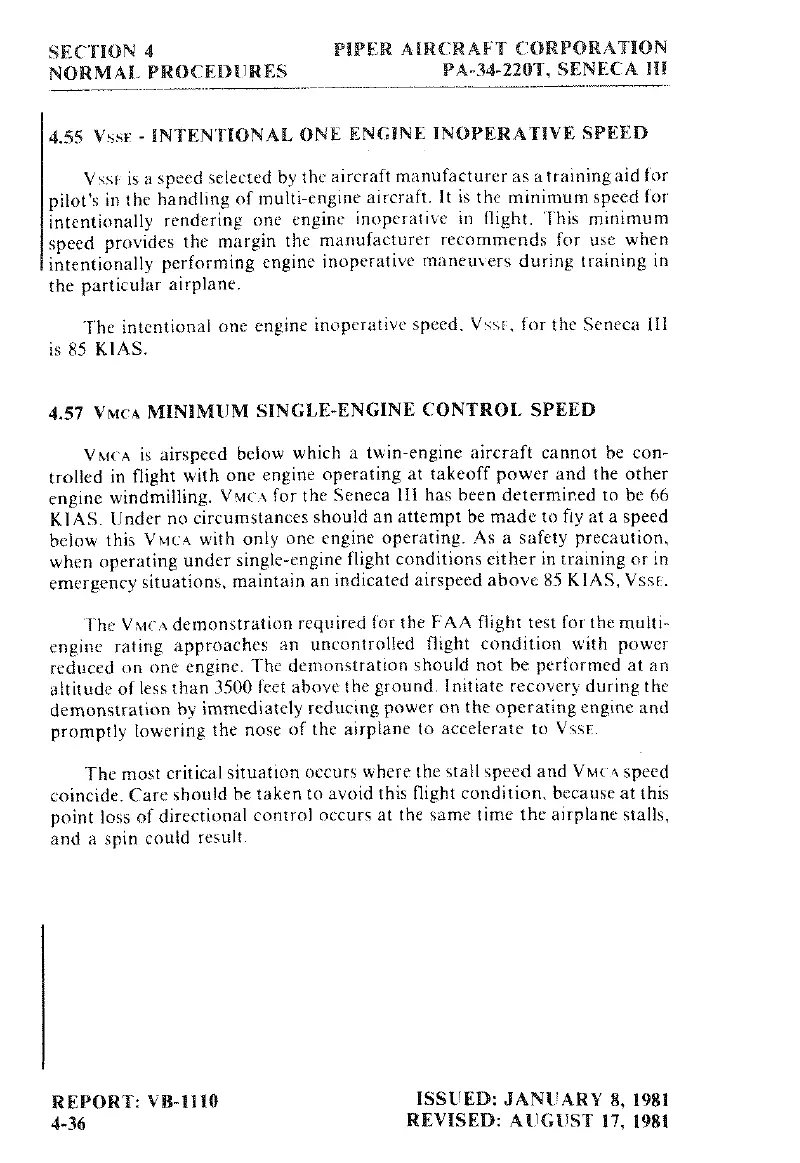
4.55
YssE
-
INTENTIONAL
ONE
ENGINE
INOPERATIVE
SPEED
VssF
is
a
speed
selected
by
the
aircraft manufacturer
as a
training
aid
for
pilot's
in
the
handling
of
multi-engine
aircraft.
It
is
the
minimum
speed
for
intentionally
rendering
one
engine
inoperative
in flight. This
minimum
speed
provides
the
margin
the
manufacturer
recornmends
for
use
when
intentionally
performing
engine
inoperative
maneuvers
during
training
in
the
particular
airplane.
The
intentional
one
engine
inoperative
speed.
Vsse,
for the
Seneca
Ill
is 85
KIAS.
4.57
VMCA
MINIMUM
SINGLE-ENGINE CONTROL SPEED
V
MCA
is
airspeed
below
which
a
twin-engine
aircraft
cannot
be
con-
trolled in
flight
with
one
engine
operating
at
takeoff
power
and the other
engine
windmilling.
V
McA
for
the Seneca Ill has been
determined
to
be 66
KIAS.
Under
no
circumstances
should
an
attempt
be
made
to
fly
at
a
speed
below
this
VMcA
with only
one
engine operating.
As
a
safety
precaution,
when
operating under
single-engine
flight
conditions
either
in
training
or
in
emergency
situations,
maintain
an
indicated airspeed
above 85 KIAS,
VssE.
The
VMcA
demonstration
required
for the
FAA
fhght
test
for
the multi-
engine
rating
approaches
an
uncontrolled flight
condition with
power
reduced
on
one
engine.
The
demonstration
should
not
be
performed
at
an
altitude
of less
than
3500 feet
above
the ground.
Initiate
recovery
during
the
demonstration by
immediately
reducing
power
on
the
operating
engine
and
promptly
lowering
the
nose
of the airplane
to
accelerate
to
VssE.
The
most
critical
situation
occurs
where
the stall
speed
and
VMCA Speed
coincide.
Care
should
be
taken
to
avoid
this
flight
condition,
because
at
this
point
loss
of
directional
control
occurs
at
the
same
time
the
airplane
stalls.
and
a
spin
could
result.
REPORT:
VB-1110
ISSUED:
JANUARY
8,
1981
4-36
REVISED:
AUGUST
17,
1981

Table of Contents

Related product manuals