EasyManua.ls Logo

Piper SENECA III - Preflight Check

Piper SENECA III
408 pages
Print Icon
To Next Page IconTo Next Page
To Previous Page IconTo Previous Page
Loading...
SECTION 4
PIPER
AIRCRAFT CORPORATION
NORMAL
PROCEDURES
PA-34-220T,
SENECA
III
4.11
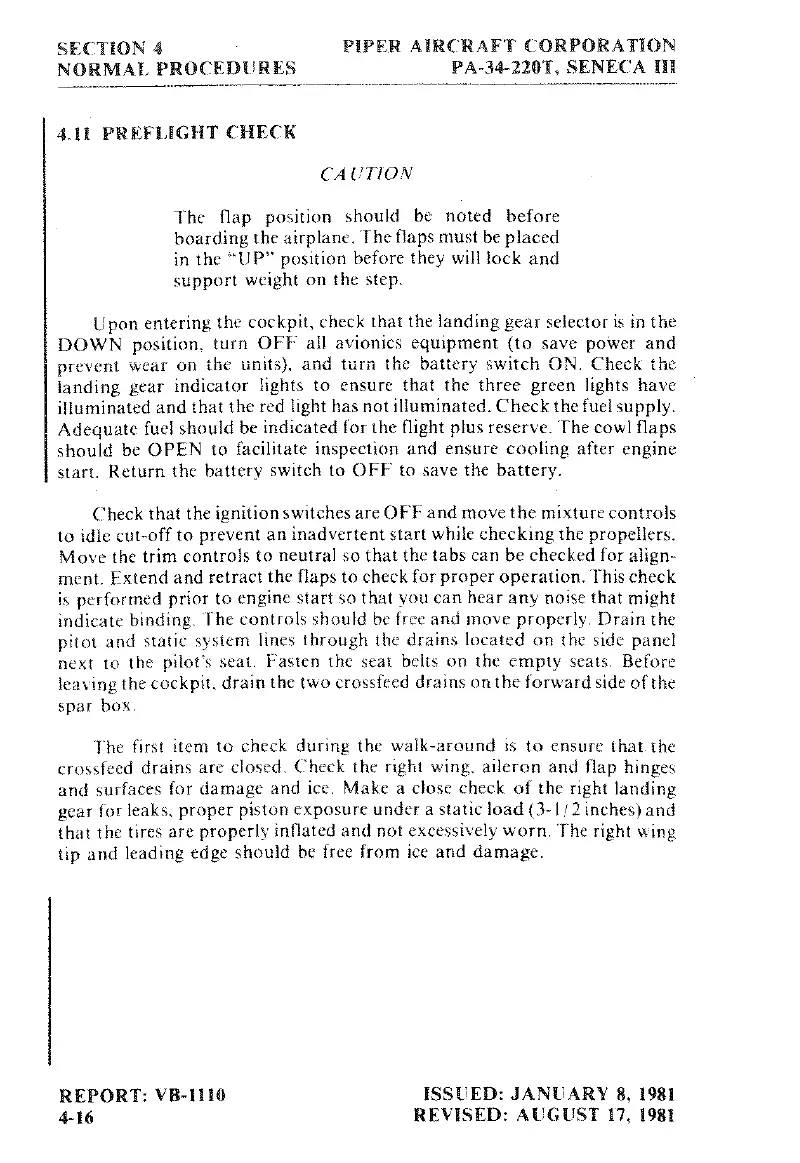
PREFLIGHT CHECK
CAUTION
The
flap
position
should
be
noted
before
boarding the
airplane.
The
flaps
must
be placed
in the
"UP"
position
before
they will
lock
and
support
weight
on
the
step.
Upon
entering
the
cockpit,
check
that
the
landing
gear
selector
is in
the
DOWN
position,
turn
OFF
all
avionics equipment
(to
save
power
and
prevent
wear
on
the
units), and
turn
the
battery
switch
ON. Check the
landing
gear
indicator
lights
to
ensure
that
the three
green
lights
have
illuminated and
that
the
red
light has
not
illuminated.
Check the
fuel
supply.
Adequate
fuel
should be
indicated
for
the
flight
plus
reserve.
The
cowl
flaps
should
be
OPEN
to
facilitate inspection
and
ensure
cooling
after
engine
start.
Return
the
battery
switch
to
OFF
to
save
the battery.
Check
that
the
ignition
switches
are
OFF
and
move
the
mixture
controls
to
idle
cut-off
to
prevent
an
inadvertent
start
while
checking the
propellers,
Move
the
trim
controls
to
neutral
so
that
the
tabs
can
be
checked
for
align-
ment,
Extend
and
retract
the
flaps
to
check
for
proper
operation.
This
check
is
performed
prior
to
engine
start
so
that
you
can
hear
any
noise
that
might
indicate
binding.
The
controls should
be
free
and
move
properly.
Drain
the
pitot
and
static
system
lines through
the
drains located
on
the
side
panel
next
to
the
pilot's
seat.
Fasten
the
seat
helts
on
the
empty seats.
Before
leaving the
cockpit,
drain
the
two
crossfeed
drains
on
the
forward
side of
the
spar
box.
The
first item
to
check
during the
walk-around
is
to
ensure
that the
crossfeed
drains
are
closed.
Check
the
right wing,
aileron
and
flap
hinges
and
surfaces
for damage
and
ice. Make
a
close check of the
right
landing
gear
for
leaks,
proper
piston
exposure
under
a
static
load
(3-1/2
inches)
and
that
the
tires
are
properly
inflated
and
not
excessively
worn.
The
right
wing
tip
and
leading
edge
should
be
free
from ice
and
damage.
REPORT:
VB-lll0
ISSUED: JANUARY
8, 1981
4-16
REVISED: AUGUST
17,
1981

Table of Contents

Related product manuals