EasyManua.ls Logo

Piper SENECA III - Page 95

Piper SENECA III
408 pages
Print Icon
To Next Page IconTo Next Page
To Previous Page IconTo Previous Page
Loading...
PIPER
AIRCRAFT
CORPORATION SECTION
4
PA-34-220f, SENECA
III NORMAL
PROCEDURES
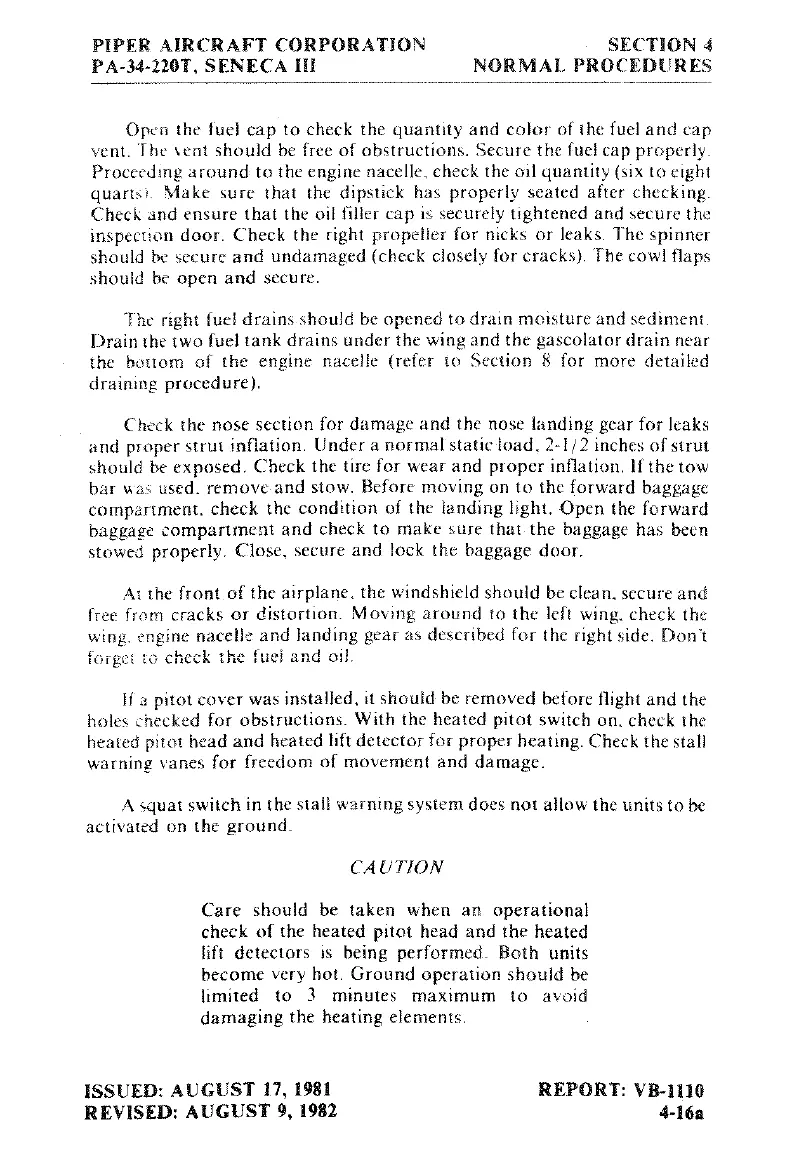
Open
the
fuel
cap
to
check the
quantity
and
color
of
the
fuel
and
cap
vent.
The
tent
should
be
free
of
obstructions.
Secure
the
fuel
cap
properly.
Proceeding
around
to
the
engine nacelle, check the oil
quantity
(six
to
eight
quartsi..
Make
sure
that the
dipstick has properly
seated
after
checking.
Check
and
ensure
that
the
oil
filler
cap
is
securely
tightened
and
secure
the
inspecdon
door.
Check the
right
propeller
for
nicks
or
leaks. The
spinner
should be
secure
and
undamaged
(check
closely
for cracks). The
cowl
flaps
should
be
open
and
secure.
The
right
fuel
drains
should
be
opened
to
drain
moisture and sediment.
Drain
the
two
fuel
tank
drains
under
the
wing
and
the
gascolator drain
near
the bottom
of
the
engine
nacelle
(refer
to
Section 8
for
more
detailed
draining
procedure).
Check
the
nose
section
for
damage
and
the
nose
landing
gear
for
leaks
and
proper
strut
inflation. Under
a
normal
static
load,
2-1/2 inches
of
strut
should
be
exposed.
Check
the
tire
for
wear
and
proper
inflation. If
the
tow
bar
was
used.
remove-and
stow.
Before
moving
on
to
the
forward
baggage
compartment.
check
the
condition of
the
landing
light.
Open
the
forward
baggage
compartment
and
check
to
make
sure
that
the
baggage
has been
stowed
properly.
Close.
secure
and
lock the baggage
door.
At
the
front
of the
airplane.
the
windshield
should be
clean,
secure
and
free from
cracks
or
distortion. Moving
around
to
the
left
wing,
check
the
wing. engine
nacelle
and
landing
gear
as
described for
the
right
side.
Don't
forget
to
check the
fuel
and
oit
if
a
pitot
cover
was
installed,
it
should
be
removed
before
flight
and
the
holes
checked
for
obstructions.
With
the
heated pitot switch
on,
check the
heated
pitot
head
and
heated lift
detector
for
proper
heating.
Check
the
stall
warning
vanes
for freedom
of
movement
and damage.
A
squat
switch
in
the stall warning
system
does
not
allow
the
units
to
be
activated
on
the
ground.
CAU77ON
Care
should
be taken
when
an
operational
check
of the
heated pitot
head
and the
heated
lift
detectors
is being performed. Both
units
become
very
hot. Ground operation
should be
limited
to
3 minutes
maximum
to
avoid
damaging
the
heating
elements.
ISSUED:
AUGUST 17,
1981
REPORT:
VB-1110
REVISED:
AUGUST 9.
1982
4-16a

Table of Contents

Related product manuals