EasyManua.ls Logo

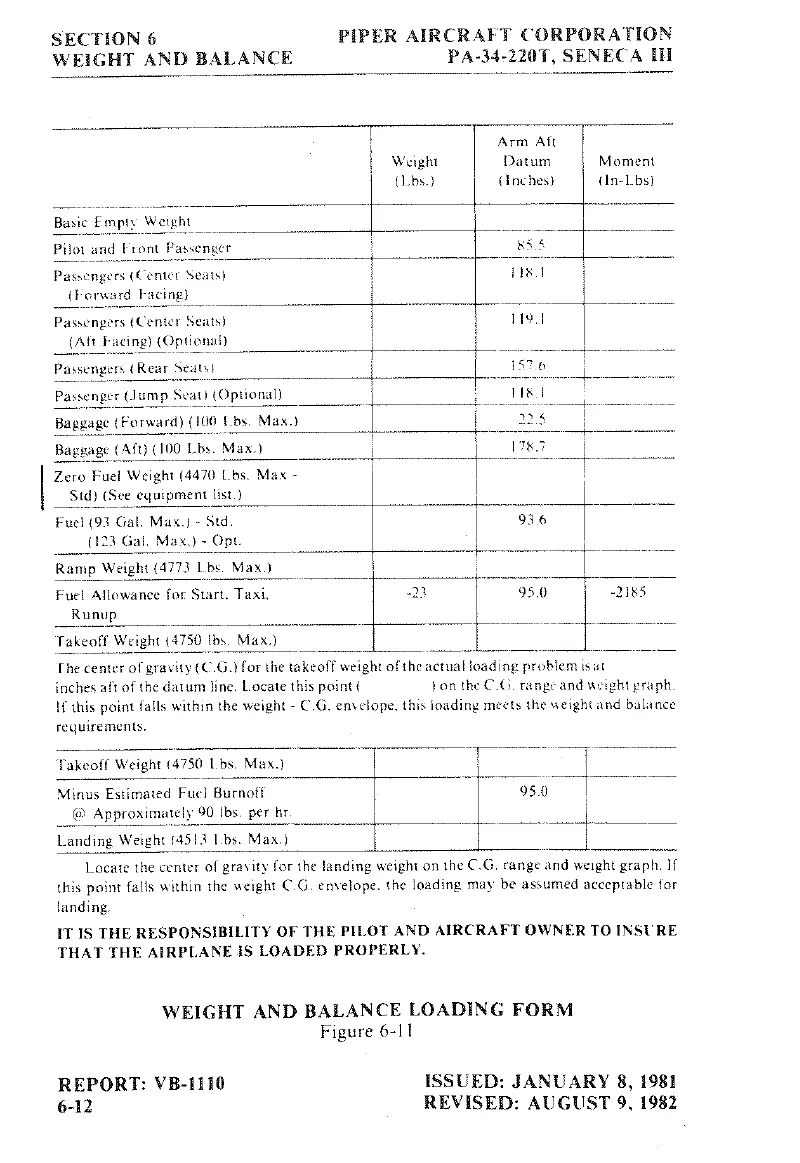
Piper SENECA III - Weight and Balance Loading Form

Piper SENECA III
408 pages
Print Icon
To Next Page IconTo Next Page
To Previous Page IconTo Previous Page
Loading...
SECTION
6
PIPER
AIRCRAFT
CORPORATION
WEIGHT
AND
BALANCE
PA-34-220T,
SENECA
IH
Arm
Aft
Weight
Datum Moment
Lbs.)
Inches) In-Lbs)
Basic Empt
Weight
Pilot
and
Eront
Passenger
85 5
(Forward
Eacing)
Passengers
(Center
Seats)
I
119 I
(Aft
Facing)
(Optional)
Passengers
(Rear
Seats:
I
15
Passenger
(Jump
Seat) (Optional)
i
is
i
Baggage
{Forward)
(100
Lbs.
Max
22 5
Baggage
iAft)
(100
Lbs
Max.)
178.7
Zero
Fuel
Weight
(4470 Lbs.
Max
Std)
(See
equipment
list.)
Fuel (93
Gal.
Max.)
-
Std.
93
6
(123
Gal,
Max.)
-
Opt.
Ramp
Weight
(4773
Lbs. Max.)
Fuel Allowance
for
Start.
Taxi.
-23
950
-2185
Runup
Takeoff
Weight
(4750
lbs.
Max.)
The
center
of
gravity(C.G.)
for
the
takeoff
weight
ofthe
actual
load[ng proMem
is
at
inches
aft
of the datum
line. Locate
this
point
( )
on
the
CG
range
and
weight
graph
\f
this
point falls
within the weight
-
C.G.
enselope.
this loading
meets
the
weight and
bahnce
requirements
Takeoff
Weight
(4750
1 bs. Max.)
Minus Estimated
Fuel
Burnoff
95
0
@
Approximately
90 lbs.
per
hr
Landing
Weight
(4513
l.bs.
Max.)
Locate the
center
of
gravity
for
the
landing
weight
on
the
C G.
range
and weight graph. If
this
point
fans
within the
weight
C.G.
envelope.
the
loading
may
be
assumed
acceptable for
landing.
IT IS THE
RESPONSIBILITY
OF THE
PILOT AND
AIRCRAFT OWNER
TO INSURE
THAT
THE
AIRPLANE IS
LOAD£D
PROPERLY.
WEIGHT
AND
BALANCE LOADlNG
FORM
Figure
6-11
REPORT: VB-1110
ISSUED:
JANUARY 8, 1981
6-12
REVISED:
AUGUST
9,
1982

Table of Contents

Related product manuals