EasyManua.ls Logo

Piper SENECA III - Page 113

Piper SENECA III
408 pages
Print Icon
To Next Page IconTo Next Page
To Previous Page IconTo Previous Page
Loading...
PIPER
AIRCRAFT
CORPORATION
SECTION
4
PA-34-220T,
SENECA
Ill
NORMAL
PROCEDURES
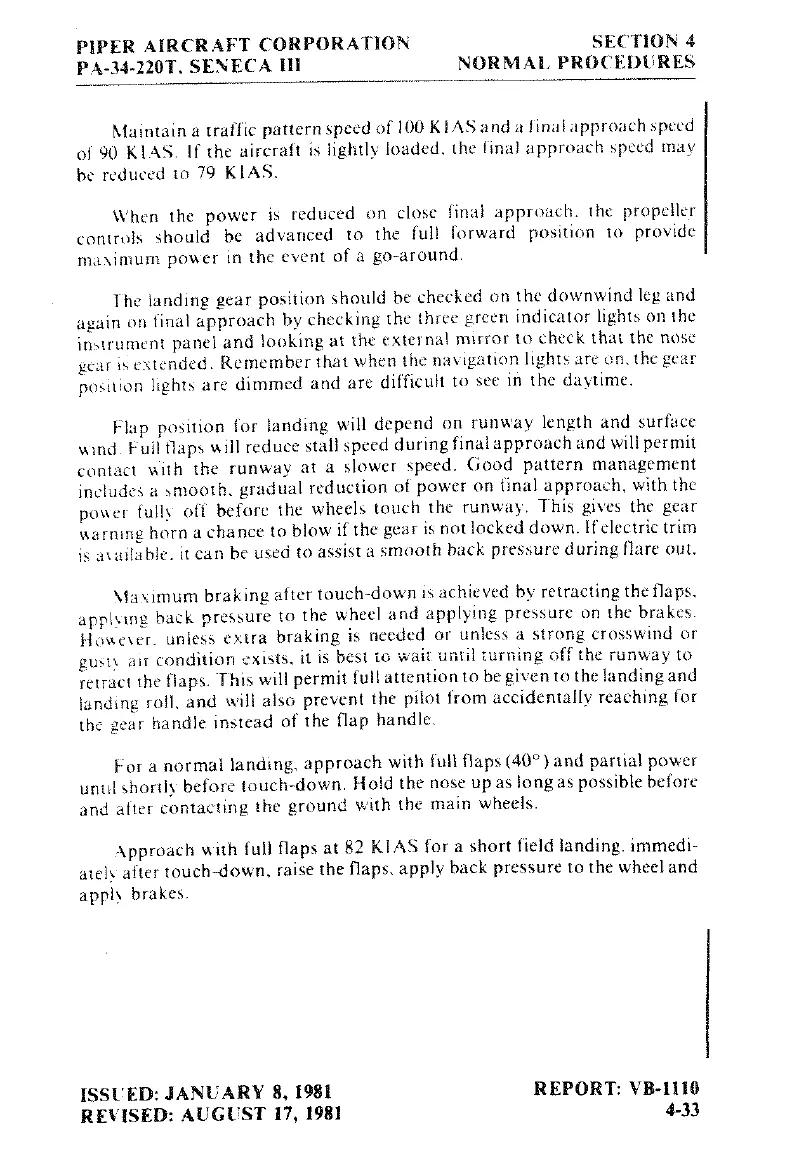
Maintain
a
traffic
pattern
speed
of
100
KIAS and
a
final
approach
speed
of 90
KlAS.
If
the
aircraft
is lightly
loaded, the
final
approach
speed
may
be
reduced
to
79
KlAS.
When
the
power
is
reduced
on
close
final
approach, the
propeller
controls
should
be
advanced
to
the
full
forward
position
to
provide
maNimum
power
in
the
event
of
a
go-around.
The
landing
gear
position
should
be
checked
on
the
downwind
leg
and
again
on
íinal
approach
by
checking the three
green
indicator
lights
on
the
instrumem
panel
and
looking
at
the
external
mirror
to
check
that the
nose
geas
is
extended.
Remember
that
when
the
navigation
lights
are
on,
the
gear
position
lights
are
dimmed
and
are
difficult
to
see
in
the
daytime.
Flap
position
for
landing
will
depend
on
runway
length
and
surface
«md
Full
flaps
will
reduce
stall
speed
during
final
approach and will
permít
contact
with
the
runway
at
a
slower
speed.
Good
pattern
management
includes
a
smooth.
gradual
reduction
of
power
on
final
approach,
with the
power
fully
off
before
the
wheels
touch
the
runway.
This
gives
the
gear
warnmg
horn
a
chance
to
blow
if
the
gear
is
not
locked
down. If
electric
trim
is
aiailable,
it
can
be
used
to
assist
a
smooth
back
pressure
during
flare
out.
N1aximum
braking
after
touch-down
is
achieved
by
retracting
the
flaps.
app\yog
back
pressure
to
the
wheel
and
applying
pressure
on
the
brakes.
However.
unless
extra
braking
is
needed
or
unless
a
strong
crosswind
or
guse
air
condition
exists,
it
is
best
to
wait until turning
off
the
runway
to
retract
the
flaps
This
will
permit
full
attention
to
begiven
to
the
landing
and
landing
rolL
and
will also
prevent
the
pilot
from
accidentally
reaching
for
the
gear
handle
instead
of the
flap
handle.
For
a
normal
landing,
approach with
full
flaps
(40°)
and
partial
power
unal
shortly
before
touch-down.
Hold
the
nose
up
as
long
as
possible
before
and
after
contacting
the
ground
with
the
main wheels.
Approach
with
full flaps
at
82
KIAS for
a
short
field
landing.
immedi-
ately
after
touch4own,
raise
the
flaps,
apply
back
pressure
to
the
wheel
and
appl\
brakes.
ISSUED:
JANUARY
8,
1981
REPORT:
VB-ll10
REVISED:
AUGUST
17,
1981
4-33

Table of Contents

Related product manuals