EasyManua.ls Logo

Piper SENECA III - Page 124

Piper SENECA III
408 pages
Print Icon
To Next Page IconTo Next Page
To Previous Page IconTo Previous Page
Loading...
SECTION 5
PIPER
AIRCRAFT
CORPORATION
PERFORMANCE
PA-34-220T,
SENECA
III
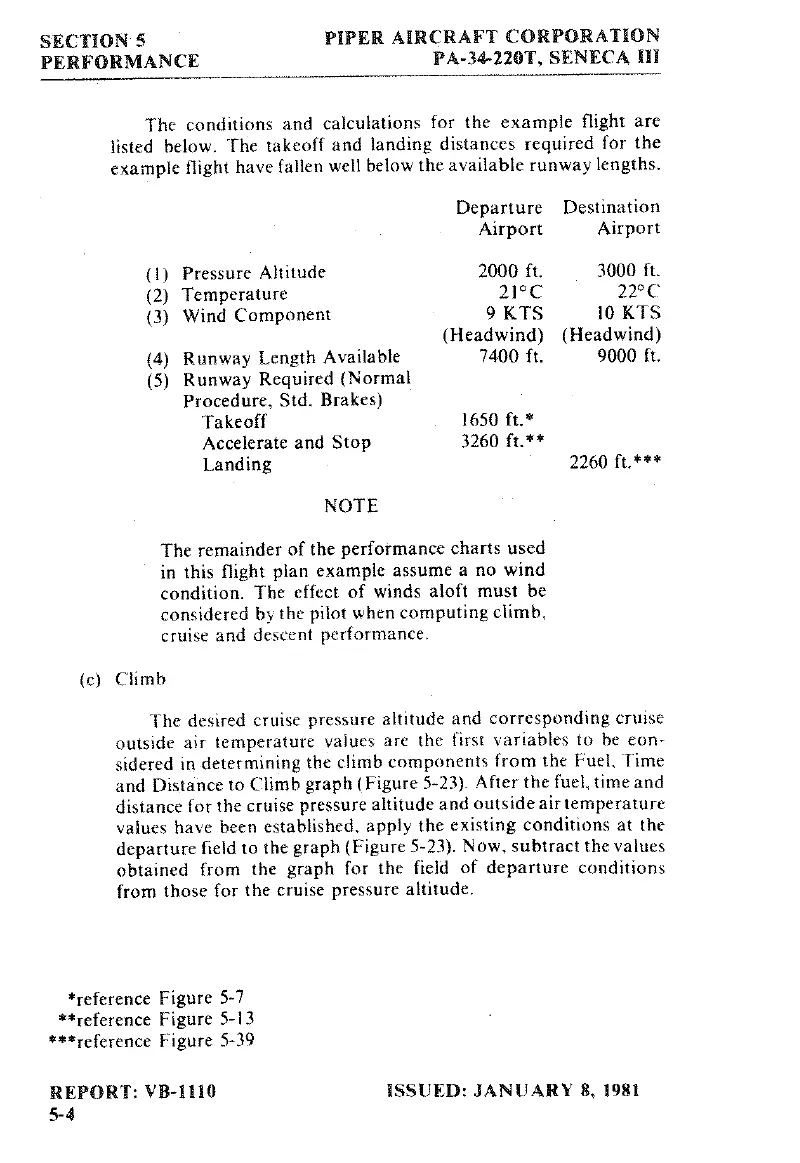
The
conditions and
calculations
for the
example
flight
are
listed below,
The
takeoff and
landing
distances
required
for the
example
flight
have
fallen
well
below the
available
runway
lengths.
Departure
Destination
Airport
Airport
(1)
Pressure
Altitude
2000 ft.
3000 ft.
(2)
Temperature
21°C 22°C
(3)
Wind
Component
9
KTS 10 KTS
(Headwind)
(Headwind)
(4)
Runway
Length
Available 7400
ft. 9000
ft.
(5)
Runway
Required
(Normal
Procedure,
Std. Brakes)
Takeoff
1650
ft.*
Accelerate
and
Stop
3260
ft.**
Landing
2260
ft.***
NOTE
The
remainder
of
the
performance
charts used
in
this
flight plan
example
assume a no
wind
condition. The
effect
of
winds
aloft
must
be
considered
by
the
pilot
when
computing
climb.
cruise
and descent
performance.
(c)
Climb
The
desired
cruise
pressure
altitude and
corresponding cruise
outside
air
temperature
values
are
the
first
variables
to
be
eon-
sidered
in
determining
the
climb
components
from
the
Fuel, Time
and
Distance
to
Climb
graph
(Figure 5-23).
After
the
fuel,
time
and
distance
for
the
cruise
pressure
altitude
and outside
air
temperature
values
have
been
established,
apply the
existing
conditions
at
the
departure
field
to
the
graph
(Figure 5-23). Now,
subtract
the
values
obtained
from the
graph
for
the
field
of
departure
conditions
from
those
for the
cruise
pressure
altitude.
*reference
Figure 5-7
**reference
Figure
5-13
***reference
Figure
5-39
REPORT:
VB-1110
ISSUED: JANUARY 8, 1981
5-4

Table of Contents

Related product manuals