EasyManua.ls Logo

Piper SENECA III - Page 197

Piper SENECA III
408 pages
Print Icon
To Next Page IconTo Next Page
To Previous Page IconTo Previous Page
Loading...
PIPER
AIRCRAFT
CORPORATION
SECTION 7
PA-34-220T;
SENECA
Ill
DESCRIPTION
& OPERATION
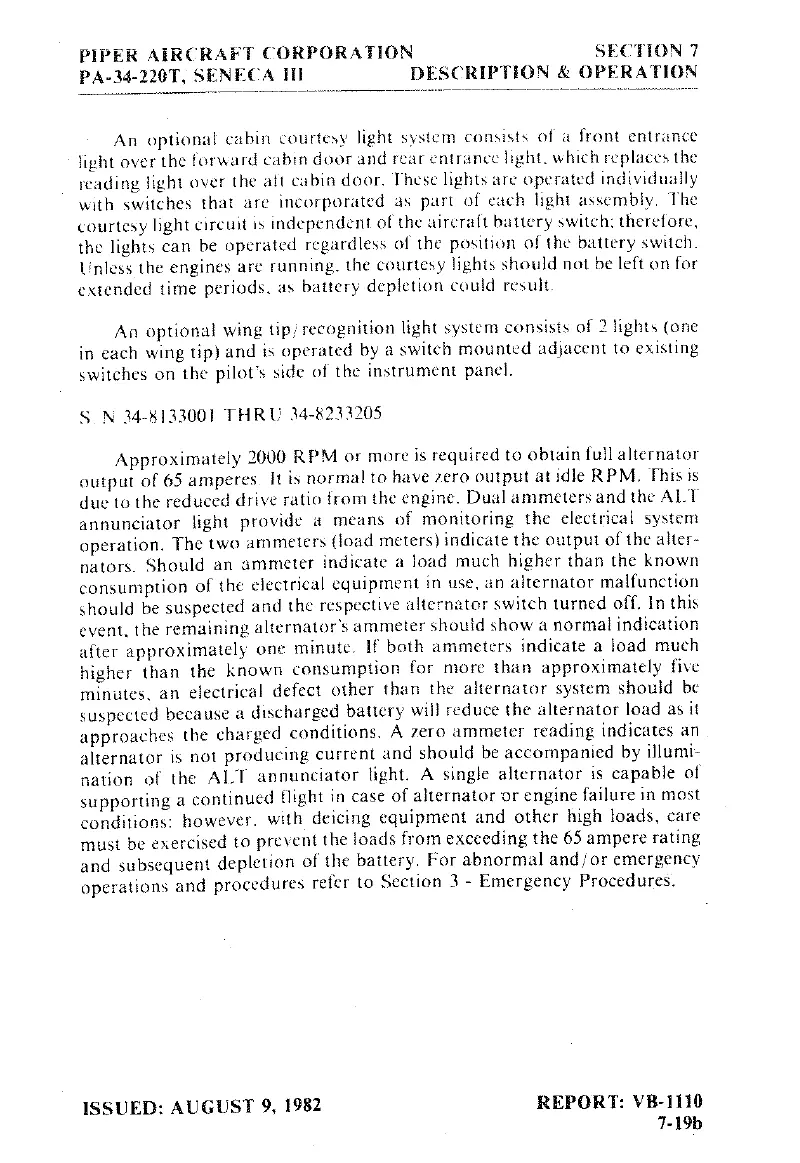
An
optional
cabin
courtesy
light
system
consists of
a
front
entrance
fieht
over
the
forward
cabin
door
and
rear
erarance
bght.
which replaces the
reading
light
over
the
aft
cabin
door. These
lights
are
operated
individually
with
switches
that
are
incorporated
as
part
of each
light
assembly. The
courtesy
light
circuit
is independent
of
the
aircraft
battery
switch:
therefore,
the
lights
can
be
operated regardless
of
the
position
of
the
battery
switch.
Unless
the
engines
are
running, the
courtesy
lights should
not
be
left
on
for
extended
time
periods.
as
battery
depletion
could
result.
An
optional wing
tip
recognition light
system
consists
of
2
lights
(one
in
each
wing
tip) and
is
operated
by
a
switch
mounted
adiacent
to
existing
switches
on
the
pilot's
side
of
the
instrument
panel.
SN
34-8133001
THRU
34-8233205
Approximately
2000
RPM
or
more
is
required
to
obtain
full
alternator
output
of 65
amperes.
It
is
normal
to
have
zero
output
at
idle
RPM.
This is
due
to
the
reduced
drive
ratio
from
the
engine.
Dual
ammetersand the
Al
T
annunciator
light
provide
a
means
of
monitoring
the
electrical
system
operation.
The
two
ammeters
(load meters)
indicate
the
output
of
the
alter-
nators.
Should
an
ammeter
indicate
a
load
much
higher
than
the
known
consumption
of
the
electrical
equipment
in
use,
an
alternator
malfunction
should be
suspected
and
the
respective alternator
switch turned
off,
In
this
event,
the
remaining
alternator
s
ammeter
should show
a
normal
indication
after
approximately
one
minute.
If
both
ammeters
indicate
a
load
much
higher than
the
known
consumption
for
more
than
approximately
five
minutes,
an
electrical
defect
other
than
the
alternator
system
should be
suspected
because
a
discharged
battery
will
reduce
the
alternator
load
as
it
approaches
the
charged
conditions.
A
zero
ammeter
reading
indicates
an
alternator
is
not
producing
current
and should
be accompanied by
illumi-
nation
of
the
ALT
annunciator
light.
A
single alternator
is
capable
of
supporting
a
continued
flight in
case
of alternator
or
engine
failure
in
most
conditions:
however.
with
deicing
equipment and other
high
loads,
care
must
be
exercised
to
prevent
the
loads from
exceeding
the
65
ampere
rating
and
subsequent
depletion
of
the
battery.
For
abnormal
and
or
emergency
operations
and
procedures
refer
to
Section 3
-
Emergency
Procedures.
ISSUED:
AUGUST
9,
1982
REPORT:
VB-llle
7-19b

Table of Contents

Related product manuals