EasyManua.ls Logo

Piper SENECA III - Page 283

Piper SENECA III
408 pages
Print Icon
To Next Page IconTo Next Page
To Previous Page IconTo Previous Page
Loading...
PIPER
AIRCRAFT
CORPORATION
SECTION
9
PA-34-220T,
SENECA
III
SUPPLEMENT 5
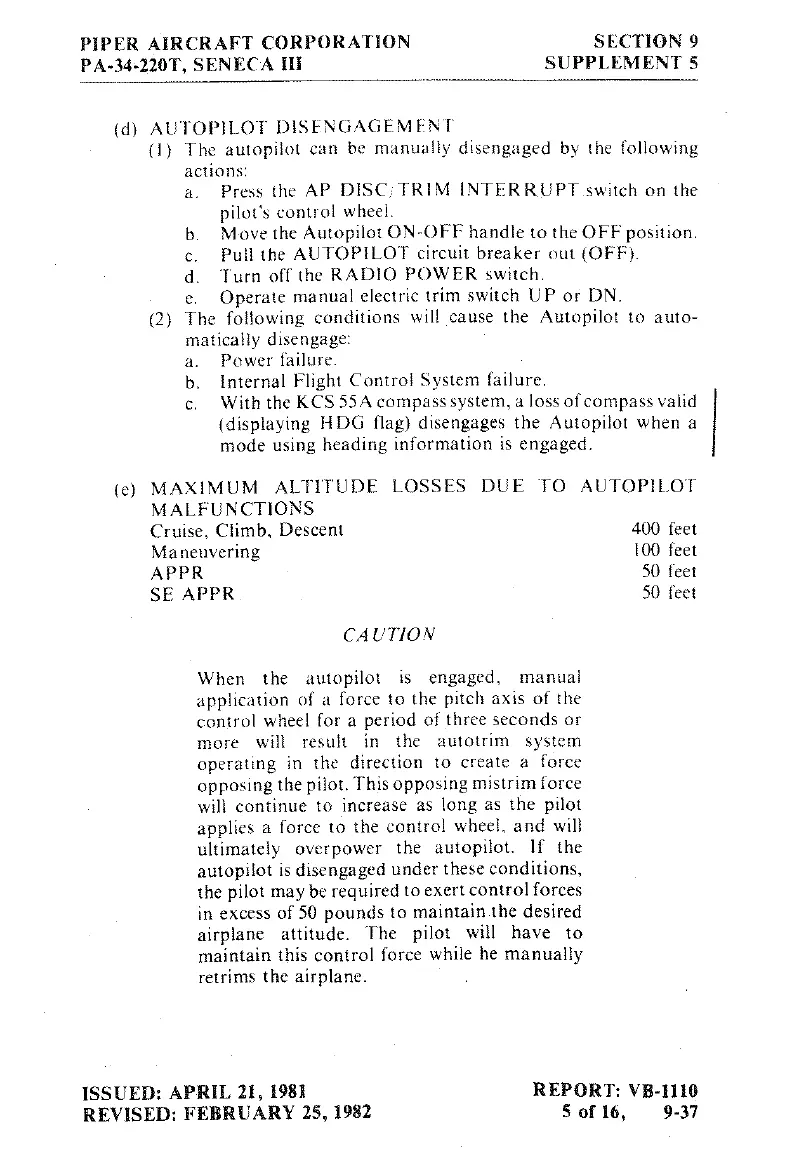
(d)
AUTOPlLOT
DISENGAGEMENT
(1)
The
autopilot
can
be
manually
disengaged
by
the
following
actions:
a.
Press
the
AP DlSC
TRlM
INTERR.UPT
switch
on
the
pilot's
control
wheel.
b. Move
the
Autopilot
ON-OFF
handle
to
the
OFF position.
c.
Pull
the
AUTOPILOT
circuit
breaker
out
(OFF).
d.
Turn
ofT
the
RADIO
POWER
switch.
e.
Operate
manual
electric trim
switch
UP
or
DN.
(2)
The
following
conditions
will
cause
the Autopilot
to
auto-
matically
disengage:
a.
Power
failure.
b.
Internal
Flight
Control System
failure,
c.
With the
KCS 55A
compass
system,
a
lossof
compass
valid
(displaying
HDO flag)
disengages
the
Autopilot
when
a
mode
using
heading
information is
engaged.
(e)
MAX1MUM
ALTITUDE
LOSSES DUE TO AUTOPlLOT
MALFUNCTIONS
Cruise,
Climb,
Descent
400 feet
Maneuvering
100
feet
APPR
50 feet
SE
APPR
50 feet
CAUTION
When
the
autopilot
is
engaged, manual
application
of
a
force
to
the
pitch
axis of
the
control
wheel
for
a
period
of
three
seconds
or
more
will
result
in
the autotrim
system
operating
in
the
direction
to
create
a
force
opposing
the
pilot, This
opposing
mistrim
force
will
continue
to
increase
as
long
as
the
pilot
applies
a
force
to
the
control wheet and
will
ultimately
overpower
the
autopilot. If
the
autopilot
is disengaged
under
these
conditions,
the
pilot
may
be
required
to exert
control forces
in
excess
of
50 pounds
to
maintain
the
desired
airplane
attitude.
The
pilot
will
have
to
maintain
this
control
force
while
he
manually
retrims
the
airplane.
ISSUED:
APRIL 21,
1981
REPORT:
VB-Il10
REVISED:
FEBRUARY
25,
1982
5
of 16,
9-37

Table of Contents

Related product manuals