EasyManua.ls Logo

Piper SENECA III - Page 300

Piper SENECA III
408 pages
Print Icon
To Next Page IconTo Next Page
To Previous Page IconTo Previous Page
Loading...
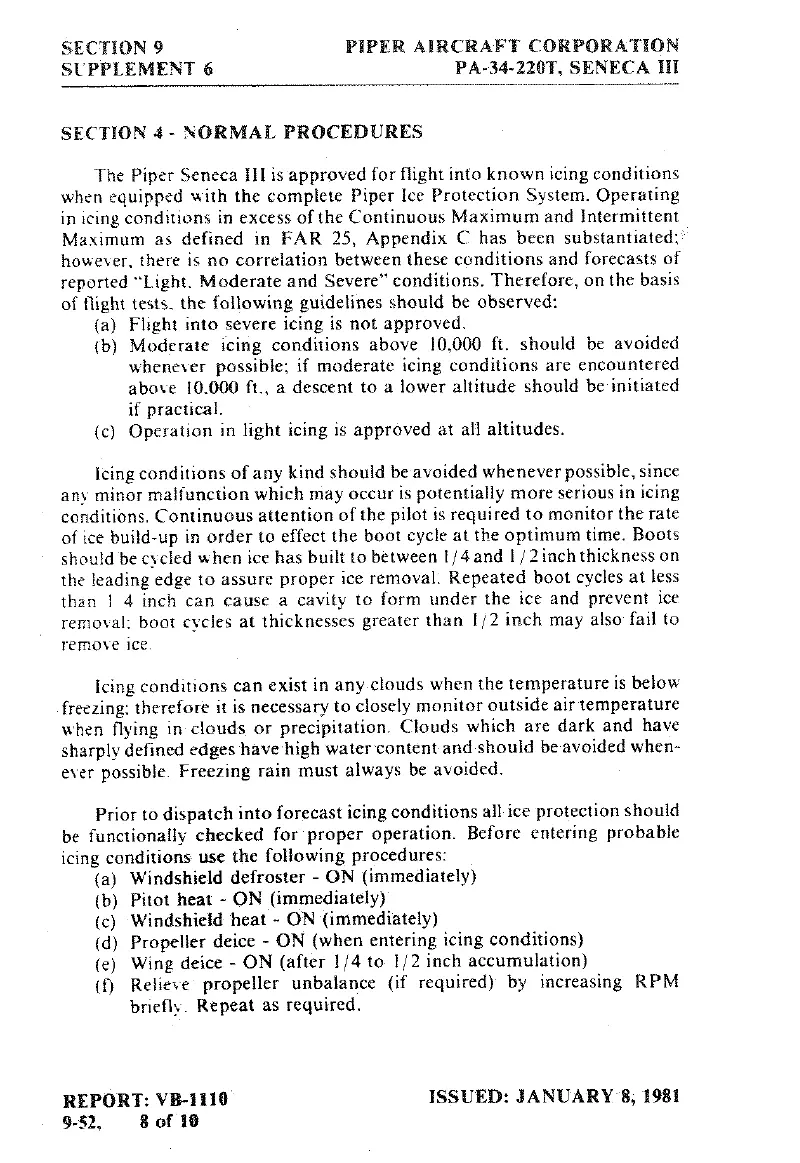
SECTION 9
PIPER
AIRCRAFT
CORPORATION
SUPPLEMENT
6
PA-34-220T,
SENECA
III
SECTION 4
-
NORMAL
PROCEDURES
The
Piper
Seneca Ill
is
approved
for
flight
into known
icing
conditions
when
equipped
with
the
complete
Piper
Ice
Protection
System.
Operating
in icing
conditions
in
excess
of
the
Continuous Maximum and
Intermittent
Maximum
as
defined in FAR 25,
Appendix C has been
substantiated;
however,
there
is
no
correlation
between these
conditions
and
forecasts
of
reported
"Light.
Moderate
and
Severe"
conditions.
Therefore,
on
the
basis
of
flight
tests,
the
following
guidelines
should
be
observed:
(a)
Flight into
severe
icing
is
not
approved.
(b) Moderate
icing
conditions above
10,000
ft.
should
be
avoided
whenever
possible; if
moderate
icing conditions
are
encountered
above
10.000
ft,
a
descent
to
a
lower
altitude
should
be
initiated
if
practical.
(c)
Operation
in light
icing is approved
at
all
altitudes.
Icing
conditions
of
any
kind should be
avoided whenever
possible,
since
any
minor
malfunction
which
may occur
is
potentially
more
serious
in icing
conditions.
Continuous
attention
of
the
pilot is
required
to
monitor
the
rate
of
ice build-up
in
order
to
effect
the
boot
cycle
at
the
optimum
time.
Boots
should be
cvcled
when
ice
has
built
to
between
I
/
4
and
1
/
2
inch
thickness
on
the
leading
edge
to
assure
proper
ice
removal.
Repeated boot
cycles
at
less
than I 4
inch
can
cause
a
cavity
to
form
under
the
ice
and
prevent
ice
removal; boot
cycles
at
thicknesses
greater
than
I
/2
inch
may
also
fail
to
remove
ice.
Icing
conditions
can
exist
in
any.clouds when
the
temperature
is below
freezing:
therefore
it
is
necessary
to
closely
monitor
outside air
temperature
when
flying
in
clouds
or
precipitation. Clouds
which
are
dark
and
have
sharply
defined
edges
have
high
water
content
and should
be
avoided
when-
ever
possible.
Freezing
rain
must
always be
avoided.
Prior
to
dispatch into
forecast
icing conditions
all-ice
protection
should
be
functionally
checked for
proper
operation.
Before
entering probable
icing
conditions
use
the
following
procedures:
(a)
Windshield
defroster
-
ON
(immediately)
(b)
Pitot
heat
-
ON
(immediately)
(c)
Windshield
heat
-
ON
(immediately)
(d)
Propeller
deice
-
ON
(when
entering
icing
conditions)
(e)
Wing
deice
-
ON
(after
1/4
to
1/2
inch
accumulation)
(f)
Relieve
propeller
unbalance
(if
required)
by
increasing
RPM
briefly.
Repeat
as
required.
REPORT:
VB-1110
ISSUED:
JANUARY
8,
1981
9-52,
8
of 10

Table of Contents

Related product manuals