EasyManua.ls Logo

Piper SENECA III - Page 361

Piper SENECA III
408 pages
Print Icon
To Next Page IconTo Next Page
To Previous Page IconTo Previous Page
Loading...
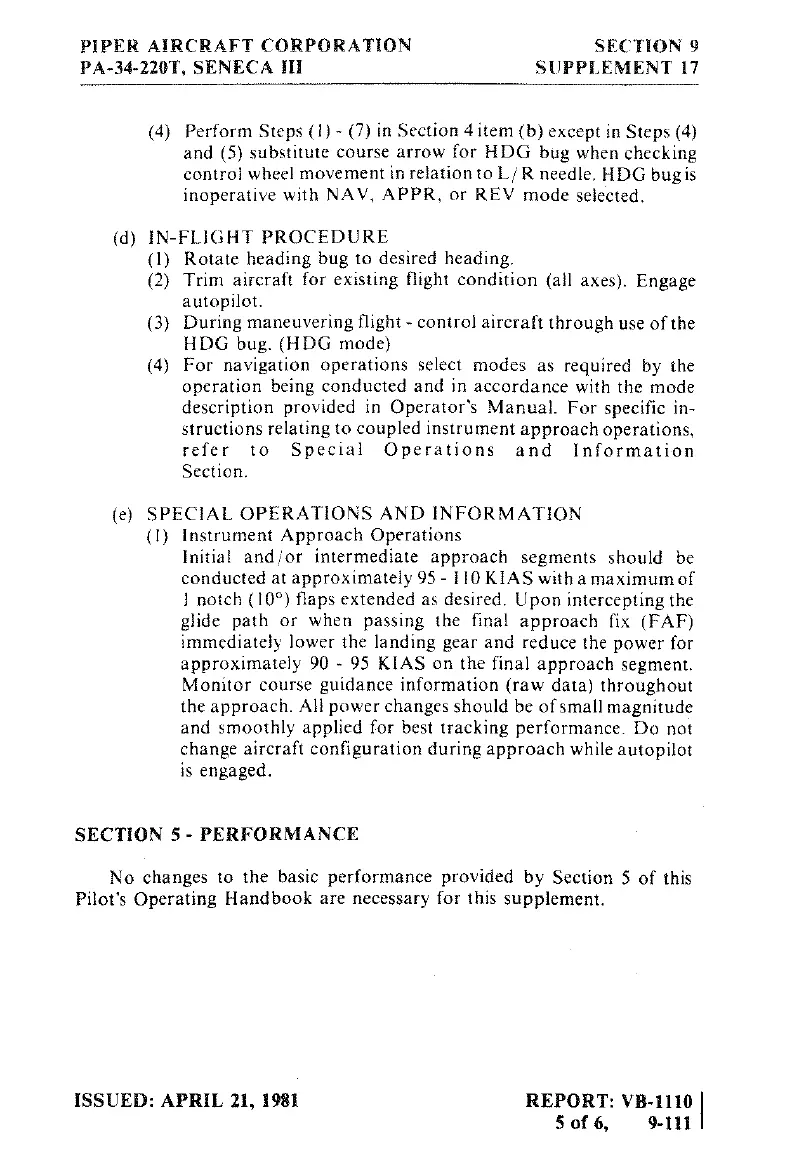
PIPER AIRCRAFT
CORPORATION
SECTION
9
PA-34-220T,
SENECA
III SUPPLEMENT
17
(4)
Perform Steps
(1)
-
(7)
in Section
4
item
(b)
except
in
Steps
(4)
and
(5)
substitute
course arrow
for
HDG
btig when
checking
control wheel
movement
in
relation
to
L/
R
needle.
HDG bug
is
inoperative
with
NAV,
APPR,
or
REV
mode
selected.
(d)
IN-FLIGHT PROCEDURE
(l)
Rotate
heading
bug
to
desired
heading.
(2)
Trim
aircraft
for
existing
flight
condition
(all
axes). Engage
autopilot.
(3)
During
maneuvering
flight
-
control
aircraft
through
use
of
the
HDG bug.
(HDG mode)
(4)
For
navigation
operations select
modes
as
required
by the
operation
being
conducted and
in
accordance
with
the
mode
description provided
in
Operator's
Manual. For
specific
in-
structions
relating
to
coupled
instrument
approach
operations,
refer
to
Special Operations
and Information
Section.
(e)
SPECIAL
OPERATIONS AND
INFORMATION
(!)
Instrument
Approach
Operations
Initial and
or
intermediate
approach
segments
should
be
conducted
at
approximately
95
-
110
KIAS
with
a
maximumof
1
notch
(IO°)
flaps
extended
as
desired.
Upon
intercepting
the
glide path
or
when
passing
the
final
approach
fix
(FAF)
immediately lower the landing
gear
and
reduce
the
power
for
approximately
90
-
95
KIAS
on
the
final
approach
segment.
Monitor
course
guidance
information
(raw
data)
throughout
the
approach.
All
power
changes
should
be
of
small
magnitude
and smoothly
applied for
best
tracking
performance.
Do
not
change
aircraft
configuration
during
approach
while
autopilot
is
engaged.
SECTION 5
-
PERFORMANCE
No
changes
to
the
basic
performance provided
by Section
5
of this
Pilot's
Operating Handbook
are
necessary
for
this
supplement.
ISSUED:
APRIL 21,
1981
REPORT:
VB-1110
|
5 of
6, 9-111
I

Table of Contents

Related product manuals