EasyManua.ls Logo

Piper SENECA III - Page 372

Piper SENECA III
408 pages
Print Icon
To Next Page IconTo Next Page
To Previous Page IconTo Previous Page
Loading...
SECTION
9
PIPER
AIRCRAFT
CORPORATION
SUPPLEMENT
18
PA-34-220T,
SENECA
TII
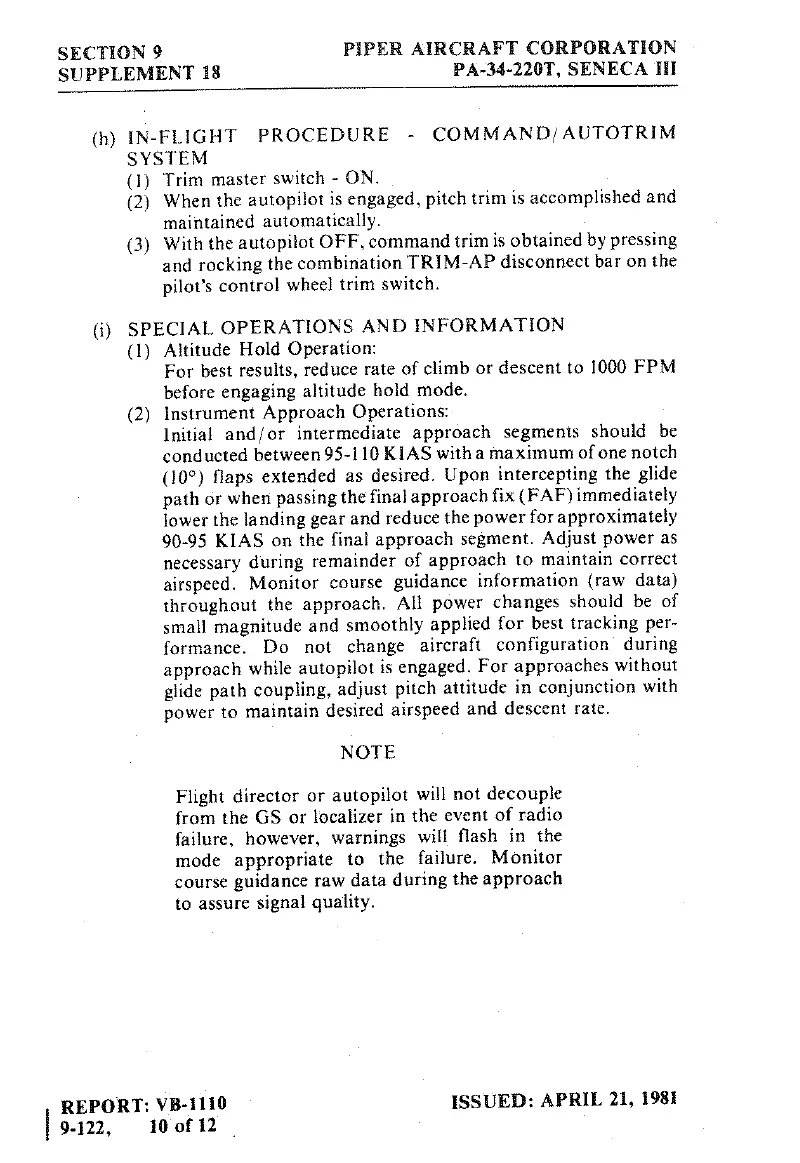
(h)
IN-FLIGHT
PROCEDURE
-
COMMAND/AUTOTRIM
SYSTEM
(1)
Trim
master
switch
-
ON.
(2)
When
the
autopilot
is engaged,
pitch
trim is
accomplished
and
maintained
automatically.
(3)
With
the
autopilot
OFF, command
trimis
obtained
by
pressing
and
rocking
the
combiriation
TR1M-AP
disconnect bar
on
the
pilot's
control
wheel
trim switch.
(i)
SPECIAL
OPERATIONS
AND
INFORMATION
(1)
Altitude
Hold
Operation:
For
best
results, reduce
rate
of
climb
or
descent
to
1000 FPM
before
engaging
altitude
hold
mode.
(2)
Instrument
Approach
Operations:
Initial
and/or
intermediate
approach
segments
should be
conducted between
95-110
KIAS witha
maximum
of
one
notch
(10°)
flaps
extended
as
desired. Upon
intercepting the
glide
path
or
when
passing the
final
approach
fix
(FAF) immediately
lower
the
landing
gear
and
reduce
the
power
for
approximately
90-95 KIAS
on
the
final
approach
segment.
Adjust
power
as
necessary
during
remainder
of
approach
to
maintain
correct
airspeed.
Monitor
course
guidance
information
(raw
data)
throughout
the
approach.
All
power
changes
should
be
of
small
magnitude
and smoothly
applied
for best
tracking
per-
formance.
Do
not
change
aircraft
configuration
during
approach
while
autopilot
is
engaged. For
approaches
without
glide
path
coupling,
adjust
pitch
attitude in
conjunction
with
power
to
maintain
desired
airspeed and descent
rate.
NOTE
Flight
director
or
autopilot
will
not
decouple
from
the
GS
or
localizer in the
event
of
radio
failure,
however,
warnings
will
flash in the
mode
appropriate
to
the
failure.
Monitor
course
guidance
raw
data
during
the
approach
to assure
signal
quality.
REPORT:
VB-1110
ISSOED:
APRIL
21,
1981
9-122,
10 of
12

Table of Contents

Related product manuals