EasyManua.ls Logo

Piper SENECA III - Page 407

Piper SENECA III
408 pages
Print Icon
To Next Page IconTo Next Page
To Previous Page IconTo Previous Page
Loading...
PIPER
AIRCRAFT
CORPORATION
SECTION 10
PA-34-220T,
SENECA III
-
SAFETY TIPS
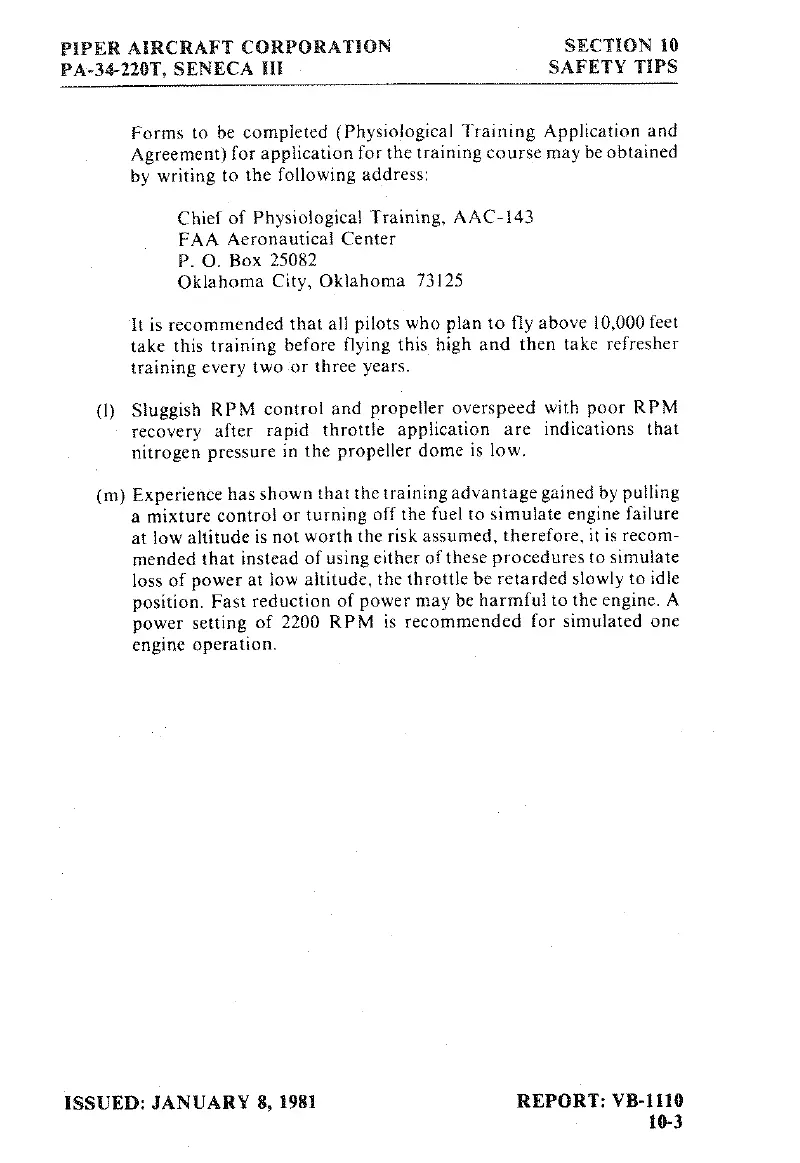
Forms
to
be
completed
(Physiological
Training
Application
and
Agreement)
for application
for
the
training
course may
be
obtained
by
writing
to
the
following
address:
Chief
of
Physiological Training, AAC-143
FAA
Aeronautical
Center
P. O. Box
25082
Oklahoma
City,
Oklahoma
73125
It
is
recommended
that
all pilots
who
plan
to
fly
above
10,000
feet
take
this
training
before flying
this high
and then
take
refresher
training
every
two
or
three
years.
(1)
Sluggish RPM
control
and
propeller
overspeed with
poor
RPM
recovery
after
rapid
throttle
application
are
indications that
nitrogen
pressure
in
the
propeller
dome
is
low.
(m)
Experience
has
shown that
the
training
advantage
gained by
pulling
a
mixture
control
or
turning off the
fuel
to
simulate engine
failure
at
low
altitude
is
not
worth
the
risk
assumed,
therefore,
it is
recom-
mended
that
instead
of using
either of
these
procedures
to
simulate
loss
of
power
at
low
altitude, the throttle
be
retarded
slowly
to
idle
position. Fast
reduction of
power
may
be
harmful
to
the engine.
A
power
setting of
2200 RPM
is
recommended
for
simulated
one
engine
operation,
ISSUED:
JANUARY 8, 1981
REPORT: VB-1110
10-3

Table of Contents

Related product manuals