MANUAL C888
C1
Rev. 304
1. General Product Information
1 Principal of Operation
2 Model Identification
2 Unpacking and Handling
2 Warranty and Spare Parts
3 General Component Information
3 Burner Component Identification
On-Off Fuel/Air Control Modes
4 Burner Component Identification
Low-High-Off or Low-High-Low
Fuel/Air Control Modes
4 Burner Component Identification
Modulating Fuel/Air Control Modes
5 Standard Burner Dimensional
Data
6 Standard Burner Ratings and
Component Data
7 Control Panel Information
2. Installation
9 Gas Supply Piping - General
9 Gas Supply Line Sizing Charts
10 Gas Train Components Supplied
for Standard UL Burner
Requirements
10 Gas Train Piping Schematics
for Standard UL Burner
Requirements
11 Oil Supply Piping - General
11 Oil Pump Suction Capacity and
Filter Selection Information
12 Oil Line Sizing Charts
12 Oil Pump Detail
13 Multiple Burner System Oil
Piping Schematic
13 Combustion Air Requirements
13 Burner Mounting - General
Principal of Operation
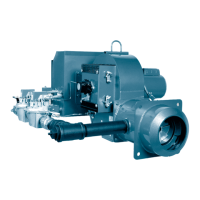
Power Flame Type C Burners incorporate the principles of
pressure atomization for oil and multiple orifice, venturi
operation for gas. The total package utilizes the forced
draft, flame retention concept. The Type C burner is listed
and labeled by Underwriters Laboratories, Inc. Capacities,
when fired at 0.2" w.c. positive combustion chamber
pressure, range from 3 to 136.4 GPH of commercial grade
#2 fuel oil and/or 98 to 19,100 CFH of natural gas. Air for
combustion is furnished by an integrally mounted combus-
tion air fan. The Power Flame packaged combustion
system can be operated under positive or negative furnace
pressures with clean, efficient combustion in a wide range
of combustion chamber conditions. (Consult page 6 for
appropriate ratings.)
The Power Flame C Burner is a totally packaged and
factory tested combustion system offering single unit
responsibility. The package incorporates accurate control
of the fuel-air ratio throughout the firing range with the
resultant controlled flame patterns and clean combustion
for maximum efficiency.
Power Flame Type C Burners are designed to produce
greater flame turbulence and reduce flame size. As a
result, they require less combustion volume for complete
combustion and can be easily fired under positive furnace
pressure. Forced draft pressurized operation requires
stacks of smaller diameter and height.
Combustion air flow is controlled by a multi-louvered
damper assembly. The combustion air is supplied by an
integral motor-driven blower, which discharges into the
burner blast tube assembly. High turbulence flow is
controlled by means of an adjustable fan diffuser system.
Various system mode operations are obtained by
applying appropriate control valves and fuel/air actuators.
Units are capable of operating in modes consistent with
specific demand requirements, from fixed or on-off through
full modulation.
The air/fuel ratio is established at the time of start-up and
proven with combustion test equipment to provide the
lowest practical oxygen with a clean flame.
13 Combustion Chamber - General
14 Combustion Chamber Data
3. Mechanical Operation of
Fuel/Air Control Modes
15 Gas - On-Off
15 Gas - Low-High-Off and Low-High-Low
16 Gas - Full Modulation
16 Oil - On-Off
17 Oil - Fixed Air Low Fire Start
18 Reduced Air Low Fire Start System
19 Oil - Low-High-Off and Low-High-
Low with Webster Oil Pump
20 Oil - Low-High-Off and Low-High-
Low with Suntec 2-Step Oil Pump
21 Oil - Full Modulation
22 Diffuser Position Adjustment for Gas,
Oil or Gas/Oil Burners
22 Gas or Gas/Oil Burner Fuel/Air
Premix Adjustment
22 Gas/Oil - Linkage Arrangement for
Full Modulation - Standard System
22 Gas/Oil - Detail and Adjustments on
Modulating Varicam
TM
Characterized
Fuel Metering System
4. Start Up, All Fuel
23 All Fuels - General Start Up Procedures
23 Information on Fuel/Air Modes of
Operation for Combination Gas/Oil
Units
24 Burner Start Up and Service Test
Equipment Required
5. Gas Start Up
25 General Gas Start Up Procedure
6. Oil Start Up
28 General Oil Start Up Procedure
7. Servicing and Component
Adjustments
31 General Information on Internal
By-pass Oil Nozzle Systems
31 Internal Bypass Nozzle Data
34 Oil Nozzle Flow Rates
34 Oil Nozzle Servicing
34 Oil Pump or Oil Flow Problems
35 Direct Spark Oil Ignition
Adjustments
35 Oil Drawer Assembly Diagrams
36 Gas/Oil Burner Firing Head
Cutaway
36 Gas and Gas/Oil Gun Assembly
Diagrams
37 Gas Burner Orifice Sizing
38 Limiting Orifice Information
39 Gas Pilot Ignition Adjustment
39 Pilot Spark Ignition Electrode
Adjustment
40 Gas Pilot Flood Test
41 Flame Safeguard Control Flame
Signal Values
41 CO
2
-O
2
Ratio Curves for Fuel
Oils and Gases
42 Trouble Shooting Suggestions
8. Maintenance
44 General
45 Periodic Check List
9. Burner Start Up Information
and Test Data
46 Combustion Analysis
47 Control Settings
51 10. Gas and Oil Burner Owner
Operating Instructions
Rev.304
CONTENTS
1. GENERAL PRODUCT INFORMATION



 To Next Page