7
Table of Contents To navigate between hyperlink topics using a keyboard, select ALT+◄ or ALT+►.
Electrical & Electrocution Alerts
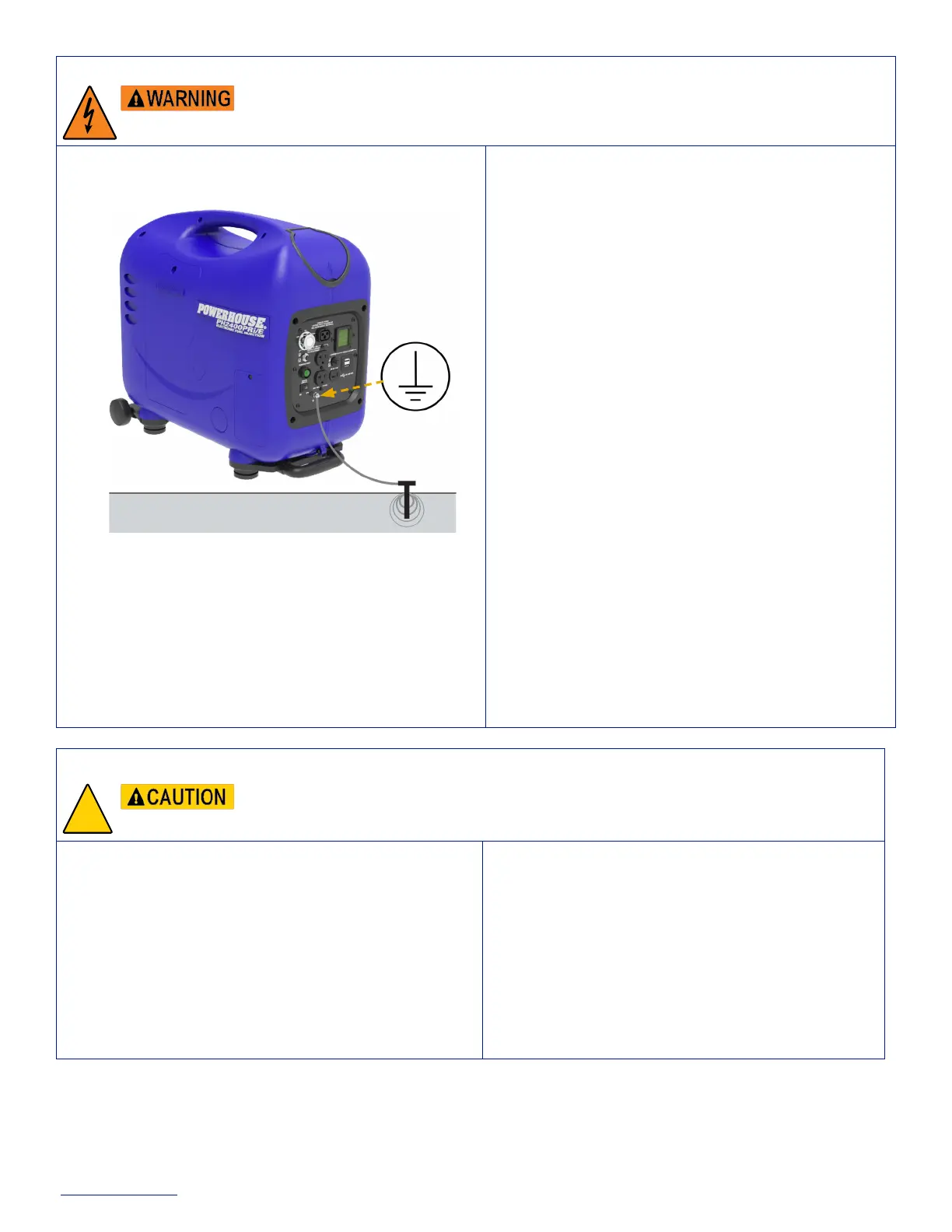
▲ To prevent electrical shock, the generator should be grounded.
Connect a length of heavy cable between the generator’s
grounding terminal and an external ground source.
▲ To avoid a potential shock, make sure that all appliances are in
good working order before connecting them to the generator.
▲ If an appliance begins to operate abnormally, becomes
sluggish, or stops suddenly, turn off the generator immediately.
Disconnect the appliance and examine it for signs of
malfunction.
▲ Do not operate with wet hands. Generators are a potential
source of electrical shock when misused.
▲ Do not operate the generator in rain or snow and do not let it
get wet.
▲ Do not exceed the current limit specified for any one
receptacle.
▲ Do not connect the generator to a household circuit.
This could cause damage to the generator or to electrical
appliances in the house.
▲ This portable generator is designed for temporary power
needs. If you need a back-up power system for your home,
install a permanent stationary generator designed for this
purpose.
▲ When an extension cord is required, be sure to use an
insulated flexible cord. Also be sure to use the proper size
and length cord.
• A 16 Gauge Cord between 0 and 100 feet long will safely
handle tool and appliance loads up to 10 amps.
• A 14 Gauge Cord between 0 and 50 feet long will safely
handle tool and appliance loads between 10 and 15 amps.
• A 12 Gauge Cord between 50 and 100 feet will safely handle
tool and appliance loads between 10 and 15 amps.
▲ Keep the generator away from other electric cables or
commercial power supply lines.
▲ Never connect this generator to a manual or automatic
transfer switch (ATS), which may result in severe damage to
the generator or personal property, and/or severe personal
injury or death. Back feed may also electrocute utility
company workers or others who contact the lines during a
power outage. When utility power is restored, the generator
may explode, burn, or cause a fire in the building’s electrical
system.
Operational Safety Alerts
▲ Never permit anyone to operate the generator without proper
instructions.
▲ Know how to stop the generator quickly and understand
operation of all controls.
▲ Always perform a pre-operation inspection before you start the
engine to avoid accidents or equipment damage.
▲ Keep away from moving parts while the generator is running.
▲ Do not operate the generator on an uneven surface, such as
sand, mud, or dense wet grass, which may restrict airflow to
the generator and its components, resulting in overheating and
potential damage.
▲ Be careful not to touch the muffler while it is hot. The
muffler becomes very hot during operation and remains
hot for several minutes after the engine is off.
▲ Let the engine cool before storing the generator indoors.
▲ Keep children and pets away from the generator when it is
in operation.
▲ Avoid repeated or prolonged skin contact with fuel or
breathing of fuel vapor.


 To Next Page