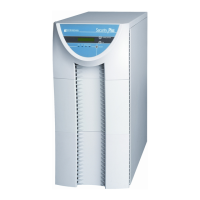
POWERVAR Security Plus UPS
56
6
6
.
.
0
0
P
P
a
a
c
c
k
k
i
i
n
n
g
g
,
,
T
T
r
r
a
a
n
n
s
s
p
p
o
o
r
r
t
t
a
a
t
t
i
i
o
o
n
n
a
a
n
n
d
d
S
S
t
t
o
o
r
r
a
a
g
g
e
e
6.1 Packing
The original shipping container for the UPS consists of a heavy duty inner cardboard carton
inside a larger plywood shipping container both of which are securely fastened to a shipping
pallet. Should you find it necessary to ship the UPS for service or installation, you should
attempt to re-use this original packaging material along with the shipping brackets that
originally accompanied the UPS. Follow these simple steps to prepare the UPS for shipment.
(Consult Fig. 3-2 on page 26 for visual guidance.)
1. Place the UPS on the shipping pallet.
2. Attach a metal shipping bracket to each side of the UPS frame at the lower edge of the UPS
near the shipping pallet. There are two bolt holes in the UPS frame on each side of the UPS
for attaching the shipping bracket.
3. Bolt the shipping brackets to the shipping pallet on each side of the UPS by passing bolts
through both holes of the shipping bracket and through the shipping pallet on both sides of
the UPS. Secure these bolts with flat washers, lock washers, and nuts.
4. Cover the UPS with the protective plastic bag.
5. Place the foam shipping inserts in appropriate places on the UPS and then slide the heavy
cardboard container over the UPS.
6. Place the plywood ramp on top of the cardboard container.
7. Place the outer plywood shipping container over the UPS and cardboard inner container, and
secure the plywood shipping container to the shipping pallet using two screws on each side
of the pallet.
6.2 Transportation
Handle the UPS with care. Avoid violent impact or dropping of the shipping carton. During
transportation, be careful to observe packing and shipping notices printed on the sides of the
shipping carton. Do not stack
6.3 Storage
The UPS should always be stored in a dry location. Do not expose it to moisture or rain. Be
careful to observe storage notices printed on the side of the shipping carton. Store it where the
ambient temperature is between 0
0
C and 55
0
C and relative humidity is between 20% and
80%. No harmful gases, corrosive chemicals, flammable or explosive materials should be kept
in the storage area with the UPS. The storage environment must be free from strong
mechanical vibration, impact, and intense magnetic fields. If not otherwise specified, the
storage period of the UPS under the required conditions of this clause is 6 months. During long-
term storage, charge the storage battery every 3 months to prevent battery damage due to self
discharge.
6.4 Fuse Replacements
The servicing of any fuses in a Security Plus UPS system should be performed by an authorized
and qualified service technician. When replacing a fuse, it is imperative that the replacement
fuse is the same type and rating. Charger PCB fuses: F1, F2: are a 250V, 5.0 amp fuse. The
control PCB fuse is a 125V, 0.25 amp fuse. In the 2kVA and 4kVA UPS systems; the Power PCB
uses a 250V, 2.0 amp fuse in F1, a 250V, 20.0 amp fuse in F2, and a 250V, 15.0 amp fuse
(Littelfuse 314 Series) in F4 and F5. In the 3kVA, 5.2kVA, and 6kVA UPS systems; the Power
PCB uses a 250V, 2.0 amp fuse in F1, a 250V, 25.0 amp fuse in F2, and a 250V, 20.0 amp fuse
(Littelfuse 314 Series) in F4 and F5.


 To Next Page