Controls and Instruments
80
TRANSMISSION RETARDER
The transmission retarder is available only with
the Allison transmission.
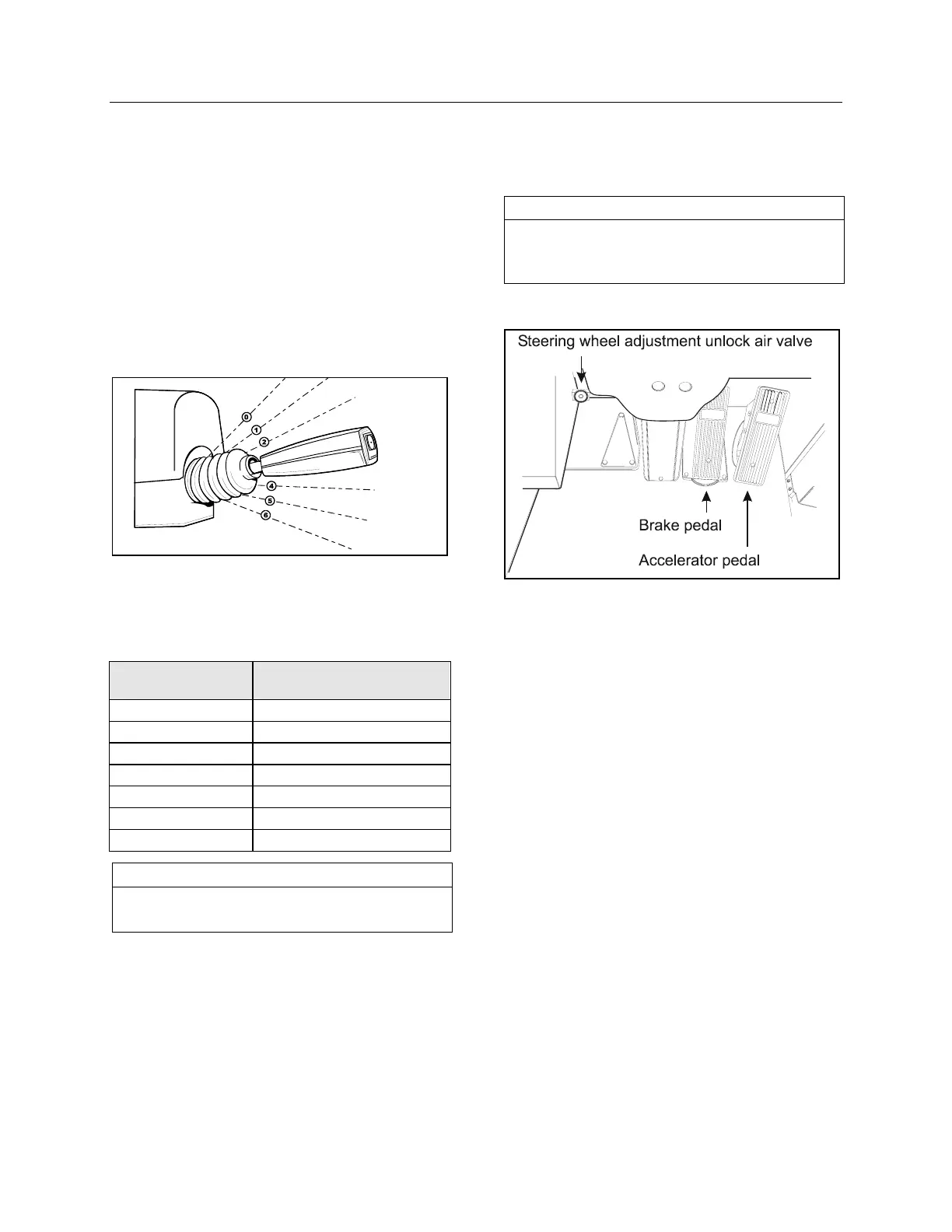
The retarder can be operated using a hand lever
mounted on the steering wheel column or using
the service brake pedal.
To use the transmission retarder, it must be
activated first by pressing one of the two
Retarder/Engine Brake buttons on the steering
wheel.
Operating the Retarder Using the Hand Lever
RETARDER HAND LEVER 07043
With the retarder enabled and the accelerator
pedal released, move the output retarder lever
clockwise from the first to the sixth position. The
braking level for each position is as follows:
Position Braking level (up to)
Initial b
Varies with brake pedal
c
16%
d
33%
e
49%
f
71%
g
89%
h
100%
NOTE
The output retarder lever is located on the
right side of the steering column.
Operating the Retarder Using the Brake
Pedal
With the retarder enabled, the accelerator pedal
released and the output retarder lever in the
initial position b, depressing the brake pedal will
engage both the service brake and the
transmission retarder. This is referred to as
retarder-brake blending. The further the pedal is
depressed, the more total braking power is
provided. Refer to “
OTHER FEATURES” chapter for
further information about the transmission
retarder.
NOTE
If the wheels start to lock up on slippery roads,
the output retarder will automatically
deactivate until the wheels start to turn.
FOOT-OPERATED CONTROLS
FOOT-OPERATED CONTROLS 00023A
BRAKE PEDAL
The coach is equipped with a dual braking
system. The front brakes operate from a
different air pressure source from the drive and
tag axle brakes. The dual braking system
becomes a modulated emergency system if a
pressure drop occurs in the primary brake
system.
Service brakes are applied by depressing the
brake pedal. Braking increases with the amount
of pressure applied to the foot pedal. Refer to
Other Features chapter under Antilock Braking
System. When the brake pedal is depressed,
the brake lights turn ON automatically.
For safe and effective braking, the air system
pressure should reach at least 95 psi (655 kPa)
in both the primary and secondary circuits. A
warning light and an audible alert will sound
when the air pressure in either the primary or
secondary circuits drops below 66 psi (455 kPa).
If this occurs, stop the coach; determine the
cause of the pressure loss before proceeding.
The brake pedal can be used in conjunction with
the transmission retarder. Refer to Transmission
Output Retarder in this chapter.



 To Next Page