1.6
Operation Manual
© 2013 Prism Media Products Ltd
Revision 1.00Prism Sound Lyra
2 Introduction to Lyra
Lyra is a USB audio interface for Windows PC and Mac. As well as analogue line inputs and outputs,
Lyra provides high-quality microphone preamplifiers and high-impedance instrument inputs, plus
stereo digital I/O and a host of advanced synchronization and monitoring facilities.
Lyra is intended to provide 'studio in a box' functionality for the digital audio workstation (DAW) user.
That's not so unusual - there are many other interfaces on the market which provide similar
functionality. However, Lyra is unique among them in providing Prism Sound's unique pedigree of
conversion, analogue, clocking and signal processing to the DAW user for the first time in a compact
form, with the plug-and-play convenience of an ordinary sound card.
Lyra is available in two versions: Lyra 2 has four analogue line outputs, and full mic/line/instrument
capability of each of its two analogue inputs, whereas Lyra 1 provides more limited functionality,
having only two analogue line outputs and only supporting one mic/line and one instrument/line input.
For a more detailed summary of the features of Lyra 1 and Lyra 2, continue to the Features section.
For directions for getting started quickly, see the Quick start guides.
For detailed hardware and software installation procedures, see the Installation procedures.
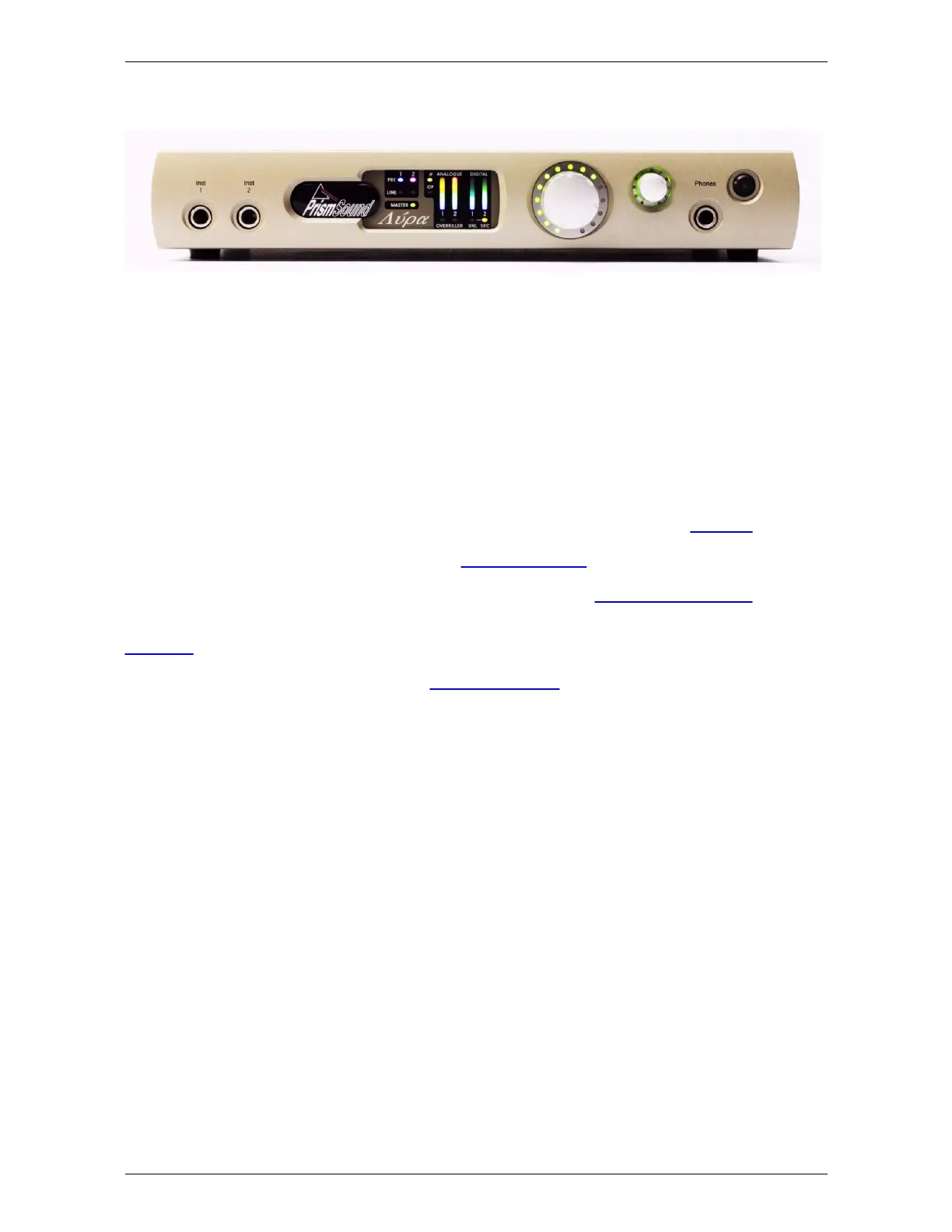
For full details of the hardware controls and connections, as well as a block diagram, look at the
Hardware section.
To learn about the control software, see the Lyra Control Panel section.
2.1 Features
Lyra 2 provides two line input channels and four line output channels, which can be operated in
balanced or unbalanced mode, and each of which can be used with professional ('+4dBu') or
consumer ('-10dBV') signal levels. The input channels have selectable microphone preamplifiers,
and selectable high-impedance, unbalanced instrument input jacks. 24-bit conversion is used
throughout.
In Lyra 2, stereo digital I/O is provided in both S/PDIF and optical (TOSLINK) formats. The S/PDIF
input can also accept professional AES3 signals, and the S/PDIF output can be switched to AES3
mode if required. A high-quality sample-rate converter (SRC) can be applied to either the stereo
digital input or output. The TOSLINK connectors can alternatively carry eight channels of ADAT I/O
at 44.1k or 48kHz sample rates, or four channels at 88.2kHz or 96kHz (SMUX mode).
Lyra's sample rate (44.1kHz, 48kHz, 88.2kHz, 96kHz, 176.4kHz or 192kHz) can be sourced from its
high-stability internal clock, or locked to the stereo digital or ADAT inputs. In Lyra 2, BNC Wordclock
I/O is also provided.
Lyra has a dedicated stereo analogue headphone output jack with its own level control.
Under Windows, Lyra can be accessed by any software applications with ASIO or WDM audio
capability. Under Apple OS X, Lyra appears as a Core Audio device.


 To Next Page