1.30
Operation Manual
© 2013 Prism Media Products Ltd
Revision 1.00Prism Sound Lyra
pink for mic or blue for instrument preamplifiers. The mic selection indicators change from pink to
red to indicate that phantom power is switched on. See Analogue inputs.
· Master indicator: this is lit when the device is set to local (internal) sample clock, and off when
locked to an external sync source; it flashes when local sync has over-ridden an invalid external
sync source selection. For more information see the Synchronization section.
· Meter input/output indicator: shows whether the bar-graph meters are assigned to the analogue
and S/PDIF inputs (IP indicator is lit), or to the analogue and S/PDIF outputs (OP indicator is lit).
This is selected in the Lyra Control Panel app. See the Metering system section for more details.
Note that in the case of Lyra 2, the analogue output meters may be selected to outputs 1/2 (OP
indicator is green) or 3/4 (OP indicator is orange).
· Overkiller indicators: indicate that the Overkiller progressive limiter is operating in that channel.
Note that the indication is dynamic, and shows when the Overkiller is actually limiting, and not
simply that it is enabled. Note that the Overkiller indicators are only active when the meters are in
input mode.
· DI unlock indicator: indicates that the S/PDIF input is unlocked, i.e. no S/PDIF carrier is
recognised. Only active when the meters are in input mode.
· SRC indicator: shows that the SRC (sample-rate converter) is configured in the S/PDIF input
(when the meters are in input mode) or is configured in the S/PDIF output (when the meters are in
output mode).
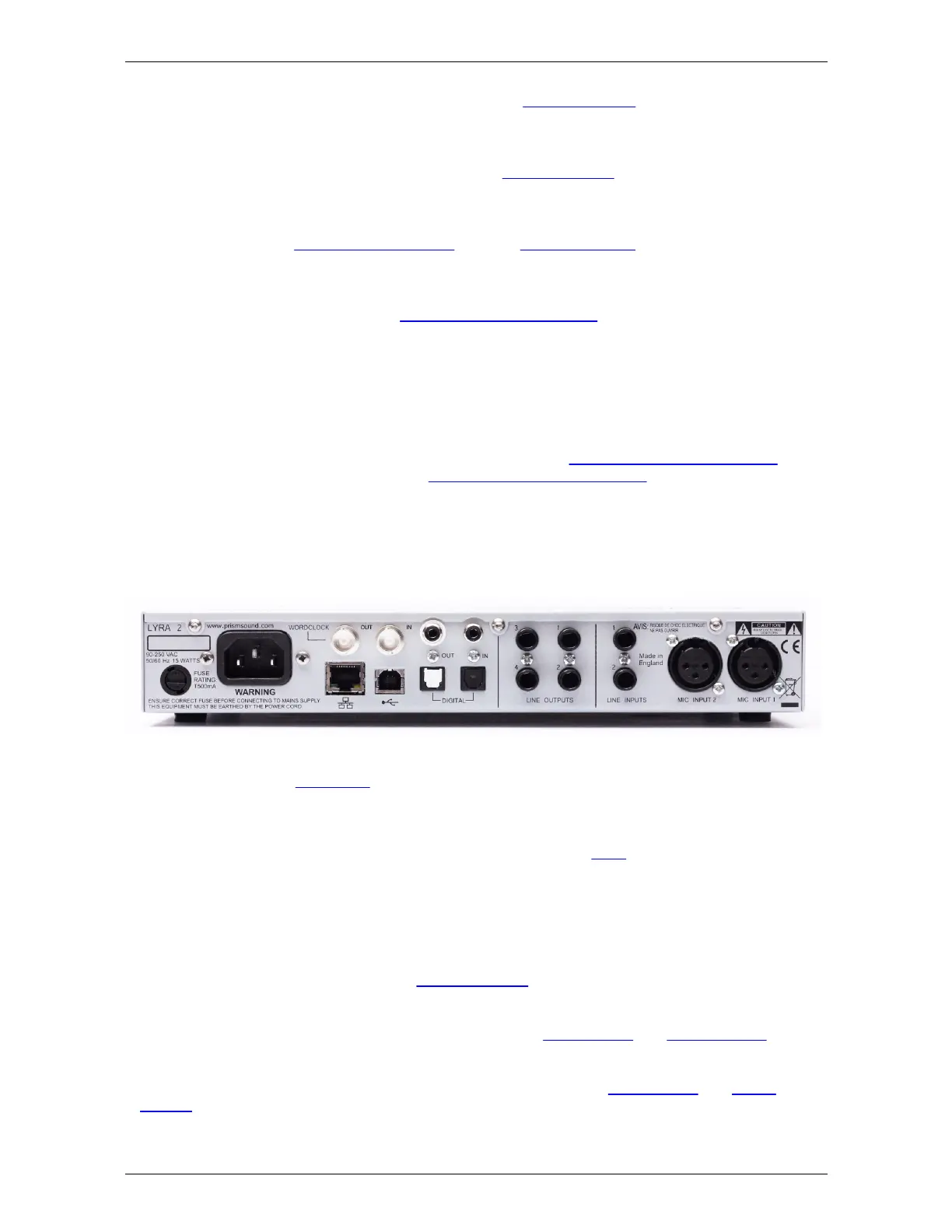
5.4 Rear panel
Lyra's rear panel contains all Lyra's connections, except for the instrument inputs and headphone
output, which are on the front panel.
From left to right (viewed from rear):
· 6A IEC inlet (regional power cord supplied): adjacent is the mains fuse holder.
· RJ45 100Mbps Ethernet port (Lyra 2 only): reserved for future use.
· USB 2.0 device port for connection to host computer (cable supplied).
· Wordclock output and input BNC sockets (Lyra 2 only): the Wordclock output can supply base-
clock or 256x clock if required. See the Synchronization section.
· TOSLINK output and input: can be used for S/PDIF (up to 192kHz sample rate) or ADAT
(44.1kHz/48kHz, or 88.2kHz/96kHz in SMUX mode). See Digital inputs and Digital outputs.
· S/PDIF output and input RCA sockets (Lyra 2 only): these can also be operated as AES3
interfaces (RCA-XLR and XLR-RCA adapter cables supplied). See Digital inputs and Digital
outputs.


 To Next Page