5 Functional description
5.1
Drive Unit
The diaphragm is driven by an electromagnet, which is controlled
by an electronic controller.
5.2 Liquid End
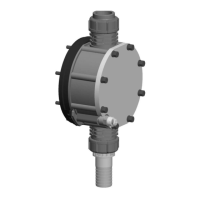
The dosing process is performed as follows: The diaphragm is
pressed into the dosing head; the pressure in the dosing head
closes the suction valve and the feed chemical flows through the
discharge valve out of the dosing head. The diaphragm is now
drawn out of the dosing head; the discharge valve closes due to
the negative pressure in the dosing head and fresh feed chemical
flows through the suction valve into the dosing head. One cycle is
completed.
5.3 Self-Bleeding
Self-bleeding liquid ends (SEK types) are capable of independent
priming when a discharge line is connected and diverting existent
air pockets via a bypass. During operation they are also capable of
conveying away gases which are produced, independently of the
operating pressure in the system. It is also possible to dose pre‐
cisely in a depressurised state due to the integral back pressure
valve.
5.4
Diaphragm rupture sensor (optional)
The diaphragm rupture warning system monitors the leak-tightness
of the metering diaphragm. The associated liquid end also has a
separating diaphragm, which prevents the feed chemical from
escaping for some time.
The diaphragm rupture warning system is equipped with an inher‐
ently safe diaphragm rupture sensor.
Functional description
15



 To Next Page